By Ifeanyi Nwabugu
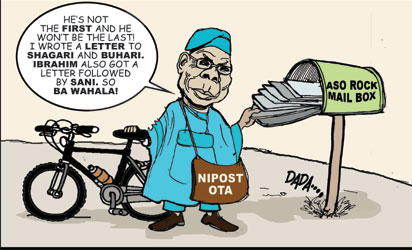
Taking a second look and very critical exposé of former President Olusegun Obasanjo letter to President Goodluck Jonathan is the covert or I may say, overt indictment of the judiciary in the ill-fated letter. This is because the said letter seems to suggest that the government under Jonathan may have unwittingly facilitated or influenced the release of some supposed criminals, apparently referring to Mustapha and co to feather its political nest especially as 2015 approaches.
Quoting him precisely, he said, “assisting criminals to evade justice cannot be part of a job of the president ” . This remark no doubt has cast aspersion on the entire justice system in the country, putting it in the dock and making it to look as grossly incompetent, corrupt and willing tool in the hands of power brokers. It also suggests that whatever judgment or judicial pronouncement from the high revered institution has either been negotiated or paid for by one of the parties or a proxy who has a shared interest. It is not only curious but very ridiculous that such statement will be coming from a former president who has a history of abuse of court judgment and human rights in Nigeria. Obasanjo vituperation ought to have been ignored but given the weighty issues he raised and his precedence as former head of state of unparalleled record of eleven years in the country, it will not be out of place to remind him of his sordid moral past, especially how he related with the judiciary during his tenure. In September 2005, an online media on September 5, 2011, quoted former Chief Justice of Nigeria, Justice Muhammad Uwais, as lamenting his harrowing experiences under Obasanjo and I would like to quote the report verbatim here: “A just released Wikileaks cable said that Nigeria’s former Chief Justice, Muhammadu Uwais, was so highly fearful of President Olusegun Obasanjo’s interference with the judiciary that, in 2005, he sought a meeting with the new American Ambassador, Mr. John Campbell, so that “someone knows what is happening here” in case something happened to him.
Uwais told Campbell that he and other Supreme Court justices were experiencing “pressure and harassment” from President Obasanjo because the Presidency was concerned that the court might not “do his bidding” beginning with complicated effort of James Ibori, the Delta State governor to run for the governorship again in 2003 against the background of his alleged conviction for stealing roofing materials years earlier.
He reportedly said the Ibori case had been followed by attempts to deposit large sums of money into his bank account in order to implicate him.
As the legal challenge against Obasanjo by the ANPP’s General Muhammadu Buhari over abuse of security forces, lapses in voting procedures and other elements in the severely flawed 2003 election drew to a close in 2005 with the Supreme Court gearing up to announce its decision, pressure on the judiciary and other participants mounted.
Uwais was quoted as telling Campbell that attempts had been made to bribe, blackmail, intimidate and threaten him. Despite that, the Chief Justice stressed he would see the process through and that he had never considered walking away from the challenge.
Uwais characterized Obasanjo as “mean, insincere and not trustworthy,” a man who would turn on anyone for petty personal reasons,” saying Obasanjo was “increasingly addicted to the office of the Presidency.” This is just one out of countless cases of threat and intimidation of the judiciary that occurred during his tenure and if this was the fear of the chief law officer of the country, what about his subordinates? I think your guess is as good as mine. One is not trying to absolve the judiciary of corruption and untoward behavior but that such sermon shouldn’t have come from someone who was neck deep and a beneficiary of what he is now raising the alarm on. One cannot forget in a hurry how Obasanjo turned down the Supreme Court judgment ordering him to release local government funds that was unlawfully withheld by the government of Obasanjo where the then Lagos State Governor Ahmed Tinubu went to court and obtained a judgment in his favour .
Suffice to say that it is also on record that Obasanjo championed the selective prosecution of political opponents. Without being modest about the Jonathan government, at least the country has not in the recent years witnessed high profile assassination just as it has not also abused court judgment unlike Obasanjo who decided which judgment to honour and which to ignore. As former Senate President Emeh Ebute rightly observed in his recent treatise of Obasanjo letter that given the destructive tendencies that characterized Obasanjo rule which period human right abuses and defiance of law, we all are at loss to unravel the import of the Obasanjo letter.
Nwabugu is a Lagos-based media consultant.
Disclaimer
Comments expressed here do not reflect the opinions of Vanguard newspapers or any employee thereof.