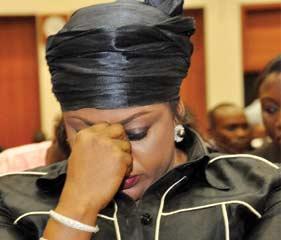
Stella Oduah
By Bisi Lawrence
The visit of a minister to a state should not ordinarily excite comment, except that in some special cases it could invite attention, especially when it involves a personality who had been making headlines of an unsavoury nature, like Princess Stella Oduah, the Minister of Aviation.
Added to that is the individual distinctiveness of her host, Governor Sule Lamino of Jigawa State, who has not been far from some steamy headlines himself lately.
He happens to be one of the two State Governors who did not totally break out of their party as the other five chose to join their lot to another party.

Aviation Minister, Ms. Stella Oduah
He ostensibly believed that that would be taking things a bit too far, though some observers would rather attribute to second thoughts arising from apprehension as to the fate of his two sons who are facing criminal charges. Lamido’s stance at the beginning of the dispute which saw him only half-way out of his party, was initially rather fierce, but has turned out not to be so firm, as they say, “at the end of the day”.
Two aspects of the visit to Dutse, the Capital of Jigawa, however, intrude themselves into one’s curiosity. The first, right or wrong, is that Governor Lamido could indeed have felt that his relationship with the party in power and in which he was a chieftain, might affect the course of justice with regard to his sons’ case.
At the hub of that power, of course, is President Goodluck Jonathan. Most of those who nurse that notion seem to share it with the view that it was a sensible move.
The evidence of executive influence in the choice of fairness was displayed unabashedly in the issue involving the recent retirement of the former Chief Judge of the Appeal Court. It might not therefore have been sensible to throw caution to the winds in preference to a great faith in the sanctity of the juridical processes which could not stand even its high custodians in good stead. .
Indeed when you come to consider it, not even during what we now sometimes whimsically refer to as the “dark days” of the military did this nation witness the naked infliction of official reprisals on her citizenry. The EFCC was recently defending itself against the indictment of being something of an “Attack dog” to the military.
The police are lampooned as “errand boys” of a political party. Several of the cases committed to court for trial reek with foul political odours, though the kennel of wrong-doing may be difficult to deny in them. In fact, the arraignment of Lamido’s sons is accounted to fall into that pattern.
On the other hand, there appear to be stark cases of malfeasance which are permitted to pass muster. One of such still staring all of us in the face is the open scandal of the super armoured-car said to have been bought as an official car for Princess Oduah as the Aviation Minister. She moves about as large as life.
There are implications of criminal manipulations in the procurement of those vehicles, now openly revealed. But investigations are still “ongoing” whilst she freely goes about her business as usual. And in the cascading succession of momentous events on the passing scene, who relly “gives a damn” about the piffling matter of a few billion—or is it million? —dollars among friends? So we can almost safely say that one, like others, has come and gone.
The governorship election in AnambraState has also come—but definitely not come , just like that. NO! It will spread its echo yet. It is the most incomplete—not inconclusive—exercise of that nature that ever happened in this nation, bar one – and that one presaged the most grievous calamity in our history.
The disenfranchisement of a section of a people leading to deep discontent may dilate into a widespread resentment of the establishment and its structures and could precipitate an eruption of prodigious proportions. BUT FAR FROM THAT IS THE NEAR-AT-HAND PATTERN OF REACTION CALLING FROM THE DOORSTEP OF THE LAW COURTS. Clearly, we are heading for a crowded path to litigation than ever before. But will that really save us?
Those who are ruled as having lost the elections saddle their objections on the old horse of rigging, and are prepared to ride for as long as it takes. Of course, those who are declared winners in such elections are seldom known to admit that they too were involved in underhand activities, although even that has happened before.
A successful candidate in an earlier edition of this same election once admitted that his party rigged to win. He also took part in the recent election but lost, and he is now among the “wailers”. But could it be that he also tried to cheat this time but was beaten by more competent contestants? If he did it before, he really could have done it again.
And he too is heading for the courts. Indeed it could all have been no more than a common sport in which every contestant took part and succeeded to the degree of his prowess, aided by the strength of his position. And that is the tragedy of our aspirations.
We dare not treat the recent AnambraState election as just any other. The improprieties and inadequacies are simply too monumental, and they emerge from so many directions. And because some of them have occurred before, we should take a holistic view of our entire electoral processes now. Not through one of those “committees” that are born with earth-shaking noise and later quietly buried in a trail of dwindling headlines, but with a purpose barbed with measures for reprisals against any involvement in such atrocities.
We have to admit that we are approaching insurmountable issues when a candidate’s name disappears from the voting list—his as well as those of the members of his family. We have to lift more than mere eyebrows when the political party which such a candidate represented joyously accepts the result of such an election.
It signifies no less than an intention that was not anchored on winning but solely to make some others lose. Nothing can be less devastating to our hopes as a nation because all are desires for a better future are tied up with our ability to choose people who share our vision and aspirations, and are able and ready to promote them for our benefit. The candidate who was openly disenfranchised would also be going to court, damn his party’s unconventional position.
And so, to the courts we go. The judiciary is the last hope of the downtrodden—if he can afford it. But it takes more than money—that is not the issue since it is evident that there is so much money flowing around. But it also takes time. Can this nation afford it?
Our courts have also been stretched almost to their limits and, with due respect, we have to admit that there are limitations to their powers set by the very laws they administer. Our only recourse is to re-discover our sense of values through a thorough examination of our desires as a nation. With the Anambra election as a possible precursor to 2015, we must admit that we are at the brink of a monumental disaster.
Time out.
Disclaimer
Comments expressed here do not reflect the opinions of Vanguard newspapers or any employee thereof.