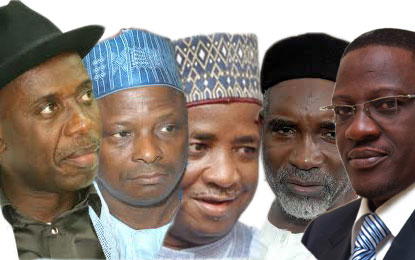
G-5 govs
When a major political event like the defection of the rebellious members of the Peoples Democratic Party, PDP, to the All Progressives Congress, APC, takes place, it is easy to get confused. When confusion sets in, you will see people who should be sober or suspicious rejoicing as though they have won a major trophy.
That is exactly what is happening to members and sympathisers of the APC. All they can see is that the governors in their party have increased from 11 to 16 with the possibility of a further rise to 18; senators swelling to 48 and members of the House of Reps ballooning to 199, more than the 147 which some media reports credited to the PDP.
Many Nigerians who have been led to believe that the PDP has been the major source of the nation’s political and economic problems, are delirious that the APC is now in a much better position to overthrow the PDP and lead Nigeria to the Promised Land where we will all live happily ever after; a happy ending to a fairy tale.
If you want to avoid getting caught up in this kind of confusion; if you want to tame your expectations to realistic levels; if you want to spare yourself the grief of disappointment or the feeling of being duped, the best thing to do is to ask yourself: what really is this political furore all about? What is the primary motivation behind the actions being taken by the major political actors?
Let us start by ruling out ideological differences. This is not a fight over ideology. It is not about G7 opposing the zoning principle of the PDP and therefore defecting to APC. We know that APC also operates zoning, which is why its presidential candidate will come from Arewa Muslim North in 2015. We don’t know where the deputy will come from as yet.
It is not about G7 believing in true federalism or devolution of powers to the second tier of government as opposed to PDP wanting to keep power concentrated in the centre. It is not about G7 joining to like-minds in the APC in protest over PDP’s “public-private partnership” model of infrastructural development, which will deny the populace access to free or subsidised services. In short, it is not a quest for better governance.
It is squarely a struggle for power. It is about the primitive concerns of the politician, who is primarily in politics to acquire power to serve his personal, religious or regional interests (where religion and region will help him achieve access to power). I do not see how APC differs from PDP in terms of respect for the rights of Nigerians.
If anything, the APC government in LagosState has demonstrated its willingness to crudely deprive fellow Nigerians of their citizenship rights due to alleged destitution and being non-indigenes. APC and PDP rig elections in their respective spheres of influence in equal measure. They commit acts of impunity within their theatres of authority just the same. They are equally prone to corruption and lack of respect for transparency and accountability.

All eyes of the major contenders are on the presidential seat in 2015. The PDP wants President Goodluck Jonathan to retain his seat after the 2015 elections. They are not willing to listen to any suggestion to the contrary, not even the so-called one term “pact” allegedly signed by the President in 2011. The G7 has been eased out of the party because it is full of people who will challenge the President for the party’s ticket; people who will employ every dirty trick to do so, including sponsorship of Islamic terrorists and regional gang-ups. The G7 also contains expiring governors who require protection from the consequences of their actions in power, which they feel, the PDP and the President may be unwilling to guarantee.
Inside the APC, it is also a game of power. Alhaji Bola Ahmed Tinubu knew he could never create a political party that would win a presidential election. He settled for a shortcut. The merger with the All Nigerian Peoples Party, ANPP and the Congress for Progressive Change, CPC, had enlarged his vineyard from six to 11 states. Now with the coming of the G7’s five governors, he has 16 in the kitty. And that is where his problems begin. Tinubu has overshot his capacity. He now has 10 states he cannot whimsically summon to Lagos as he used to do with his defunct ACN; ten states whose governors owe him no political debts; ten states, five of which are governed by hotheaded politicians with notorious track record of rebellion, indiscipline and disloyalty to their party.
That aside, Tinubu, the touted National Leader of the APC, is faced with an Arewa challenge, the magnitude of which will be apparent in no distant future. Arewa now has a commanding hold on the APC with its eight states compared to Tinubu’s six. But Arewa is not disputing the post of National Leader with Tinubu because they know the presidential slot is coming their way. That, after all, is their real objective. Arewa, through General Muhammadu Buhari, tried to use ANPP and CPC platforms to grab power back. It failed. Alhaji Atiku Abubakar tried to rally the fabled Arewa might within the PDP in 2011 but failed to clinch the party’s presidential ticket. He and other ambitious Arewa governors have tried again for 2015 only to be quietly eased out of the PDP.
As APC is a willing horse, Arewa will cooperate with Tinubu, the National Leader, until they put their hands on the grand trophy. Then, Tinubu will be retired, with or without full benefits, depending how well he takes what is coming. The same thing happened when General Olusegun Obasanjo prepared the 1976 to 1979 transition to culminate in a Northern president. It also happened when the same Obasanjo, as elected president, prepared the 2006/2007 transition to end with Umaru Yar’ Adua to emerge as president. But whether Tinubu will be able to deliver the presidency to Arewa this time around is something we watch to see.
APC will have to keep its eyes peeled because among the defectors might be a horde of PDP moles. I do not believe that PDP will lie supine and allow APC to emerge and overwhelm it just like that, without trying to riddle the upstart party with cankerworms. They have done it before. They sent Chief Etiebet and the late Augustus Aikhomu to the ANPP to destroy the party and come back to PDP during the Obasanjo years. They have the money and the willing and experienced hands to do it for them.
These worms are likely to strike when it is time to pick tickets. APC, a patchwork of political amalgams, might begin to yield at the seams. It will be PDP’s time to take back what they have just “lent” to the opposition. By then, for the APC, it might be too late.
The road to 2015 and beyond will be rougher for APC than PDP because of its volatile diversity, which is an alien experience to Tinubu as a political leader. His admirers have started calling him a “master strategist”. Orji Uzor Kalu’s admirers also called him exactly that fanciful name. In fact, Mike Awoyinfa and Dimgba Igwe wrote a biography of Kalu with that title. But where is Kalu now?
The new APC mega party is an excellent opportunity for Tinubu to prove his admirers right.
Disclaimer
Comments expressed here do not reflect the opinions of Vanguard newspapers or any employee thereof.