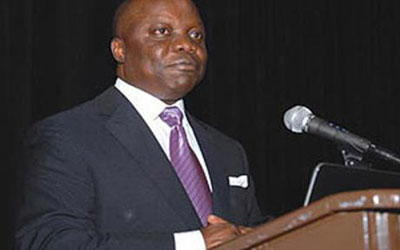
Gov Uduaghan
BY Austin Ogwuda
Asaba— DELTA State Government, yesterday, announced a budget proposal of N391.51 billion for 2014 fiscal year.
Tagged Budget of Consolidation, Sustainable Economic Growth and Development, it comprises N159.78 billion (48.8 per cent) for Recurrent Expenditure and N231.72 billion (59.1 per cent) for Capital Expenditure.
The year 2014 budget proposal shows a decrease of N80.49 billion, when compared to the year 2013 approved budget of N472.00 billion.
Presenting the budget proposal before members of the state House of Assembly, Governor Emmanuel Uduaghan said “the main focus of year 2014 budget is to sustain the drive towards Delta State beyond oil initiative.
“We have in this respect put together a budget and business plan in line with the objectives and priorities we set out in the three-point agenda.
“Emphasis in 2014 shall be on the completion of ongoing key projects given the size of carryover projects.
“This is a result-oriented strategy, wherein an allocation to budget heads are tied to performing projects and programmes that can sustain development.
“This budget contains clear proof of our sound financial management and evidence of our commitment to good governance for the benefit of Deltans of today, and in the years to come.
“Mr. Speaker, I want to use this opportunity to restate our very strong desire to finish strong.
“With 2014 being the last full year of this administration in office, Deltans are desirous that the promises and hopes we have raised should be kept. We are determined that it shall be so.
“Without the appropriate strategies, it will be unwise for us to make ambitious revenue projections. During 2014 fiscal year, our Revenue Services will increase its focus on untapped revenue potentials.
“We shall review the provisions of the Delta State Internal Revenue Consolidation Bill 2009, which may not have envisaged current realities.
“New revenue sources are being identified and their rates need to be properly captured in the revenue law.”
Disclaimer
Comments expressed here do not reflect the opinions of Vanguard newspapers or any employee thereof.