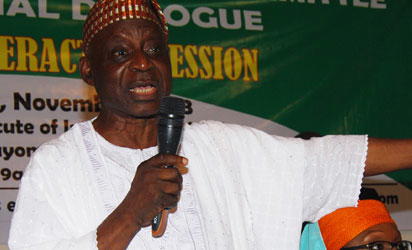
Chairman of the Presidential Advisory Committee on National Conference/Dialogue, Dr Femi Okurounmu
Memorandum to The Presidential Advisory Committee on the Proposed National Dialogue/Conference presented at a stakeholders forum in Lagos.
Preamble
It is a good thing that the President has seen it fit to set in motion the process that will lead to the holding of a national conference to give Nigerians opportunity to make their input in the making of a constitution that will govern our common life.
Except in 1949/50 when the colonial government of Nigeria sent questions to every clan council or Native Authority to seek the views of Nigerians from the grassroots up, no other constitution making effort has involved such a widespread consultation and public participation since then.
People of the age bracket (80 +) will remember the Ibadan Conference of 1950 which was the culmination of that exercise which was started in 1949 at the various local government levels; then to the provincial councils moderated by the colonial officers known as resident; then to the Regional level (in 1948/49 parlance, they were not called Regions but Groups of Provinces) where the views from below were harmonised and streamlined into a “Constitution” for each group of Provinces. And so we had a constitution for the Eastern Group of Provinces, another for the Western Group of Provinces and the third for the Northern Group of Provinces.

Chairman of the Presidential Advisory Committee on National Conference/Dialogue, Dr Femi Okurounmu
In the process, each Region built in the peculiarities of their region. For example, the West had a Council of Chiefs in addition to a House of Assembly, also the North had two chambers, but the Eastern Region had a single-chamber legislature; a House of Assembly. It was from this build-up that the London Conferences that came later hammered out what we had as 1960 Independence Constitution.
This process had three effects: 1) It created awareness that something momentous was happening and gave the various groups in the country a sense of belonging as well as satisfaction for their aspirations; 2) It helped the people to identify their credible leaders; and 3) It substantially aided the process of nation-building and the awakening of national consciousness among Nigerians.
1). Structure of the Dialogue/ Conference
It is being suggested here that the Advisory Committee should adopt a staggered multi-layered, bottom-up, and then up-down approach to this proposed Dialogue/ Conference. The bottom-up approach will primarily be in terms of raising the delegates that will ultimately represent each group or zone in the national conference as well as collate the opinions and preferences of the people from down up.
On the other hand, the up-down stage will come after the National Conference when each federating unit will begin to work out its structure and the size of its third tier (and perhaps a fourth tier if so decided at the national conference), and the constitutional arrangements from the level of the federating unit down to the third and, if need be, fourth tier.
What we stress here is that it is the people themselves that should raise the delegates and not the state or local governments, and that their choices and preferences must be aggregated and taken to the ultimate dialogue: the national conference.
Let the people decide
Thus, each town or village in the country will be given the opportunity to nominate, select or elect (whichever method a town prefers) a given number of its citizens (preferably 10 per town) to represent the town in a Local Government Area, LGA, conclave in which all the towns in the LGA shall have equal representation.
Delegates should include men and women, mostly between 30 and 50 years of age but also sizable numbers of more elderly politically conscious delegates to guide them.
Ideally at this level, education, experience and maturity matters
Each LGA Conclave across the country shall also select, nominate or elect from among its constituent membership the people that will represent the LGA in the subsequent state conclave. Of course like what obtained at the lower levels, the state conclave or conference shall have equal representation for all the constituent LGAs in a State (say, 10 per LGA).
Similarly, the state conclave shall from among its members nominate, select or elect those that will represent the respective states at zonal or regional conclaves or conferences; again with representation on equality basis from the constituent States in the zone (say, 40 per State).
The zonal or regional conference shall then from among its membership raise those that will represent the zone in the proposed National Conference in which each zone is likewise to have equal representation (say, 60 per Zone), to create a people-based constitution for the country. This will result in a National Conference of 360 delegates from the six geopolitical zones of the country.
Actually, it must be noted that the above provisions should not obviate the rights of a conclave at whatever level to draft, nominate, select or elect notable individuals or specialists in the community, from outside itself, to be part of the delegates of the LGA, State or Zone to the next level of conference.
Summary:
*We want the Conference/ Dialogue to be composed of respective territorial units of the Nigerian society; the towns, LGAs, states and zones, and to be staggered to give each level scope to seat, starting from the lowest level
*Representation to be on equality basis
*Size to be 360 delegates at the national level
2). Legal Framework for the Dialogue/ Conference
We accept the authority of the President to convene the Conference. We also urge the President to take every necessary step to put the legality and authenticity of the conference beyond doubt or question.
3). Duration of the proposed Dialogue/ Conference
We suggest one year duration for the four stages of conferences, including the referendum and the ultimate promulgation the National Constitution.
4). Issues to be tabled before the Dialogue/ Conference
Our treatment of the question of what issues are to be tabled is only indicative and not exhaustive. At town and local government levels, issues of local concerns are to be dealt with. Discussion of the relevance or otherwise of Traditional Rulers/ monarchs, etc and what role for them if adjudged relevant. Each town shall decide if it wants to retain the monarchy as a facet of grassroots administration.
This provision is especially relevant in Igboland where the monarchical institution was imposed on the people by Nigeria’s military rulers at the end of the Nigeria-Biafra war, notwithstanding the fact that the institution had become anachronistic even in those sections of the Nigerian society where the monarchical system was traditional.
After the national conference, the issue of structuring the federating units and the third tier and creating constitutions for these tiers will then be holistically addressed, with critical inputs coming from the respective towns.
Issue of what will constitute the federating unit of the country:
At the national level, appropriate issues such as what unit of government should be regarded as the “federating unit” – the state or the geopolitical zone? Where an ethnic nationality falls into two or more zones, should they be allowed to merge into one federating unit, say in a zone?
Following on this, and considering the COST OF GOVERNANCE, how many levels of government should the constitution allow – two, three or four? It might become appropriate to combine and subsume the state and local government areas systems into a provincial (or Division) system.
The Province as a unit will then be slightly larger than the present LGAs and slightly smaller than the present territorial size of existing states. It will then constitute the second tier of government under the zonal or hoped for regional governments. In this way, a zone which today is made up of five to seven states might be turned into 30-50 provinces, replacing its constituent states/LGAs.
It will be the business of the national conference to pronounce on what constitutes the federating units of the country – whether it is the zones or states – but it will then be the business of the federating to deal with the actual creation of Provinces, Divisions or whatever the second tier of government at under the federating units is called and what number of these each of them wants.
Form of government:
Do you want a presidential form of government with executive powers outside of the elected assembly (as in the 1979 Constitution) or a parliamentary system under which the executive (cabinet) is formed from elected members of the House of Assembly as in the 1960/1963 Constitutions, with the leader of the majority party becoming the Premier or Prime Minister?
Devolution of powers
What powers should be devolved to the central government (Federal Government) and what powers should be reserved to the Federating units?
Which level of government should levy and collect which kind of tax? How are the proceeds to be distributed among the various levels of government?
Here the delegates to this level will have to do a thorough study of the existing Legislative Lists in order to answer the above questions.
Judicial Powers and the Criminal Code:
Should any federating unit be allowed to adopt Sharia or Customary law? What protection should be accorded to people not covered by sharia or customary law within such states or zones? To what extent should this be allowed to operate? What happens in case of conflict with the received Common and Statute laws and the Constitution?
How many levels of Court should be established?
Armed Forces and Police Formations:
Should we have a professional Army, Air Force and Navy under the central (Federal) government with a unified command or should each zone or federating unit be allowed to maintain its own regiments? What are the implications?
Should we have a unified federal police system and/or zonal/state police formations? How should law enforcement be organised for effectiveness? What safeguards should be put in place to ensure that politicians do not misuse the law enforcement agents to intimidate ordinary citizens or non-indigenes?
Regional constitutions for local peculiarities:
This will come after the national conference, but the zones have two tasks to perform before the national conference;
1. To prepare the position of the zone for presentation at the National Conference.
2. To elect 60 delegates to represent the zone in the National Conference, a leader of the delegation, a secretary and a legal adviser.
At the National Conference, the first question to be put to the House is: “Given our common experience in the last 53 years, are we ready to stay together as one country? If yes, do we want a unitary, federal or confederal country?
Depending on the answer to these questions, then the burning issues will be tabled for discussion, negotiated and agreed to before lawyers are asked to draft the constitution, incorporating what has been agreed upon.
BURNING ISSUES
Basic principles to which all must subscribe: Sanctity of human life; and
Basic freedoms and inherent rights.
Should the country adopt one religion or should each Federating unit adopt a religion or should we leave the issue of religion to individual choices?
Elder Uma Eleazu is the Chairman of Ndi-Igbo Council for National Coordination, NCNC.
Disclaimer
Comments expressed here do not reflect the opinions of Vanguard newspapers or any employee thereof.