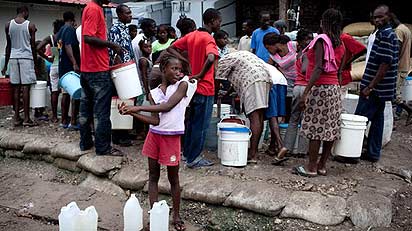
*Water, water everywhere, but……
By CHARLES KUMOLU
DO they know about the recent cholera outbreak in Lagos State? This question would easily be asked by anyone who is aware of the ignorance being displayed by Lagosians in the face of cholera outbreak in the city.
The reasons for t the poser is not far-fetched: But for some highbrow parts of the city, most places in Lagos present the picture of a city where hygienic standards are taken for granted by residents and concerned authorities.
A trip to settlements like Orile Iganmu, Ajegunle, Mushin, Ijora Badia, Agege, Agboju, Amukoko, Ikotun Egbe,Ilaje, Bariga and Ijeshatedo/Itire , among others, speaks volume about how unclean most parts of Lagos are. In these places, potable water, good healthcare facilities, roads, houses and other basic amenities are absent. Many residents eat and sleep in the midst of garbage. Majority of them are less concerned about the hazards the dirty environment poses to their health.
Findings by Vanguard Features, VF, showed that the worst hit suburbs are Apapa, Ajeromi, Lagos Island, Surulere and Oshodi-Isolo local governments.
Lagos State commissioner for Health, Dr Jide Idris, who confirmed the report noted that ‘’although many of the cases have been treated and discharged in several health facilities, three have been confirmed dead” . He confirmed that most of the suspected cases are from Ajeromi, Apapa, Lagos Island, Oshodi-Isolo and Surulere local government areas.
Confirming claims that the poor hygienic state of the metropolis is responsible for the epidemic, Idris said most of the reported cases arose from poor hygiene standards by residents.
Buttressing this allegation, he listed some of the causes to include eating contaminated foods like abacha (African salad), drinking well water and non washing of hands.
“Cholera is an acutely contagious bacterial disease characterised by a sudden onset of profuse painless watery stool, nausea and profuse vomiting,” the commissioner said. He encouraged residents of the State to report cases of deaths or symptoms to the nearest health facility or the State Ministry of Health.
“Cholera should be suspected in any person who develops diarrhea with or without vomiting, weakness, restlessness, irritability, dry mucous membrane, low blood pressure, leg cramps, excessive loss of body fluid (dehydration) or dies from frequent stooling, hence measures should be taken to reduce the risk of contracting the disease,” he said.
Washing fruits and vegetables
To reduce the risk of being infected with the disease, he urged Lagosians to wash their hands with soaps and water frequently, thoroughly boil water before drinking if the source of the water is in doubt; wash fruits and vegetables thoroughly before eating and cook food thoroughly before eating. He also counselled them to dispose wastes properly and keep water containers clean.
With this alarm, it was expected that residents would stand up against the spread of the disease, but VF discoverd that while many are not even aware of the outbreak, others displayed a nonchallant attitude towards it.
‘’Where is the cholera? Abeg that one is not my business. I am concerned about how to cater for my family with the income I generate from this business or do you want me to abandon my business? We always hear of disease outbreak in Lagos,’’Mama Igala, who makes bean cake at Abule-Ado Bus-stop in Satellite Town, told VF during an informal discussion.
When told that the spot where she sells was not clean enough, she retorted: ‘’What then do I do? I know you are saying this because of the gutter which is uncovered and not flowing and but my customers are not complaining. Do you have any issue with cholera?’’
If you find Igala’s carefree attitude shocking, Aliyu Daba’s response would leave anyone speechless.
Daba, who sells roasted chicken at Mile 2 Bus-stop at night was very unfriendly when Vanguard Features posing as a customer, engaged him in a conversation in Hausa language.
‘’Oga, this is my business and not yours. Do you want me to steal? I have been doing this business for several years, so you cannot teach me what to do, ‘’ he responded angrily when asked why he was exposing his products.
Following this display of ignorance by the duo in the face of the current epidemic, many stakeholders have questioned the role of relevant authorities in ensuring that hygienic standards are kept.
Although the state government had on few occasions, closed down some markets for flagrant abuse of the environmental sanitation laws, further checks showed that not many stakeholders believe that the government is doing enough in this regard.
A public health expert, Dr. Johnson Igomale is one of those who scored the government low on its environmental responsibilities.
He told VF that ‘’the noise about environmental cleanliness and hygienic standards is usually made any time there are environmental challenges. Why must it be so? Can’t we be proactive? Some of the common diseases which result into massive deaths in this country are preventable.’’
Igomale argued thus: ‘’Cholera will remain an environmental issue in this country as long as government has refused to play its role. A lot of things are wrong; the settlements are not planned with drainage systems, while access to potable water has been a challenge. So what do yo expect from such a society?.’’
Though, he noted that the public is also culpable, he regretted that relevant bodies are doing little or nothing to enlighten the people on the need to maintain a healthy hygienic standard.
‘’In the past, we had sanitary inspectors who ensured that the environment was properly taken care of. But like other good things that fizzled out in Nigeria, we no longer have them. I doubt if the environmental health officers still work. It is a very difficult situation but I believe the government can address the problem with all sincerity of purpose,’’ he added.
Meanwhile, the Federal Ministry of Health has confirmed that 86 deaths have been recorded from 1,623 cholera cases in six states of the federation just as all federal health facilities nationwide have been directed to provide free treatment to cholera patients.
A statement issued in Abuja by the apex health ministry, identified Zamfara State in the North-West as the most affected with 51 deaths out of 1,110 cases. It is followed by Nasarawa State with nine deaths out of 105 cases.
Giving an update on the outbreak of the disease in the country, Minister of Health, Professor Onyebuchi Chukwu who explained the current estimate of the patterns of distribution of the outbreaks across the country, noted: “These are estimates because trickles of incidents and mortalities may still be coming.
However, in Sokoto and Katsina states, the gastro-enteritis outbreaks have not been proven to be cholera. While further investigations continue, only confirmed cases are included in the current statistics. The outbreak in the states mentioned earlier has been confirmed by our laboratories to be caused by vibiro cholerae serotypes 01 and 0139,” the Minister said.
Continuing, he said the affected states are being supported to respond to the outbreak by supplying them with emergency drugs, diagnostic kits and other commodities. “The Federal Ministry of Health realises that the affected states will require further assistance and efforts are being made to upscale our technical and material assistance to those states immediately.”
The minister who has directed the Nigeria Centre for Disease Control, NCDC, to immediately co-ordinate response activities and report to him daily on both the patterns of occurrence, efforts at achieving total control of these outbreaks as well as the status of the control, assured that government will continue to enhance its surveillance, intervention measures and implement public health awareness campaigns aimed at stemming such occurrences.
Already, the Minister has directed immediate release of adequate quantities of emergency drugs (cholera kits) to all the affected states for prompt and adequate treatment of cases.
Disclaimer
Comments expressed here do not reflect the opinions of Vanguard newspapers or any employee thereof.