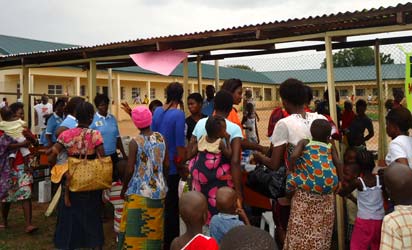
* Expectation is high among a wide section of Nigerians especially women and children that the Senate will come up with a comprehensive new National Health Bill, NHB, that would realistically address basic primary health challenges in the country.
By Ogbemi O. Omatete
IT is best to start at the beginning. I was born in October 1939 in Ugborodo, DeltaState of Nigeria, the first child of my father and only male child of my parents.
I had an older stepsister, Akpeto and two younger sisters, Olofagbo, who died in her early teen, and Mrs. Tetsoma Pinnick. I was the first grandson of my maternal grandmother, who really spoilt me.
I did not meet my paternal grand parents. Early in 1945 before I was six years old, because there was no school in Ugborodo at the time, I was sent to live with Aunt Oleghenju in Sapele, where I attended FirstBaptistSchool. This was a momentous decision in the family.
First, why did my father, an illiterate like other parents in Ugborodo then, decide to send his first and only male child into an unknown future in pursuit of education? I know none of my contemporaries who were sent away that early to school.
Second, this was an expensive proposition for a poor fisherman (crayfish) on subsistence living, because education was not free then at any level. I can only surmise that the decision was difficult for him because he did not even accompany us on the journey to Sapele.
In those days it was a tedious and sometimes dangerous journey lasting three days and two nights of intense rowing and paddling on canoes upstream from the Ugborodo estuary at the Atlantic Ocean, on the wide UgborodoRiver through Nana Creek into BeninRiver and to Sapele on the EthiopeRiver. It was left to my grandmother, my mother and my sister, Akpeto, to take me to Aunt Oleghenju in Sapele.
The family docked their canoe at the Sapele Main market waterside, where Aunt Oleghenju was a well-known broker between the crayfish and fish traders from downstream Benin and UgborodoRivers and the traders at Sapele and those from Onitsha.
In a couple of the days, my family had sold their bags of crayfish and bought wares to take back home. Although I was young, I could sense that something was going on, so I clung tightly to the three women I knew. On the departure day, I sat tight in the canoe, so it was decided that I should be let off at the downstream CMS waterside instead of at the Market waterside.
I was happy when grandma, mother and sister pushed off the canoe from Market waterside. About ten minutes latter, however, they paddled into CMS waterside where Aunt was waiting. I was told that my aunt had something special for me.
Consequently, my mother and I disembarked and wadded ashore. Aunt gave me some sweet fluffy cake, that I had never tasted, and made me sit down to eat it. Meanwhile, mother announced she was going to ease herself as I concentrated on the cake. When I turned around to look for our canoe it was pulling away.
I screamed, threw the cake into the ground and ran straight into the river. I wadded in, crying, screaming, and trying to swim towards the rapidly disappearing canoe carrying grandma, mother and sister away, the only people I knew. As I started to swallow water, adult swimmers came and pulled me out and handed me to my aunt.I am sure this was a well-planned strategy. I looked up at my aunt holding me in her hand, and looked at the people around, all were total strangers. So, I continued to cry calling out for my grandma, mother, sister and father.
But none of them showed up as Aunt Oleghenju held my hands and walked with me to her home. Besides people walking on the streets, I noticed strange objects moving on two wheels (bicycles), with people sitting on them. Even stranger were a few contraptions that looked like a houses on wheels, roaring by (lorries). This was Sapele town in 1945.
A couple of weeks later I walked from our compound across McPherson Street into FirstBaptistSchool. There was no fence then. With my new brown khaki uniform of shirt and shorts, I proudly stood in front of the Kindergarten line, as one of its smallest and youngest members.
Although attempts to bend my right arm over my head to my left ear to determine if I was old enough to be admitted were unsuccessful, I was allowed to stay. I was told my name was Oritsegbemi Fregene and should answer “present” when it was called. That was it. My foray into Western Education had begun.
Beginning as a six year old, I barely spoke accurate Itsekiri before I picked up Pidgin English on my way to becoming one of the Sapele Bomer Boys (SBB).
Continuing my education
My school fees were paid regularly, although I did not know who did. School was rather easy for me as I had affinity for numbers and Aunt was very proud of me. However, in 1948, Aunt Oleghenju was very sick and had to be taken out of Sapele. While others were contemplating sending me back to my parents in Ugborodo, my aunt would have none of that.
She wanted me to continue with my education. As a result, she convinced her uncle, Mr. Olumami Fregene, to be my guardian while she was away. So I moved down to Papa Olumami Fregene’s residence at the very end of McPherson Street, there being nothing but rubber plantation behind his property then.
I lived with Papa Olumami Fregene, a strict disciplinarian, from 1948 to 1952. As a boy being sent on errands then, I learnt a lot about the Fregene family and the Itsekiri royal family.
Aunt Oleghenju had been cured of her ailment and returned to Sapele long before 1952. However, although she was bold to ask her uncle to become my guardian, she respected him too much to ask him to allow me to return to her. So I took matters into my hands by playing truancy.
Prof. Ogbemi O. Omatete is of the Covenant University, Otta, Ogun State
Disclaimer
Comments expressed here do not reflect the opinions of Vanguard newspapers or any employee thereof.