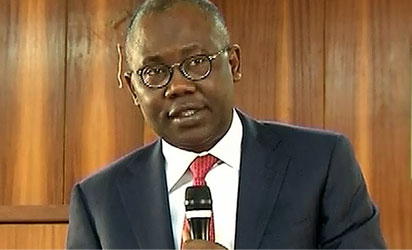
Former attorney General of the Federation and Minister of Justice, Mohammed Adoke
By Innocent Anaba
Nigeria gave a good account of her human rights record, when she faced other countries at the 17th session of the Universal Periodic Review, UPR of the United Nations Human Rights Council in Geneva, Switzerland, last week.
The UPR is a new and unique mechanism of the United Nations, which started in April 2008 and consists of the review of the human rights practices of all states in the world, once every four and half years. Nigeria was first reviwed in 2009 and last week addressed some of the issues raised in her report of 2009.
Nigerian delegation, led by the Attorney General of the Federation and Minister of Justice, Mr Mohammd Adoke, SAN, said that since the first review in 2009, significant developments had been recorded, as she had largely fulfilled its commitments to the Human Rights Council through its active participation in the work and activities of the Council, support for the National Human Rights Commission, commitment to human rights instruments and support for all strategies at regional and international levels to promote and protect human rights.
He added that Nigeria has also fulfilled its commitment by amending the National Human Rights Commission Act in 2010, granting the commission operational and financial independence, and enhanced its investigative and enforcement powers.

*Attorney General of the Federation and Minister of Justice, Mohammed Adoke
“Nigeria acceded to several international human rights instruments. The Constitution was amended to grant financial autonomy to the Independent National Electoral Commission, which contributed significantly in making the 2011 general elections of Nigeria free, fair and credible. Also, Section 254 of the Constitution was amended to provide for the establishment of a National Industrial Court.”
The delegation added that the government has maintained a rights based approach to economic management that is pro-poor and gender sensitive, which is reflected in the economic transformation blueprint tagged: Nigeria’s Vision 20:2020, while government is committed to improving access to afford able housing through legal and policy frameworks, which have increased the number of prototype housing units constructed from 25.49 percent to 151.17 percent between 2011 and 2012.
Adoke added that the Federal Justice Sector Reform Coordinating Committee, FJSRCC, was mandated to coordinate the development, management and implementation of policies aimed at improving the delivery of justice services with an Administration of Criminal Justice Bill before the National Assembly. The bill is intended to institutionalise the broad objective of the proposed National Prosecution Policy.
He said that terrorism and violent insurgency have posed existential threats, adding: “These threats, which are externally-induced, have manifested in the activities of militant insurgents and organised crime groups committing atrocities, crimes against humanity and violation of human rights. To address the problem, constitutional measures have been adopted which include the declaration of a state of emergency in the states of Adamawa, Borno and Yobe in the Northeast, where the insurgents have their base and carry out attacks.
A Joint Task Force, JTF, and a Special Task Force, STF, have been deployed with the required legislative authorisation to utilise rights-based “Rules of Engagement” and “Operational Plans” in combating the insurgency. The government has established a committee on dialogue and reconciliation aimed at providing incentives to dissuade terrorists and other extremists from violence.”
The delegation stated that significant efforts had been made to implement the accepted recommendations and the efforts made in this regard constituted a substantial part of our national report.
In response to advance questions, the delegation emphasised that torture, as a means of extracting information from suspects, had no place in law enforcement. “The police have been retrained and were now relying on, modern and scientific means of interrogations and processes. Police officers found to have committed extrajudicial executions are usually dismissed from service and prosecuted in accordance with the law.”
The delegation noted that the demolition of illegal structures in various parts of the country was embarked upon in the public interest. The affected structures were those erected without permission from relevant authorities and was therefore not in conformity with the master plan of those areas. He added that experts had warned that the continuous existence of those illegal structures posed a danger, not only to the lives of inhabitants of such areas, but also to the ecosystem. The authorities have carried out verification exercises to ensure that those who have genuine claims were either compensated or relocated to other areas and provided with alternative shelter.”
With regard to what is being done to ensure that the fight against terrorism was in accordance with international standards, the delegation stated that despite the difficult circumstances that terrorism generate, our law enforcement agencies have been instructed to observe human rights while countering acts of terror. In areas where the state of emergency was in effect, the JTF and the STF have been deployed with the required legislative authorisation to utilise rights based “Rules of Engagement” and “Operational Plans.”
The delegation stated that the issue of sexual orientation did not enjoy consensus within the United Nations human rights system and all attempts to integrate sexual orientation into existing universally recognised human rights have so far failed, adding that “overwhelming majority of Nigerians objected to same sex relationship based on their deep religious, cultural and moral orientations, against which no government could successfully legislate. There was no policy or practice of witch hunting people based on their sexual orientation.”
It must be appreciated that not all the defence of government of its rights record was shared by all. For instance, on the punishment of security officers involved in extra-judicial killings, the Niger Delta Coalition of Universal Periodic Review, called on the Nigeria Government, to take all necessary steps to bring the perpetrators of the various acts of extra-judicial killings in the Niger Delta region in the country to justice.
In its report to 17th UPR session, the coalition said, “During the four year period after the review, rather than Nigeria improving on its record in respect of promoting the enjoyment of its citizen’s right to life, the country, particularly the Niger Delta area, has become a killing field, where innocent citizens have been extra judicially killed in their hundreds by the Police and the various security forces established in different states,and this has become a national pastime.
“Non state actors have also been implicated in these acts but the growing regime of impunity in the land had ensured that the non state actors go unpunished. The period under review had witnessed high incidences of mindless and unlawful killings of numerous citizens by the police and their ilk.
“Unfortunately, most of these killings have not been investigated and the culprits go unpunished thereby, increasing the level of impunity among security and law enforcement agents in the region. Contrary to the expectations inherent in UPR recommendations, by some countries, Nigeria has not taken the necessary steps required for bringing the perpetrators of these various acts of extralegal killings to justice,” it added.
On Nigeria’s claim that demolition of structures was embarked upon in the public interest, the National Human Right Commission, NHRC, hinted that it will next month commence public inquiry into the demolition of homes, estates and villages in some parts of the country by the Federal and state governments, following the receipt of over 100 petitions from Nigerians.
Chairman of the commission, Prof Chidi Odinkalu, told Nigerian journalists at the UPR that the public hearing slated for Lagos, Enugu, Kano and Abuja, will take off on November 18, 2013 in Lagos.
Odinkalu insisted that the commission was carrying out part of its core functions by the exercise.
While Nigeria maintained its ground on the issues of gay and death penalty by not conceding to them, the United State of America and Britain, asked the country to review its position on the two issues.
Meanwhile, Nigeria’s response to the issues raised in the review comes up in March 2014, when the report will be adopted finally.
The review, for the first time, had eight Nigerian journalists, covering same. The journalists, drawn from the print and electronic media, were sponsored by Gmedia, a non-governmental organisation based in Geneva, Switzerland. The group also sponsored some Senegalese and Chadian journalists. Nigeria, Senegal and Chad were the African countries reviewed this year. The journalists from the three countries also underwent a one week training organised by Gmedia, with experts in human rights, the UN, UPR as resource persons.
Disclaimer
Comments expressed here do not reflect the opinions of Vanguard newspapers or any employee thereof.