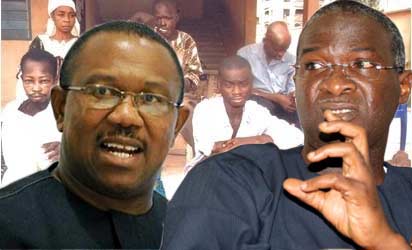
Anambra State Governor, Peter Obi and Lagos State Governor, Babatunde Fashola
By Ochereome Nnanna
This year, Aka Ikenga, the Igbo think-tank, celebrated its 25 years in style. Its President, Chief Anayo Uwazuruike, an eminent lawyer, reflected the mood of the day by decking himself out in grand royal raiments.
The high table at the anniversary lecture was star-studded, with retired Major General Ike Nwachukwu as the Chairman of the day; Bishop of Sokoto, Father Matthew Hassan Kukah as the Distinguished Lecturer; Secretary to the Government of the Federation, Chief Pius Anyim representing the Chief Guest of Honour, President Goodluck Jonathan; Governor Babatunde Raji Fashola, Special Guest of Honour and Deputy Speaker of the House of Reps, Emeka Ihedioha, Guest of Honour.

Fashola
For some reason, many guests at the event did not expect Governor Fashola’s to show up in person. When the State Commissioner for Budget and Planning, Mr Ben Akabueze came into the hall, I expected him to be announced as the Governor’s representative. Rather, after recognising Akabueze, the Master of Ceremonies still informed the packed hall at the Nigerian Institute for International Affairs, NIIA, that the Governor’s convoy was “very nearby”.
Then, shortly after, Fashola strolled into the venue and was immediate ushered to his seat.
It should not be news to anyone that Fashola attending the event in person should be a matter of considerable interest.
After the “deportation” of some indigent people said to be Igbos and their shabby dumping on the shores of the River Niger in Onitsha by officials of the Lagos State Government a couple of months ago, the event not only raised ethnic tensions, it also became a great political issue against the All Progressives Congress, APC and its candidate in the Anambra guber election, Dr Chris Ngige.
Even Bishop Kukah expressed his surprise that Fashola not only came to the event personally but would speak. He concluded that the Governor must have come to address the matter. The man of God, as if to heckle the Governor, said he had considered entitling his lecture: “Importation, Exportation, Deportation and the Future of Democracy”. The hall roared with laughter. Fashola kept a straight face.
When he took to the podium, the Governor made it clear that the “deportation” was very regrettable, and offered his “unreserved apology”. He said those who were making it seem that he had problems with Igbos were only being mischievous or playing to the political gallery.
He recalled the warm solidarity Igbo people extended to him recently when his father left for the great beyond, pointing out that the Igbos were the first to bring cows to his family. But he also forgot to point out the leading role he and the state government played when the great Igbo leader, Chief Chukwuemeka Odumegwu Ojukwu, was given one of the grandest burials ever known in Nigeria.
But in tendering his apology, the governor handed an assignment to Aka Ikenga and agender-setters for the Igbo nation. He asked them to reflect on the factors that prompt people to leave home in massive numbers to other parts, with people who obviously could do better at home joining this migratory stampede. What are the factors behind the trend, he asked. Is it because of lack of resources back home? Or is it because governance has not provided enough enabling environment for some of these migrants to sit down and make a good life for themselves?
Well, as a member of Aka Ikenga, I can list a few reasons for the Igbo migrations. The first is that Igbo people are large in population but are seriously disadvantaged by paucity of land and their inland location, as opposed to the Yoruba whose vast land extends to the oceans.
The Igbo republican culture did not encourage empire building in the dim past. Even when people fought wars, they settled through symbolic reparations. It was not usual to overcome your neighbour and annex them. Most Igbo groups did not even have militaristic culture.
Paucity of land and large population also predisposed Igbos to trading, an activity they are second to none. Business people look for places where opportunities exist. Lagos is one of such prime spots. Apart from its sea and airports, Lagos as the former capital of Nigeria, was developed infrastructurally with the wealth of the nation and this furthered its appeal and opportunities for all sorts of economic activities.
Lagos has come to be home for all, and this is one reality that those who call themselves “original Lagosians” had better adjust themselves to. That time will never come when non-indigenes will be driven out of Lagos so that indigenes will seize their “abandoned property”, an evil design some are now harbouring.
But Fashola’s point about people needing to develop their home states in order not to run away to other lands is sound. It is one truth that is not even bitter. Part of the Igbo agenda should be to develop Igboland so well that other Nigerians, Africans and foreigners should want to also come there with their investments. They would come if the opportunities are there. Nigerians feel cheated that Igbo come to their door mouths in large numbers and they cannot find enough of their own people in Igboland. Whatever is keeping them away should be addressed. Why would they even come when the owners of the land are leaving in such droves?
Fashola’s unreserved apology was greeted with thunderous ovation, but I wonder if those clapping even realised the hidden message behind it. Uncontrolled migration will destroy the Igbo nation. It will extinct the language, custom and values of the people. It will attenuate its majority status and bastardise its population which is rapidly being absorbed by their various host communities. It will continue to increase the insults the Igbo people suffer from their oft-aggrieved hosts and expose them to hostility and xenophobia.
The Yorubas and Hausa-Fulanis also migrate and settle outside their native lands, but they do not suffer the level of hostility aimed at the Igbos because back home, there are enough indigenes and non-indigenes living profitably.
Only a person who loves you can tell you the home truth.
Disclaimer
Comments expressed here do not reflect the opinions of Vanguard newspapers or any employee thereof.