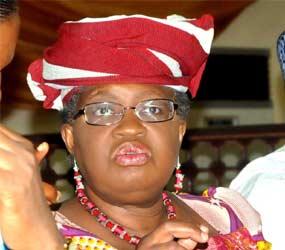
Dr. Ngozi Okonjo-Iweala
By Bisi Lawrence
Could it be that Dr. Ngozi Okonjo-Iweala, the Minister of Finance and Co-ordinating Minister of the Economy, is being economical with the truth? One must confess that the people are not fully let into the true state of affairs concerning the health of the nation’s wealth.
What appears before us simple-minded citizens is a bewildering account told in contradictory terms. Only astute economists like Henry Boyo, seem to entirely understand the goings-on.

Okonjo-Iweala
Their verdict leaves us with little comfort. What we ourselves actually perceive provides even less . The transformation which is supposed to be set in a programme to be systematically unveiled is not distinguishable except in the vision of its protagonists. Nothing seems to change for the better.
There is a lot of money around that really does not amount to much in value. The Finance Minister boasts that inflation has been repressed to 8 percent but cash liquidity still rages. And when there is too much money than is needed to acquire goods and services, prices naturally rise to the occasion.
But knowledgeable experts, particularly Henry Boyo, have spared no effort to explain that the cash deluge inundates the economy mostly from the unjustifiable process of naira allocations strained out of dollar revenues. Nobody is listening, least of all the Coordinating Minister.
One sometimes wonders if she actually believes in what she is saying, as she recently plied some British officials and businessmen with the glorious story of that containment of the inflation in a single-digit limit. It was in the exercise of riding her hobby-horse, to wit, the solid situation of the national economy. With great relish, she added that the economy was, as a matter of fact, being diversified right now.
Nigeria no longer restricts her dependence on only the proceeds of her petroleum products, she stated. One of the notable areas, according to the lady, is in entertainment. That, of course, could not but be in connection with any other effort except the offer of 50 million naira which President Goodluck Jonathan offered to Nollywood sometime ago.
Nobody was deceived then, and no one is in doubt now, that the money was no more than an “incentive” towards the acceptance of the President’s cause. A polite way would be to say it was to “lobby” the actors, and singers, and comedians, and what-have-you in the entertainment industry to look in the direction of President Goodluck Jonathan.
We all know that it was by dint of individual and collective hard work and enterprise that the young men and women are emerging as prominent citizens in good number. Now that they are becoming more than just a mere speck on the horizon of our social lives, the generosity of the President can be said to have been well considered. But does that really add up to a diversification of the economy?
The Minister of Finance said recently that there were problems to be solved over the disbursement of the fund— it is yet to be used for any real purpose. And, in any case, how far does that amount go? That is what is meant by diversification of the economy?
The response to both the foreign and domestic debts is also rather tepid. When you are dealing with debts realistically at any level, they have to be juxtaposed with the height of the income. Our Finance Minister would glibly inform you that the domestic debt is this, while the foreign debt is that without aligning them with the projected revenue.
That is what would give meaning to the data. But that you don’t get. What you are served with is the bland statement that the nation cannot afford 500 million naira demanded by ASUU to bring down the rupture in our university education development. That position is clearly untenable if there is nothing wrong with the health of our economy, especially as the Federal Government had earlier committed itself to an agreement that the money would be provided.
And I believe that it takes only an Okonjo-Iweala as a Finance Minister, to stare boldly at the nation and spew that out, while saying that the economy is in robust circumstances. She has the fascinating attribute of an accomplished bully who expects or accepts no contrary view. She has spoken. She is right. That settles it … but does it?
Well, the Sovereign Wealth Fund, for instance, will not go away, though the policy is being actuated. Dr. Okonjo-Iweala had breezily announced, right in the heat of deliberations by State Governors about it, that there had been enough said about the matter; and that it was going to happen. And that was it. Period. Well, it really isn’t, since the governors have gone to litigation over it.
How could we contemplate such a scheme which proclaims a reserve of acquired revenue at a time when a cabinet minister swears that the entire economy of the nation would collapse over an expenditure covering ASUU demands?
But then, the monthly allocations to the States are indeed in a fiasco. The Federal Government appears unwilling ( or is it unable ?) to loosen the purse strings of the Federation Account and pay the States the tidy sum of 336 billion naira the States’ Commissioners of Finance insist they are being owed. On no less than two occasions in the past week, the commissioners have had to openly turn down all blandishments to make them accept less than they claim is their due from the Federal Government.
So you might indeed wonder if there is more than meets the eye in the conflicting statements of Okonjo-Iweala about the nations’ economy. You might begin to ponder on this unedifying shift from one foot to the other about what is and what is not. Are we broke or are we not? Or why are we fighting shy of meeting our bills in the midst of declared affluence?
The Honourable Minister of Finance and Coordinating Minister of the Economy has to answer that question satisfactorily, once and for all— and not with a forked tongue, either. No wonder there is a clamour already for her to go, from the people who have also asked her master not to come back.
akanbi “ege” factor
The largesse that recently fell into the lap of our artistes nudges our minds in the direction of the influence of comedians, musicians, actors and the men and women of the entertainment world on the course of politics.
In other parts of the world, specifically in the United States, the involvement of the world of entertainment with politics is of a long-standing tenure, though very famous stars seldom care to be identified with any particular political suasion. Ronald Reagan, however, could not help himself after getting involved in trade union activities in aid of his fellow actors. He never looked back until he became the US President.
Arnold Schwarznegger, on the other hand, practically stumbled into the governorship of California, the largest US state. Most actors and musicians seem to content themselves with merely endorsing political candidates and keeping their noses dry from elaborate involvement.
That would also appear to be the practice in Nigeria, generally. Popular bands have even been seldom made to perform in the political campaigns of the past two decades. Nigerians are prone to be too personal about public issues and an open alignment with a particular political policy or personality may be a matter of severe consequence to an entertainer. In fact, such was supposed to have happened to Akanbi Wright, a “master guitarist” of the forties.
He was totally committed to the fortunes of the Nigerian National Democratic Party, known for short as the “Demo”. The only opponent they had was the Action Group which had the Area Council Organization as its subsidiary in the Local Government election of the early forties. The contest was for the Mayoralty and membership of the Lagos Town Council. Against all odds, the “Demo” emerged winners. Alhaji Ibiyinka Olorunimbe became the Mayor of Lagos, and Mazi Mbonu Ojike was elected the Deputy Mayor. (He was an Igbo man, by the way. And this was some 60 years ago.)
Akanbi Wright, aka “Akanbi Ege”, was rapturous. He joyfully came out with a juju musical number in which he derided the losing Area Council and called them, “Area Mosa”. Lagosians took to the streets with it and danced through the night.
Well, Akanbi somehow contacted what was reckoned to be tuberculosis — openly, that is. And he soon died thereafter. But those who professed to know the real cause of his death whispered that it was connected with his political outspokenness. That seemed to have signalled a marked coolness on the part of Lagos musicians towards political matters thereafter. But some young musicians have welcomed such engagements as legitimate business in recent times. And not a slight cough heard. Yet.
Echoes: After 53 years of independence, we have nothing to cheer. Students, pensioners, fathers, mothers, artisans, professionals, youths, etc, still stew in the hellish scourge of irreverent policy. Can Nigerians survive? Have a sober celebration. (Chief Bobson Gbinigie, Mandate Against Poverty, Warri.)
Time out.
Disclaimer
Comments expressed here do not reflect the opinions of Vanguard newspapers or any employee thereof.