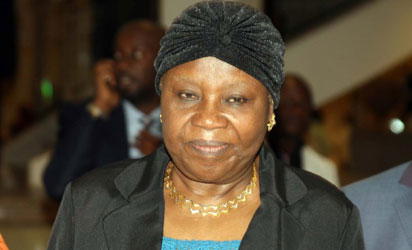
*Aloma Mariam Mukhtar
By IKECHUKWU NNOCHIRI
ABUJA—The Chief Justice of Nigeria, CJN, Justice Aloma Mariam Muhktar, yesterday, urged the Federal Government to pay closer attention to justice administration in the country, saying courts were increasingly finding it difficult to effectively perform their day-to-day constitutional roles.
Her call came on the heels of a raging controversy over perceived moves by the executive arm of government, through the office of the Head of Service of the Federation, to fix the tenure of heads of agencies in the judiciary.
The CJN, who made the call while flagging off the 2013/ 2014 legal year at the Supreme Court, maintained that a situation, where budgetary allocation to the judiciary continued to drop at a time government budget was on steady increase every year was clearly an impediment to the quick and effective dispensation of justice in Nigeria and, on the whole, a set back to the current effort at transforming the judiciary.

*Aloma Mariam Mukhtar
Besides, the CJN took the opportunity to administer oath on 17 new Senior Advocates of Nigeria.
She said it was a glaring but painful fact that most courts in the country were ill-equipped and lacked basic necessities, hoping that government would live up to its expectations and rescue the judiciary from plunging further.
She said: “Over the years, funding of the courts has remained a challenge as evidenced in the condition of many courts in Nigeria today.
Funding of courts
“Statistics have shown that, funding from the Federal Government has witnessed a steady decline since 2010, from N95 billion in that year to N85 billion in 2011, then N75 billion in 2012 and dropped again in the 2013 budget to N67 billion.
“Indeed, with this amount, if the amount allocated to the extra-judicial organisations within the judiciary is deducted, the courts are left with a paltry sum to operate.
“The simple implication is that our courts are increasingly finding it difficult to effectively perform their day-to-day constitutional roles.
“The resultant effect of a slim budget in the judiciary is that a number of courts in Nigeria today evince decay and neglect of infrastructural amenities particularly at the State level.
“In some cases the court buildings do not possess the required well equipped library for Judges to conduct their research. This may make Judges rely on information supplied by lawyers which should not be the case.”
She said there was need for the judiciary to be allowed to perform its constitutional obligations without undue interference from other arms of government, and called for full adherence to the principle of separation of powers in Nigeria.
The CJN had promptly written the Head of Service, describing the circular to the judiciary on appointment tenure as a misnomer which could not be implemented since it amounted to the usurpation of the functions of the National Judicial Council, NJC, and an encroachment on the constitutional rights of the judiciary as an independent arm of government.
She contended that only the NJC was constitutionally empowered to deal with issues of administration and policies for the nation’s judiciary.
CJN said: “Indeed we must be guided with the reality that under democratic dispensation, the three arms of government must keep faith with the doctrine of separation of powers as enshrined in the 1999 Constitution, the Judiciary must continue to defend its independence so that it should not merely be apparent but must be seen to be real.
“By virtue of Section 153 of the Constitution, the National Judicial Council is the apex body for the nation’s judiciary. By paragraph 21(1), part 1 of the Third Schedule of the 1999 Constitution, the council has the power to deal with matters relating to broad issues of policy and administration of the judiciary.
“During the 2012/2013 legal year, a total of 511 cases made up of 416 civil appeals, including political matters and 95 criminal appeals were filed in this court. Of this number, 280 of the cases were heard which consisted of 224 civil and political appeals and 56 criminal appeals.
“Also in the same legal year, judgment was delivered in 137 civil appeals and 42 criminal appeals bringing the total number of judgments delivered to 179.
“This is undoubtedly a tremendous achievement and I must congratulate and commend my learned brother Justices of the Supreme Court for their exemplary dedication, hard work and commitment to duty, which are indeed admirable by any standard.
“While I cannot stop commending our effort, I must be quick to add that there is room for improvement not just on the part of the judiciary but for all the stakeholders in the country’s justice system.
“Our police force have been doing the best they can in their operations and in our criminal justice system, but it is greatly out – spaced by sophistication given to criminals by our archaic and culturally irrelevant laws. There is need for a comprehensive restatement of our criminal laws to take into account what is relevant for retention and update regularly.
“The problem is exacerbated by the unwholesome practice of some of our security agents involved in the criminal justice administration system.
“It is common knowledge that our security agencies usually rush to the courts with suspects, before looking for evidence to prosecute them. The persistent use of the ‘’Holden charge” by these agencies to detain awaiting trial suspects, is a major contributor to the high number of cases pending in our courts.”
“This procedure is a far cry from what obtains in other democracies, where discrete surveillance is placed on crime suspects who are painstakingly stalked by security agents, until such a time when enough evidence would have been obtained for their arrest, arraignment and prosecution.
“But in Nigeria, suspects are promptly arrested and often times arraigned in court, even when no evidence for prosecution has been gathered. The backlash from such failure of proper investigation by our security agencies is the resultant hike in the number of cases pending in the courts.
“An extreme consequence of these glaring lapses may lie in the loss of confidence in our domestic justice administration system which rubbishes our often brandished favourable investment climate and translate to a huge disincentive to potential foreign investors in Nigeria.
“The process of interlocutory appeals aggravates the situation to the extent that by the time the Supreme Court decides that they be continued in trial court, most of the witnesses might have died or are alive but senile, with documents no longer traceable.”
“In trying to identify the fault lines of the problem of snail speed justice delivery, it is impossible not to call the attitude of litigants, lawyers and Judicial officers alike, to question. We know that litigants are often not straight forward with their lawyers by not duly perfecting their briefs. This may take the form of neglect to furnish , as at when due, requisite facts for prosecution of cases filed in court or failure to fulfill some other pecuniary obligation without which the lawyer might not be able to continue with the case.
“Conversely, it is also known that some lawyers unscrupulously devise stratagem for cases to linger in court, through, for instance, their resort to seeking unnecessary adjournment at every turn in court proceedings or failure to attend court for flimsy or unfounded reasons. These unethical practices have been solely attributed to tardiness resulting from laziness, knowledge gap and/or the quest for lucre.
“Our judicial officers are no less enmeshed in this orgy of laziness and failure to update their knowledge of the law through periodic training and retraining, as our observation has revealed that a plethora of bad judgment and rulings churned out in lower courts contribute to the catalogue of pending cases in courts having appellate jurisdiction over such lower courts.”
Disclaimer
Comments expressed here do not reflect the opinions of Vanguard newspapers or any employee thereof.