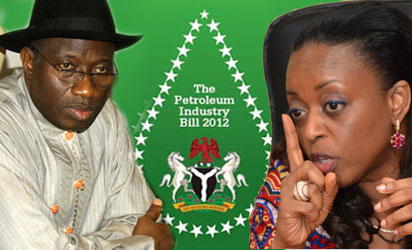
President Jonathan and Petroleum Minister, Diezani
ON April 4, Vanguard reported that the IOCs – or international oil cormpanies – have responded aggressively to the latest draft of Nigeria’s Petroleum Industry Bill (PIB). It’s no surprise that they’ve been so critical.
The IOCs making the criticisms – including ExxonMobil, Chevron, Total and Shell – responded through the Oil Producers Trade Section, a body that was founded to speak for both international and indigenous corporations in the Nigerian petroleum industry.
They’re on dubious ground speaking through this organ, as the complaints they’re making are only relevant to international corporations: many of the issues disliked by IOCs are supported strongly by domestic Nigerian producers. But despite this, these criticisms are being heard, and they deserve a response – because the arguments make out that their private grievances are also grievances for the Nigerian people.

President Jonathan and Petroleum Minister, Diezani
They are not, and we have to get rid of this idea. The public interest is quite separate from the IOCs’ private interests – indeed,on occasions they’re directly opposed.
So Nigerians need to hear a counter-argument from the PIB’s defenders, so that it becomes clear that the Nigerian public interest is not harmed by the legislation – even if IOCs have problems with it, for reasons of profit and loss.
Attacks on PIB
What are their attacks on the PIB? One of the main criticisms noted by the Vanguard was that the IOCs prefer to export gas, and are reluctant to produce it for the Nigerian market.
The PIB gives companies great reasons to produce gas for Nigerian consumers, including tax breaks, but the IOCs have made clear that they still favour export to America and Europe. As many IOCs know, natural gas is a clean, efficient source of energy – as Statoil argued in 2013, “natural gas is a particularly attractive energy source and should play a key part in … the EU’s long term energy mix”.
Natural gas is important, and the PIB makes a powerful and justified effort to persuade oil companies to let Nigerians buy some of the gas coming from their own land. And this gas is important. As all Nigerians know, our power supply is unreliable and needs lots of investment. As well as new power cables and generators, we also need a supply of fuel – and gas is the best option.
So why are the companies not eager to make the most of the PIB’s incentives to keep gas in Nigeria? Perhaps they’re under political pressure elsewhere to keep the flow of export gas coming – in America, in Europe. Undoubtedly, it appears that export-oriented gas projects are taking precedence over the needs of the Nigerian people.
It stands to reason, therefore, that only the Nigerian people can secure this protection for themselves, through legislation to create new incentives to keep Nigerian gas in Nigeria. The draft PIB 2012 is poised to do just that as lack of gas infrastructure forms a major constraint.
In a further criticism, the IOCs criticised the new approach being taken to regulation. Under the PIB, two new taxes at fixed rates will be introduced – the Nigerian Hydrocarbon Tax and the Companies Income Tax. But though these tax rates are fixed in the PIB, royalty rates – the amount of profit that the IOCs get – are going to be set at a later time, in more detailed regulations. Contrast this with the 1993 deep water regulations, in which oil companies gained an 80 per cent share of profits, and it’s clearer why the IOCs are dissatisfied with the new PIB model. For the IOCs, this new deal enforces a standard of fairness that defends the Nigerian taxpayer and the underdeveloped communities of the delta, asking a little more from the IOCs’ generous profit margins.
Furthermore, to the IOCs’ claim that this plan will create uncertainty for investors, we reply that in truth setting rates like this is common across the world, and already happens under the current Petroleum Profits Tax Act here in Nigeria. The system works well, because it offers regulators the degree of flexibility needed to respond to changing market conditions – it steadies the ship in the storm. The Nigerian taxpayer, represented by the government, is not locked into a fixed regime but is able to respond nimbly to rising and falling prices, ensuring that (as in other areas of taxation) rates can alter as political and economic circumstances change. We’re asking that companies take on some of the uncertainty that was previously taken on by the taxpayer.
Lower royalty
A further complaint exposes a similar, rather self-interested defence: citing the lower royalty-take rates of other African countries, the IOCs argue that Equatorial Guinea (with a 44 per cent Government take) or Ghana (52 per cent) are more attractive than Nigeria, which is uncompetitive by comparison. But in reality, even countries with far higher takes – the UAE takes 77 per cent, Angola 83 per cent – have implemented these rates without causing a flight of IOCs to low-take countries like Ghana. There has been no exodus – because investment remains very profitable, even at higher rates. Indeed, many high-rate countries have benefited from recent investments, including Total’s Ofon Phase II investment, Shell’s Southern Swamp project here in Nigeria, and ExxonMobil’s Reserve developments – the last of which won African deal of the year award in 2012. We know, and the IOCs know that it’s better to have something than nothing – especially when indigenous Nigerian competitors are reading to snatch up any available oilfields.
So the Nigerian government is no enemy of investment, and the IOCs are not looking after Nigeria’s best interests when they scaremonger about possible falls in investment: investment will continue, as it has elsewhere.
Another key objective of the PIB is the introduction of a modern system of acreage administration which would ensure that tracts of acreages that have been lying dormant under the current regime are operated in a vigorous and continuous manner that would shore up the nation’s reserves and production.
Therefore, under the PIB, the days in which IOCs could sit on valuable acreage without actively working them would be over. This system will not only help Nigerian oil companies, but will also attract new independent players that are ready to take exploration risks to increase production.
Predictably, the IOCs are scared of the competition this will create, as it will reduce their dominance and open up the sector for increased investment. If we remember that in the past decade, much success in major oil and gas discoveries globally has been by the independents, not by risk-averse IOCs who expand through acquisition and mergers, it’s easy to understand why this regulation is viewed as a threat to IOCs, but positively by non-dominant, up-and-coming market players.It’s an excellent reform for the sector as a whole.
In a final attack, the IOCs have criticised the system of investment allowances, which rewards companies by output, discouraging wasteful behaviour by IOCs. Once again, these rules do turn the tables on IOCs, improving the terms for the taxpayer and Nigerian citizen. IOCs have complained, here, that the authorities are not paying enough attention to their needs, and haven’t consulted them sufficiently. In a way, they’re right – the Government is listening, but they’re going ahead with reforms in spite of the complaints. Because the PIB deliberately shifts the balance of interests in favour of the people.
Nigeria’s oil industry remains profitable
Legislation doesn’t have to be a zero sum game, in which one side gains as the other loses: as the Nigerian people claim some basic standards, just as other countries across the world have done, the IOCs will pay their fair share.
But in spite of what the IOCs say, they won’t be leaving Nigeria any time soon. The oil industry here will remain profitable. We just need to be careful, as the debate about the PIB goes forward, to separate the IOCs’ complaints from the public interests.Their concerns about profit are real to them, but they shouldn’t be allowed to wear the mask of public interest. The government, elected by the people of Nigeria is legislating to improve Nigerians’ lives: the IOCs can contribute to this democratic process of reform, but we will not stand by as their petrodollars spread misinformation. The PIB represents the real public interest. It should pass.
Abiye Membere is Group Executive Director for Exploration and Production at the Nigerian National Petroleum Corporation.
Disclaimer
Comments expressed here do not reflect the opinions of Vanguard newspapers or any employee thereof.