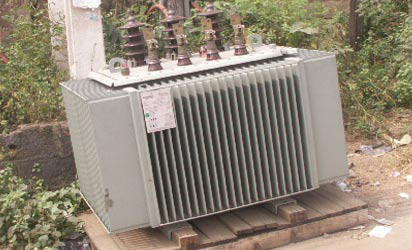
Transformer
BY KINGSLEY OVEDJE
INVESTORS who missed out on the telecoms licence regime in Nigeria now have another golden opportunity to invest in the next big sector on the African continent – the Nigerian Power Sector – with huge returns to make from generating electricity to a population in excess of 160 million people!
This is because the Niger Delta Power Holding Company, NDPHC, is currently offering for sale an 80 percent stake in the 10 gas-fired power generating stations it built from the scratch on behalf of the three tiers of government.
Already, the NDPHC has invited prospective investors to submit Expressions of Interest (EoI) for the 10 thermal stations through publications in national dailies. Following this, 110 private investors’ companies have put in their EoIs, which submission closed on Friday, July 19, 2013.

The transactions, to be conducted through International Competitive Bidding, will cover the following generation companies: Alaoji Generation Company Nigeria Limited, situated near Aba, Abia State, with total gross installed capacity of 831.3 MW (at ISO); Benin Generation Company Limited, situated near Benin city in Edo State with total gross installed capacity of 507.6 MW (at ISO); Calabar Generation Company Limited – near Calabar city in Cross River State, with a total gross installed capacity of 634.5MW (at ISO); Egbema Generation Company Limited – near Owerri in Imo State with a total gross installed capacity of 380.7 MW (at ISO), and Gbarain Generation Company Limited, situated near Yenegoa in Bayelsa State with total gross installed capacity of 253.8 MW (at ISO).
The rest are Geregu Generation Company Limited in Ajaokuta, Kogi State with total gross installed capacity of 506.1 MW (at ISO); Ogorode Generation Company Limited, Sapele Delta State with total gross installed capacity of 507.6 MW (at ISO); Olorunsogo Generation Company Limited, located at Olorunsogo in Ogun State with total gross installed capacity of 754 MW (at ISO); Omoku Generation Company Limited, near Port Harcourt in Rivers State with total gross installed capacity of 264.71 MW (at ISO) and Omotosho Generation Company Limited in Okitipupa Local Government Area of Ondo State, with total gross installed capacity of 512.82 MW (at ISO).
These power plants have a combined design capacity in excess of 5,453 megawatts (mw) at ISO conditions and 4,774mw (Net)
To handle the sale of the power plants in line with due process and laid down procedure, the three tiers of government have set up three committees, namely: the Joint Evaluation Committee, charged with evaluating the expression of interest for the power plants; the Joint Transaction Committee of the NDPHC headed by Managing Director, NDPHC, James Olotu and the Joint Technical Committee, headed by Benue State Governor, Gabriel Suswam.
Also, the NDPHC, the Bureau of Public Enterprises (BPE) and other stakeholders in the power sector recently launched a road-show in Lagos, whose train also moved to London, Hong Kong and New York in the United States (US)to provide necessary information to potential investors on the 10 power plants. The road-show has apparently yielded good dividends, as no fewer than 110 global and indigenous investors are currently jostling to buy the NDPHC plants.
Understandably, a great scramble is underway for the NDPHC plants. With Nigeria’s population of over 160 million people, the country is without doubt the largest market for investors in Africa. To be sure, the meteoric rise of hitherto unknown telecommunications companies to global reckoning following their entry into the highly rewarding Nigerian telecoms sector has put both indigenous and foreign investors on the alert for any investment opportunities in Nigeria. It is against this backdrop that over 200 investors have indicated their interest in acquiring the NDPHC plants.
Also, these investors are seeking to capitalise on the growth opportunities in the Nigerian electricity market, where demand far outstrips current supply and the potential for strong economic growth is high.
Moreover, some foreign investors are interested in the plants because they want to establish a strong presence in West Africa, using Nigeria as a platform for acquiring further assets in the region.
The NDPHC plants are also being sought after since they are all newly constructed and as such offer the best fuel efficiency and lowest operating costs, thereby relieving investors of pressure from construction cum commissioning costs.
Investors are also excited by the NDPHC plants because they are assets that can be further developed, as all but one of the open cycle gas turbine power plants have the potential for expansion and growth.
In addition, these investors relish the opportunity to partner with the three tiers of government that have shown a strong commitment to the country’s power sector reforms, including taking several measures to support the credit-worthiness of investments in the country.
The power plants have also attracted mammoth investors’ interest because their buyers-operator would benefit from a Multi-Year Tariff Order (MYTO) designed to be cost-reflective tariff that accounts for operating cost and capital recovery, incentivising efficient operations based on best new entrant capabilities and technology. The MYTO also brings certainty to the tariff regime.
Potential operators are also scrambling for the NDPHC power plants because they would benefit from Power Purchase Agreements (PPAs) with the Federal Government owned entity – the Bulk Electricity Trading Plc. (NBET) – which will act as the bulk buyer of electricity in the early stages of market liberalisation.
And the opportunity to benefit from the 10-year term Gas Supply and Aggregation Agreements with Nigerian oil producers makes the NDPHC’s power plants a good buy for private sector investors.
At the Hong Kong road-show, Suswam disclosed that the three tiers of government have thus invested well over $8 billion in building 10 power plants, and expect over $6 billion (about N936 billion) in revenue from their sale.
The revenue receipt, according to Mr. Olotu, would be ploughed back into the sustained capacity development in the power sector, specifically to build a number of hydropower dams across Northern Nigeria.
During the road-show, Minister of Power, Prof. Chinedu Nebo, stressed that “the power sector will thrive in the hands of the private sector and drive the Nigerian economy. We will give maximum support to investors to take over the sector.
“The entire process of privatisation of the power sector is irreversible and what happened in the telecoms sector is about to repeat itself in the power sector. We expect that achievements in the power sector will dwarf the telecoms sector, and this will revive our economy/SMEs which are currently moribund.”
Also at the road-show, Director-General, BPE, Benjamin Dikki, said the sale of the power plants fell within the context of President Jonathan’s Transformation Agenda “which seeks to create a conducive atmosphere for private capital inflows.”
Similarly, Representative of the financial advisers to the privatisation programme, West African CPCS, Arif Mohiuddin, assured potential investors that the bidding process would commence in August and the final handover to eventual winners would be in June, 2014.
Likewise, Olotu assured: “All the plants are in top condition and have gone through pre-commissioning checks to ensure optimal performance in the hands of the operators who would be selected through a detailed and rigorous process to ensure that the full objectives of the NIPP projects are realised.”
Although Global System of Mobile communications (GSM) operators are currently making huge profits in the country, analysts say successful bidders for the NIPP power stations are in for bigger returns on their investment, given the acute thirst for regular power supply in the country. Without an iota of doubt, buying into any of the 10 power stations up for sale is the best investment move anyone could make in Nigeria today!
* Ovedje wrote in from Asaba, Delta State
Disclaimer
Comments expressed here do not reflect the opinions of Vanguard newspapers or any employee thereof.