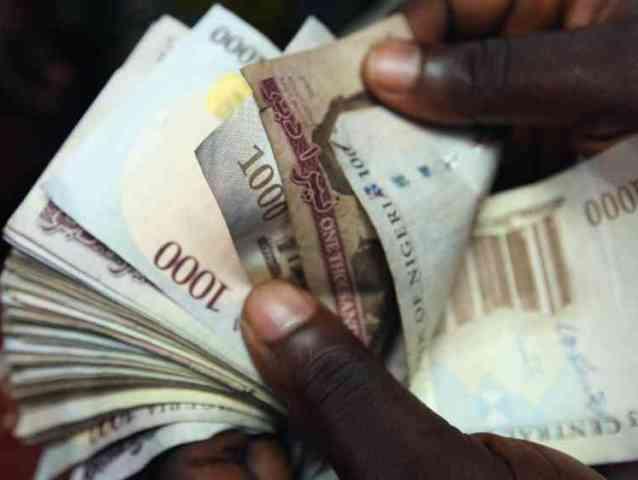
Naira
By Akintola Omigbodun
A budget is an estimate of the amounts of money to be received and amounts of money to be spent for carrying out the objectives of an organisation or government over a specified period of time, usually a year. The budget identifies the activities that would be carried out, when each activity would commence and end, the costs of the resources that would be applied for each activity and the source of funds to meet the costs.
The performance of a manufacturing/commercial organisation is usually set out in a statement of comprehensive income after the organisation’s activities have been carried out for the year. The statement of comprehensive income identifies the revenue from which the cost of sales is deducted to give the gross profit.
Other operating income is added to the gross profit while marketing, distribution and administrative expenses are deducted to arrive at the operating profit. The profit for the year that is attributable to the owners of the organisation is obtained after deductions for finance costs and taxation. The organisation also gives a statement of its financial position in which it sets out its assets and liabilities at the end of the year.
Financial statements are usually published by governments that have raised funds from the capital market in Nigeria. The statement of the government’s consolidated revenue fund identifies internally generated fund, statutory allocation, value added tax and other revenue that make up the total revenue. The basic expenditure is made up of personnel cost, pensions and gratuity, consolidated revenue fund charges, overhead cost, grants and contribution. The surplus of consolidated revenue fund over basic expenditure is transferred to the capital development fund.
Capital receipts plus transfers from the consolidated revenue fund make up the capital development fund which is applied for the provision and maintenance of social infrastructure such as roads, bridges, water supply, power supply, schools, hospitals and other public buildings. The government’s financial statement does not include these fixed assets but is limited to what can be described as current assets and liabilities.
A manufacturing/commercial organisation in addition to making a profit provides for the depreciation of its fixed assets and in the process allows for the replacement of its fixed assets from its operating profit. For example, computing equipment is usually depreciated over a period of three years by manufacturing/commercial organisations and such equipment can be replaced at the end of the three-year period.
If, however, government builds a road which breaks up and has to be resurfaced three years after its completion, that government cannot readily increase the social infrastructure available. Thus, a government’s performance should be based on the quality of social infrastructure it provides and the value the public derive from using the social infrastructure.
In this respect, the Lagos State Government, LASG, should be commended for its policy of building its roads with a crushed stone base above the earthfill before the road surface is made with asphalt. The roads being built now should remain serviceable for several years from now. This should be the standard for road building everywhere in Nigeria.
The value of any social infrastructure encompasses its costs and how it functions in use. The Lagos Metropolitan Transport Authority, LAMATA, in a recent television programme indicated that it had carried out traffic surveys on roads it had constructed and it was found that travel times on these roads had reduced significantly. This is a good example of how value can be delivered on social infrastructure projects.
The reports of a significant drop in government revenues from crude oil sales should give us the impetus to examine how best to apply the diminished revenues in order to obtain optimal value. Contracts for the reconstruction of the Lagos to Ibadan expressway were reported to have been awarded recently for a sum of about N170billion with a completion period of 4years.
More recently, there have been reports that the Federal Ministry of Works, FMW, has current commitments on road contracts of about N1,630 billion. The capital budget for FMW for 2013 has been given as N141billion of which N42 billion had been released to FMW at the time of the report. FMW also has 25 highway projects under the 2013 budget and there exists the possibility of other new projects being added in 2014.
The spread of the available resources over so many projects would leave us with many uncompleted projects. I would like to suggest that as an act of giving value to the population both the executive and legislative arms of government should agree to provide at least N80 billion for the reconstruction of the Lagos to Ibadan Expressway in the 2014 budget.
To be continued
Disclaimer
Comments expressed here do not reflect the opinions of Vanguard newspapers or any employee thereof.