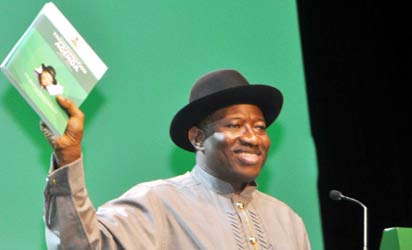
PRESIDENT GOODLUCK JONATHAN PRESENTING HIS ADMINISTRATIONS MID-TERM REPORT AT THE 2013 DEMOCRACY DAY CELEBRATION IN ABUJA ON WEDNESDAY (29/5/13). STATE HOUSE PHOTO
By Douglas Anele
Moreover, October 1 is more appropriate for marking Democracy Day, assuming there is need to celebrate democracy, taking into consideration the landmark national events that took place on that day. The most significant dates in Nigeria’s political history are 1914, 1960 and 1967. Of the three, October 1, 1960 is the most relevant to our discussion for two reasons.
First, it was the date Nigeria achieved political independence from Britain. Second, full political autarky in modern governance for Nigerians began on that very day. At independence, the departing colonial administration bequeathed to us the parliamentary system based on regionalism.
Most historians agree that, despite some hiccups occasioned by ethnic rivalry and suspicion, inexperience of some key political actors, and immature democratic institutions, the parliamentary system of 1960-1966 represents the finest moment in our political history.
Nigeria went through a devastating civil war from 1967 to 1970. In October 1, 1979, civilian rule was restored when Obasanjo handed over power to Shehu Shagari. Since then, all the civilian administrations operated with constitutions modelled after the American presidential system of government.
Critics of the American model point out, correctly in my view, that it is too expensive and concentrates excessive powers on the executive. Additionally, the penchant of our key political actors to manipulate the system for selfish interests has crippled the growth of democracy and alienated people from effective participation in the political process.
Looking at the quality of governance from 1999 until date, Nigerian political leaders have not learnt any
thing from the mistakes of their predecessors. For example, when Obasanjo, one of the luckiest Nigerians alive today, became President in 1999, people thought that he would be an effective leader, considering his more mature age and previous experience as military head of state. Obasanjo started well. He tried his best to restore efficiency and professionalism in the armed forces.
Between 1999 and 2007, Nigeria paid a significant percentage of her foreign debt to the Paris Club, and his fiscal policies and currency reforms bolstered confidence in the Nigerian economy. One of Obasanjo’s greatest achievements is the setting up of the Economic and Financial Crimes Commission (EFCC) and the Independent Corrupt Practices Commission (ICPC).
The EFCC was so effective during his tenure that, despite criticism that the agency was an instrument for persecuting enemies of the President, mere mention of its name struck fear in the minds of corrupt politicians and businesspersons. Overall, Obasanjo’s performance was average. But it must be said that, the tremendous increase in crude oil revenue were not prudently managed by his government.
Thus, Obasanjo missed a wonderful opportunity to improve the fundamentals of Nigeria’s economy, especially electricity supply, manufacturing, and infrastructure. He was too preoccupied with the “third term agenda” to work in concert with the National Assembly to amend relevant sections of the constitution that militate against the practice of true federalism.
It seems that Obasanjo was much more interested in retaining power and maintaining the unjust status quo than in transforming the country for the good of ordinary Nigerians. Therefore, his successor, Umar Musa Yar’Adua, inherited so many problems, which eventually proved too much for his declining health condition.
Yar’Adua was not an effective President. In fact, his administration did not record any outstanding achievement. The late President was a humble and compassionate man, but public declaration of his assets is a good example in transparent leadership. Yet what Nigeria needed in 2007 (and still needs now) is an intelligent, selfless and courageou
s leader with iron will to take and implement tough decisions required for positive national transformation.
I believe that Yar’Adua committed a fatal error of judgment when he decided to contest for the presidency in 2007, because he underestimated the negative impact of the pressures of that office on his fragile health. Probably, despite his lack of solid achievements, when the story of his tenure is finally documented history will be somewhat charitable to him. What will be the verdict of history with respect to Goodluck Jonathan, Yar’Adua’s successor?
No one can answer that question with certainty now, because Jonathan is still in office and his tenure might extend to 2019 if he secures a second term in two years’ time. However, he has spent about three years in office, which is enough for one to make a prognosis of how history will judge his administration.
Now, notwithstanding the garrulous and ill-tempered defence of their boss against criticism by his lieutenants, the fact remains that there are no clear signs that Nigeria is progressing since 2010 when Goodluck Jonathan assumed office as President. Perhaps, the man is doing his best, but the vast majority of our people are yet to experience positive transformation in their existential condition, which Jonathan promised them at his inauguration.
Obviously, Jonathan, like his predecessor, inherited numerous challenges brought about by decades of incompetent leadership. Nevertheless, he was aware of this before he decided to vie for the Presidency. Consequently, Mr. President must be prepared to handle wisely both the huge benefits and burdens of his office.
In my opinion, several decisions and choices made by him thus far are unwise and unpatriotic. A very important area where his government has failed Nigerians is electricity supply. It is a big disgrace that a country of over 160 million people cannot generate up to and sustain 5000 megawatts of electricity, whereas South Africa with a quarter of Nigeria’s population generates up to 45,000 megawatts.
Definitely, Jonathan could easily have secured wide acceptability for his second term ambition in 2015 presidential elections by using all necessary means to ensure 24-hour uninterrupted power supply nationwide.
For now, he is chasing shadows, wasting precious time in flexing muscles unnecessarily against his “political enemies” instead of working his fingers to the bones to make sure that we have stable electricity. Considering the abysmal level of power supply in Nigeria and the crucial role electricity plays in manufacturing and wealth creation, investors will continue to shun the country unless government satisfactorily addresses the power issue.
With respect to the malignant cancer of corruption, Jonathan’s administration is not tackling it effectively. Heart-rending corruption is rampant among top public office holders, high profile businesspersons, and multinational companies operating in Nigeria connected to government officials.
To be candid, Jonathan’s government is corruption-friendly, as can be seen from the expanding eddies of official corruption and inability of the EFCC to prosecute so-called “sacred cows” in and out of government since the present administration. Indeed, Mr. President’s attitude sometimes encourages corruption: examples include his refusal to declare his assets publicly and wrongheaded presidential pardon granted to Diepriye Alamesieyegha his former boss.
Disclaimer
Comments expressed here do not reflect the opinions of Vanguard newspapers or any employee thereof.