By Douglas Anele
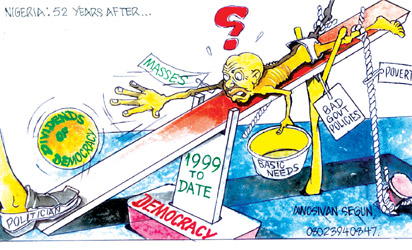
Wednesday last week was a public holiday because, according to the federal government, 29the May is “Democracy Day”. The choice of that date and the political significance it has acquired are due to Olusegun Obasanjo whose inauguration as a civilian President took place on May 29, 1999. Since Obasanjo left office in 2007, his successors, namely, Umaru Musa Yar’Adua and Goodluck Jonathan, have retained the public holiday he introduced fourteen years ago.
We shall commence reflection on the event for this year by raising pertinent questions such as: What is democracy? How democratic was the political process that led to the emergence of Obasanjo, Yar’Adua and Goodluck Jonathan as President? Is May 29 the most appropriate day or date for celebrating democracy instead of October 1, the day Nigeria became independent of colonial rule? With respect to the first question, there is no better definition of ‘democracy’ than the one credited to Abraham Lincoln, according to which democracy is “government of the people, by the people, and for the people”.
Lincoln’s definition captures the core idea in John Locke’s theory of politics that presents a vision of government as stemming from the powers given in trust to representatives freely chosen by the citizens of a country. This means that political authority in a truly democratic setting ultimately derives from the consent of the people who, by implication, also have the capacity to replace a set of non-performing leaders with another.

There are different systems of democratic government throughout the world, and the particular system practiced in a given country is determined by the dialectical interplay of complex factors such as culture, history, demographic configuration, the economy and dynamics of international relations, political experience of the citizens as a whole, and so on. Most Nigerians do not realise that democracy, like every achievement of human beings, is always a work-in-progress, which can never get to a state of total perfection.
Hence, the ideals of democracy, such as equal political rights and opportunities, complete freedom of choice, flawless elections etc. can never be completely realised in practice because of human fallibility and the law of unintended effects, although political leaders in various countries, through hard work, intelligent strategies, and selfless service ensure progress towards these ideals. A genuine democratic system is a form of political organisation such that both the leaders and the led work cooperatively together to improve democratic practice.
Now, because the fundamental reason and premise for the existence of government is to ensure the well-being and security of members of the society, a visionary dictatorship can actually out-perform a democratic government. For example, in spite of its excesses Lee Kwan Yew’s dictatorship inaugurated a decisive transformation in Singapore, which surpassed what obtained in most democratic countries during the same period when he was in power.
It follows that the main advantage of democracy over authoritarianism is not that the basic needs of the citizens are more likely to be met in the former rather than in the latter, or that a democratic government cannot degenerate to a level that people would wish for a different type of government, including military dictatorship.
The lessons of history are decisively against any simplistic assumption of the superiority of democracy over aristocracy and authoritarianism. Karl Popper, the Austrian-born philosopher of science and social theorist, correctly suggested that the main advantage of democracy over other forms of government is that it provides an institutional non-violent means of replacing bad leaders by the people.
That said, democracy is a complex socio-political concept loaded with certain values, and its concrete realisation in a geo-political space is extraordinarily arduous, and requires genuine desire and continuous effort to reduce the human and institutional obstacles that weaken its foundations. Regarding the question of how democratic (or transparent) the political processes that produced President Obasanjo, Yar’Adua and Jonathan were, it is difficult to give a straightforward answer.
Of course, for the three men (and others who contested and won elections at different levels} the political process is credible. However, both local and international observers documented numerous cases of electoral malpractices shortly before, during, and immediately after the votes were cast in all the elections conducted since 1999. In fact, there are indications, though inconclusive, that the quality of elections might have degenerated nationwide between 1999 and 2011.
It is unnecessary to state in details here the pitfalls of elections in Nigeria, because they are matters of common knowledge across the country. Fundamentally, the problem is that our political leaders behave as if they have not learnt anything from the mistakes of their predecessors. More specifically, most politicians in the country, because of the selfish pecuniary reasons that propelled them into politics in the first place, are Machiavellians of the worst kind who believe strongly that there is nothing wrong in winning elections at all cost.
The immature and egoistic belief that the end justifies the means in politics is the most serious danger facing Nigeria’s evolution towards genuine democracy, and explains why political institutions in the country are not functioning properly. Even if we bring the people running the best democratic set up in the world to manage our political system, as long as politicians continue with their desperate, winner-takes-all attitude to political power, nothing will change.
Therefore, the conclusion seems inevitable: Obasanjo, Yar’Adua, and Jonathan had a flawed mandate; that does not necessarily mean they could not govern well if they really wanted to and had the intelligence, will power and selflessness to do so. Now to the issue of whether May 29 is more appropriate than October 1 as the day for celebrating democracy in Nigeria. Before we take a categorical stand on the matter, we should first determine whether there is democracy in Nigeria. Some fundamentals of representative politics, such as the Independent Electoral Commission (INEC) and parliament at the three tiers of government are functioning.
On that ground it can be said that we have democracy, albeit a flawed and wobbly one which caters mainly for the gluttonous interests of the rich and powerful. Nonetheless, there is really no need to have a public holiday to celebrate democracy, given that Nigeria is yet to witness the dawn of a democratic government that really democratises the good things of life by working for the well-being of the masses.
Obasanjo’s and Yar’Adua’s government benefited only themselves, their family members and well-placed business tycoons and cronies, but further impoverished the underprivileged. Goodluck Jonathan, despite his shibboleth of transformation agenda, is following the same despicable anti-people path of Obasanjo and Yar’Adua.
Disclaimer
Comments expressed here do not reflect the opinions of Vanguard newspapers or any employee thereof.