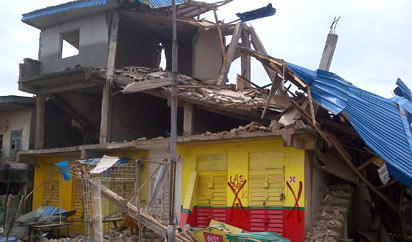
one of the buildings that collapsed in Lagos last few months
By Jude Njoku & Kingsley Adegboye
*Four down already
As relatives of those who died in the buildings which collapsed in Lagos last week, mourn the demise of their loved ones, there are fears that more rickety houses in the “Centre of Excellence” would take their turn sooner or later. This is because the Lagos landscape, especially the high density squalid neighbourhoods are littered with “coffins” which people live in as houses.
Although the frequency of building collapse in the country reduced in the dry season, no fewer than four houses have collapsed in the last one week and fears are rife that more rickety buildings may cave in with the rains peaking. Giving reasons why more buildings may still go down in Lagos and other parts of the country, built environment experts however called for strict enforcement of building regulations. They also want the Building Code to be given a legal teeth so that offenders would be appropriately sanctioned.
The President of Building Collapse Prevention Guild, BCPG, Mr. Kunle Awobodu, said rainfall comes with lateral and axial forces thereby compounding the weakness of an unstable structure.
Awobodu who is the National Publicity Secretary of the Nigerian Institute of Building, NIOB, added that during the rainy season, “we have a revelation of shoddy jobs by some developers”. He also listed faulty design, lack of comprehensive sub-soil investigation, quackery, use of substandard materials, poor workmanship, non-adherence to professional advice and greed as major reasons for the rising occurrence of buildings collapse in the country.

one of the buildings that collapsed in Lagos last week
“Nature is supreme. That is why in construction, we always take resistance of weather effect into priority. Also, we have eroding effect of some foundation areas with flash flooding which occurs in the low lying communities which can equally expose the weakness in foundations in such areas.
“From the onset, all these factors must be taken into consideration before embarking on construction of buildings. Poorly constructed buildings can further cause building collapse during rainy season. Occupants of such buildings will always see or notice signs of imminent collapse during rainy season. The advice to such occupants is that if they notice such signs, they should quickly alert the relevant government officials”, BCPG boss advised.
A Lagos-based Architect, Mr. Emeka Izuwah stated that although building collapse is not limited to the rainy season, he posited that rains heighten the risk of collapse. Buttressing this point, Mr. Izuwah said: “Water is often absorbed by exposed buildings thus weakening the building fabric and where this is unchecked over the years, it could have disastrous consequences”
He noted that the roof, because of its exposure to the elements, is often susceptible to threat of collapse. “The rains which are often accompanied by violent winds have capacity to uproot roofs, especially where the anchorage has become weak. In other to prevent such occurrences, roofs must be regularly maintained, roofing sheets and wood members of appropriate sizes should be well treated and replaced when their lifespan is exhausted.
“In this regard, the use of stone coated roofing sheets with concrete facia is most welcome as the anchorage system for this type of roof is very firm and can withstand the severest of storms. Every building material exposed to the elements must be regularly maintained to avoid decay which weakens the building fabric,” Izuwah, who is the CEO of Archiplex, a firm of Architects and Builders, said.
The experts also lamented that many private developers in Lagos are not safety conscious; they are only after maximising profits than ensuring that they use quality building materials. They are also guilty of not using the required quantity of materials, hence most houses built by these Shylock developers are defective right from the foundation works.
In a related development, Messrs ATNIG Lightning Protection Limited has advised property developers and owners to install rainstorm protectors in their structures. The firm said the prolonged impact of lightning on structures built without adequate protectors often leads to collapse of such structures. It noted that cracks on the walls of some buildings are primarily caused by the impact of lightning that usually accompanies rainstorms.
Managing Director of the firm, Mr. Babalola Olusanya, said at a recent forum in Lagos that the best protection against the weakening impact of lightning on buildings is to fix lightning conductors that would channel the effect to the earth.
“We all know of the recent collapse of buildings in this country and this was because some of these buildings did not have lightning protectors. So, the effects of the lightning weakened the structures and caused the eventual collapse of the affected structures.
“Cracks on the walls of some of these buildings were not mainly caused by structural defects, but by the intense effects of lighting strikes and that is why we are introducing protection solutions to guard against further loss of properties,” he added.
Olusanya listed some of the products that could be used to protect buildings against the adverse impacts of lightning and thunderstorm to include earth electrodes, inspection kits, conductors, ground enhancers and storm detectors.
Disclaimer
Comments expressed here do not reflect the opinions of Vanguard newspapers or any employee thereof.