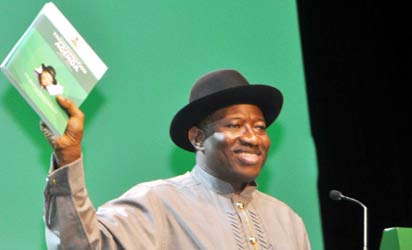
PRESIDENT GOODLUCK JONATHAN PRESENTING HIS ADMINISTRATIONS MID-TERM REPORT AT THE 2013 DEMOCRACY DAY CELEBRATION IN ABUJA ON WEDNESDAY (29/5/13). STATE HOUSE PHOTO
By Adisa Adeleye
In management parlance, a periodic appraisal is necessary to consider and compare the present position with the last one as a means of planning for the future. Therefore, it may be rewarding to assess the progress of the present administration from the time of its inception in 2011 to the present time. Some analysts might question the justification for judging a President half-way to the end of his term.
In fairness, a just appraisal should be on the ruling party in terms of its policy in respect of promises of political stability and economic prosperity. It is also true that President Jonathan is not the architect of the present state of political instability and that he could not be absolutely held responsible for large-scale unemployment and abject poverty in the country. This appear like inherited maladies.
Many apologists of the current President have stated clearly many times that the opposition and the cynics have been criticizing the man rather than the system. If the structure is deficient, the actor is just trying, in his own best way, to redeem what looks like ‘irredeemable situation’.
Political stability
It is true that the political stability of the country at present has been disturbed by the Boko Haram destructive insurgency which is now being firmly addressed by the military, as ordered by its Commander-in-Chief. Under the late President Yar’ardua, there was the Niger Delta Militants’ insurgency which was successfully ended, leading to amnesty being granted to the insurgents. Rebels under President Obasanjo in Odi(Bayelsa) and Zaki Biam(Benue) were not so lucky as they incurred the wrath of the military general, and not, peaceful, but a ‘bloody civilian’.

PRESIDENT GOODLUCK JONATHAN PRESENTING HIS ADMINISTRATIONS MID-TERM REPORT AT THE 2013 DEMOCRACY DAY CELEBRATION IN ABUJA ON WEDNESDAY (29/5/13). STATE HOUSE PHOTO
Within the last 14 years of civilian rule, (former President Obasanjo is treated as a civilian), Plateau and Ekiti states came under strict State of Emergency,with military administrators appointed. There is hope that the latest declaration of state of emergency in Borno, Yobe and Adamawa States(without military administrators) would be successful in bringing to an end Boko Haram insurgency and restore peace and prosperity to the affected areas and other parts of the country.
In the analysis of the past events, questions are being asked as to the suitability of the policies (or none) of the ruling party on political stability of the country and its security situation. In the unfortunate situation of no reliable or concrete policy, each leader is left on his own to adopt whatever action is deemed to be necessary and suitable for the occasion. Many precious lives have been lost through tough action, belated negotiation and slow reaction to dangerous events in the country.
It is widely recognized that Nigeria is a curious federation, and a complex one at that. “All federations are the consequences of the agreement among hitherto separate and independent states to form a national state under one central parliament and government, with individual states maintaining their sovereignty on a number of subjects agreed to be left to the states. Such was the position in the case of United States, Switzerland, Australia and Germany”, observed a political analyst. The military adventurers seemed to have turned Nigeria’s federation into a central administration, ruled by a Leader who could turn himself into a dictator, if he so wishes.
The country is lucky that President Jonathan is not a ‘bully’ at present, even if it appears that he does not brook any opposition among his supporters. However, what Nigeria needs is a return to true federalism and not the ‘doings and misdoings’ of the President in the discharge of his duties. The country would expect exceptional leadership with an extensive administrative capacity and imaginative grasp to provide political stability.
On the economic plane, it is convenient to argue that according to official sources, there has been a great success in achieving macro-economic stability. According to the Central Bank Governor, Sanusi Lamido Sanusi, after the last NPC Meeting, ‘in the final analysis, the Committee was convinced that in view of the successes achieved on all fronts-banking stability, low inflation, exchange rate stability, strong reserve buffers and the recovery in the equity market, there is no reason at this point to change a policy that has worked so well’.
What are the elegant statistical facts? Foreign exchange reserves at $49.13billion (14 months imports); Inflation rate of 9.1%; exchange rate of N159.50 to 1 US dollar; Monetary Policy Rate of 12% and GDP rate of 6.72%. Certainly, these figures are better than those woeful figures – the Inflation rate of 20% and GDP growth rate of 2.8% in 1999, of fourteen years ago. However, in 1999 foreign exchange reserves, totalled $5.4billion;average exchange rate was N92.3 to 1US dollar while inflation rate stood at 6.6%.
Also, there has been no observable change in increase in employment over the same period. From observation, it looks as if the Central Bank Governor, by his action and words will not shift ground on his tight monetary policy.
Even if the consequence of such a policy is notable decline in employment. Recently, at the risk Management Conference in Lagos, Mallam Sanusi Lamido Sanusi was quoted as saying, “the threat of inflation was still high in the economy, especially when government spending expected to increase in 2014 to 2015 due to elections”.
He added “so people should not look forward to low interest rate at a time of increase government spending”. The Central Bank Governor is so obsessed with the problem of inflation (rising prices) that he often forgets the damage of continuous “tight monetary policy” on the economy, especially mass unemployment.
The consequence of growing unemployment in a nation is far greater than that of slight increases in prices as Prof. Lipse once noted, “when resources lie idle, their potential output is lost forever. Unemployment for a long period can be a very degrading thing, indeed when an able bodied head of the household finds himself without work for a period of years the experience can be soul destroying”.
It stands to reason that there is no super magic by which an ailing economy can be rightly guided or suitably directed by the “classical economists” in the Central Bank and its Monetary Policy Committee.
Therefore, the less faith placed on tight monetary policy, the better it would be for advocates of full employment. To some observers, Mallam Sanusi Lamido Sanusi looks like a weird economist with jaded ideas on modern economic development.
Disclaimer
Comments expressed here do not reflect the opinions of Vanguard newspapers or any employee thereof.