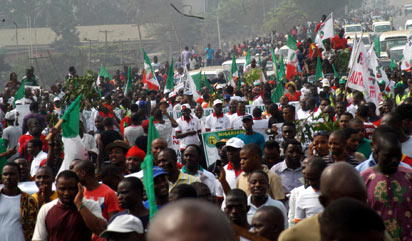
Protesters along Ikorodu Road in Lagos.
By VICTOR AHIUMA-YOUNG
WEDNESDAY, May 1, Nigerian workers celebrated the Workers’ Day like their counterparts across the globe, besides the United States of America, USA. For Nigerian workers, this year’s celebration was very significant because it was the last before the centenary celebration of Nigeria’s nationhood.
With the theme; “One Hundred Years of Nationhood: The Challenges of National Development”, Nigeria Labour Congress, NLC, and its Trade Union Congress of Nigeria, TUC, counterpart, used the occasion to reflect on the socio-economic and political developments in the country and lamented the misery workers and the masses have been subjected to.
The national addresses by NLC and TUC at the Eagle Square in Abuja, were dominated by issues of unemployment, poverty, ethnicity, corruption, insecurity, declining standard of education, decayed infrastructure, rights abuse, deprivations, erratic power, leadership failure among others that have characterized the Nigerian state.
Addressing workers and other guests including President Goodluck Jonathan, President of TUC, Peter Esele, praised Nigerian workers for enduring the vagaries and vicissitudes of national development, lamenting that the nation’s economy had impacted negatively on ordinary Nigerian in the past 100 years of nationhood.
He argued that the economic indicators as presented by government had not translated into better living standards for majority of Nigerians, but created few super rich.
According to Esele: “Since the beginning of this year, the Central Bank of Nigeria, CBN, has repeatedly told us that Nigeria’s nominal Gross Domestic Product ,GDP, is to reach $300 billion within the year, with an annual GDP growth rate of 7.03 percent mainly driven by the non-oil sector. This is very good news. But one cannot help but ask some pertinent questions. Which are the non-oil sectors that have purportedly contributed so much to our economy? We are now in the second quarter of the year.
“How far has the economic growth postulated by the CBN reflected in the life of the average Nigerian? How much extra naira has it put in our pockets? Has it provided more food on the table? How much impact has it had on housing, education, job creation, basic infrastructure, etc? Is it real or superficial? Is it the kind of growth that makes the rich richer and the poor poorer?
“For instance, we are yet to see the return of the companies that have divested from the Nigerian economy in recent years. When shall we attract them back? Is the government doing anything or enough in this direction? Our economy has not come to grips with the common man.
It has defied all logic. Does it mean that the hallowed developmental strategies that turned the Asians countries into economic tiger nations have no relevance in this country? For hundred years we have transformed virtually nothing.
Struggling to break even
“Over the years much of our infrastructure have collapsed. Many industries and business enterprises still struggle to break even due to the overly high overhead costs they incur on transportation, power generation, exorbitant demurrage at the ports, high exchange rate of the naira, multiple taxation, etc.
The manufacturing sector is worst hit by these negative factors which have resulted in capacity utilisation remaining abysmally low. Owing to these, the domestic economy has witnessed an unprecedented closure of factories and the unemployment profile has continued to rise.
“The relocation of several companies from Nigeria to Ghana and other countries is indicative that all is not well with our economy. The Bank of Ghana recently released a report that lists Nigeria as the 9th leading source of foreign direct investment in Ghana. The list of companies that relocated include Dunlop Nigeria Plc, Michelin, etc. And as they shut down their plants, they invariably laid off hundreds of their workers and put some on half pay.
Unemployment crisis: On his part, President of NLC, Abdulwaheed Omar, warned that the high rate of unemployment in the country posed serious danger to Nigeria’s stability and demanded decisive and immediate action to address it.
He said: “Official statistics put the national unemployment rate at approximately 24 per cent. As high as this rate is, it nevertheless camouflages the enormity of the unemployment crisis in the country. If unemployment and disguised unemployment were to be added to the figure, the monumental crisis will become more glaring.
With an estimated 80 million youths in the total population,30 to 40 million unemployed youths constitute a veritable army of the hungry, disillusioned and an angry that can undermine the stability, security and peace of any nation if left unattended. There is an urgent need for decisive intervention to rein in the unemployment problem. The signal of strife and insecurity today are warning banners we cannot afford to ignore.
“To overcome the problem of unemployment, Nigeria must promote strong industrial policies that recognize manufacturing as a key engine of growth and decent mass employment for the national economy. The federal government must urgently initiate a range of measures to revive and project labour-intensive industries like textiles, food and beverages, construction, iron and steel sectors, and others.”
The NLC President who also spoke on the dangers posed to the nation’s stability by increasing insecurity, corruption among others, added however, added “as we commence the process of stock taking of nation building since the amalgamation of 1914, let us all commit to building a united, just and egalitarian nation.
Disclaimer
Comments expressed here do not reflect the opinions of Vanguard newspapers or any employee thereof.