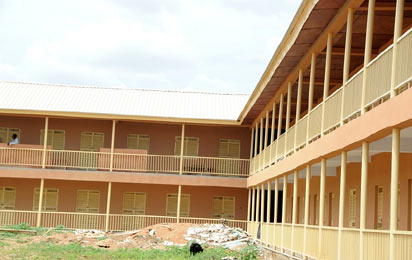
*One of the new model schools built by the state government
By Bisi Lawrence
Jonathan Olatunde Lawrence was a born intellectual. He was blessed with a high capacity for original thinking and the acquisition of knowledge. He was therefore outstanding in almost all his endeavours.
He found music easy where others strove to acquire the art. He was an artist who could have made painting his profession. In sports, he was the captain of his school’s tennis team, one of the best swimmers of his days, and a member of the cricket eleven.
He was even a King’s Scout, when that attainment was considered an achievement of a high degree. And though he had little time for athletics in the secondary school, he made up for that by featuring prominently for Oxford University where he graduated in Nuclear Physics as the first African to ever have the qualification.
He had earlier done the Pre-medical first degree in Liverpool University, and it was at a time when the prodigious potentials of nuclear energy were being explored for various functions including medicine.
So he was invited, at the instance of his professor, to join the research team of the St. Bartholomew’s Hospital for the Blind which had taken an enthusiastic role in the effort to bend the powers of nuclear energy to the aid of relief for the sightless. For two years he worked as a researcher, and he became well known to the extent that Dr. Kwameh Nkrumah, the President of Ghana, eagerly invited him to come and start a research centre in Ghana.
It was during the interview in Ghana that it occurred to him that he might as well do just that in his own country, Nigeria. That was how he left a brilliant future in the attempt to bring honour to his nation.
But he did not find the government of the day to be on the same page with him. In stead of returning to Britain, however, he decided to teach and, since there was no university that had a department of Nuclear Physics, he opted for his old school, the CMS Grammar School, where he taught secondary school physics. He found himself on familiar grounds, having taught the same subject at the Ondo Boys’ High School, years earlier before going overseas.
Although he was very popular with the pupils at the CMSGS, the authorities at his alma mater seemed uncomfortable with his methods which tended to revolutionise some educational theories, especially as they pertained to self-reliance, and so he reluctantly left for King’s College, Lagos. The coast was clearer here, but the old prejudices still wore hard. At that point, he recognized that he was probably ahead of his time. So he abandoned teaching, albeit temporarily, and took to land survey albeit as a civil servant. He thereby acquired some useful knowledge about various vacant pieces real estate in Lagos, which came in good stead when he was later to search for land for the establishment of Gaskiya College.
But before all that, he had taught in Kwara State, and also at Imade College in Owo, Ondo State, and gathered a lot of invaluable experience to develop what he wished to accomplish in education for the country. It was at City College, Lagos, however, that he eventually founded a kindred spirit — a visionary and missionary, in Dr. Nnamdi Azikiwe who was the proprietor of the Lagos City College. They had a number of attributes in common. They were sportsmen, fine intellectuals, men of great resourcefulness and refined intelligence. Dr. Azikiwe encouraged him to experiment with the tutorial system in imparting knowledge to the students, and was highly impressed with the results. But the politician had to answer the call of patriotism ‘at a higher level, and so left City College which fell into hands of a board that unfortunately neither could appreciate what the fine points of the new methods were, nor understand why they were found necessary anyway.
It was at that point that Olatunde Lawrence decided to make his own history.
But it was still not for himself, but for his country and those who represented its future. So he called the name of the institution, GASKIYA COLLEGE. Alhaji Tafawa Balewa was Prime Minister then, and the detractors reared up their heads saying the name indicated a sell-out to the Northerners who were in control of the Federal Government. But nothing could be further from the truth. Olatunde Lawrence was not just a “detribalised” Nigerian; he was never “tribalised” in the first place. The school he attended, the community in which he grew up, even his parentage which was of mixed Yoruba and Edo components had deprived him of any affiliation to an ethnic group.
The truth is that the word, “Gaskiya”, which is of Hausa origin and means “truth”, but had been adopted into popular usage within the Yoruba community, was a word which crept into the normal speech of his father, Chief John Ojo Lawrence, who “swore” by the truth with every breath and became famous for it. It was a quality he admired in his father and naturally made both the word and its meaning a beacon in his path through life. And he enshrined firm discipline in the establishment underlying his educational concepts.
Gaskiya College was founded in Yaba first, as a Nigerian school; the uniform was therefore designed with a Nigerian motif Second, it was of a liberal scope which had no religious bias for its population but was inclined to Christianity, the faith of the founder. Third, it was to adopt the tutorial method of teaching, the impartation being based on exercises and assignments which gave the pupil a complete control of the assimilation of instruction and knowledge; not all the teachers even welcomed it.
The school was also an institution which encouraged a healthy relationship between boys and girls with the consciousness of gender differences and respect. It was eventually moved to the present site when its proximity to a sophisticated government institution tended to show off the pretentiousness of the educational system, which persists to this day, but is seldom openly challenged.
For instance, it happened that Gaskiya College trounced a government institution in a radio quiz — which was subsequently cancelled for no explicit reason. Of course, Gaskiya withdrew from a proposed rematch. That was the quality of the college in those days.
But the venture was not confined to Nigeria. The position of Nigeria in Africa and, in fact, the rest of the world, has always advised that the education be strongly founded on a bi-lingual philosophy —specifically, English and French.
The fragile attempts made at teaching the French language were simply inadequate. It could have changed significantly over the years, had the system of Gaskiya education been allowed to flourished. It was based on sister schools in Nigeria and a French-speaking country with the inter-change of pupils over a three-year framework.
The products were truly.’ bi-lingual in every sense of the word, and the system achieved a remarkable degree of success. But the officials of the’ Ministry of Education stopped the granting of visa requirements which frustrated the plan. For their own reasons.
Likewise, the idea of a private university played a major role in the thinking behind the acquisition of the college. But the idea was discouraged almost to the point of criminalizing it before it was dropped. The other forward-looking educationists who were at the vanguard of the movement can now only shake their heads in disappointment — if they are still alive.
But Olatunde Lawrence, though no longer with us, is still lives amongst us. He gave his state a school it can be proud of, and gave that name to the street on which it is built. The school actually built the street; the founder’s name would have been given to it, but he demurred. As long as the school is alive, he was sure he would have survived the passage of time. And so, as Gaskiya College celebrates her fiftieth anniversary, he is still here today.
He was indeed, a visionary and a missionary. Those who see beyond the confines of the horizon and dare to turn imaginative prospects into reality, continue to live in the inspiration they bestow on life and bequeath to generations after them. They live on and on.
Time out.
Disclaimer
Comments expressed here do not reflect the opinions of Vanguard newspapers or any employee thereof.