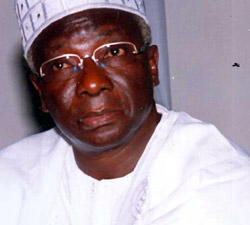
…Asiodu
Chief Philip Asiodu, CON, delivered this paper at the international conference of the Nigerian Association for Energy economics in Lagos
IT is very interesting that the Nigerian Association For Energy Economics is holding this International Conference at this time when the Federal Government and the National Assembly are still far from concluding the discussions and negotiations on the Petroleum Industries Bill which was submitted to the National Assembly in 2008.

…Asiodu
We should note that consultations and the process of preparing the Bill started as long ago as year 2000. The intention with the PIB is to create with a single legislation the basis for regulating more efficiently all aspects of the oil and gas industry in Nigeria.
A Federal Government publication in 2009 states that it is meant to “combine 16 different Nigerian petroleum laws in a single transparent and coherent document”. It adds for good measure that “This is the first time that such a large-scale consolidation has happened anywhere in the world.”
The PIB is meant to ensure improved revenues for Nigeria while at the same time keeping Nigeria internationally competitive and attractive to investors in upstream and downstream sectors of the industry. It is a sad fact, and we shall return to this later, that many important decisions have been held up for more than a decade and some major investments consequently diverted to other countries. Equally tragic for our economic development and diversification, the urgently needed reform and restructuring of the Power Sector has dragged on for more than a decade. For reasons which will soon be clear I propose to deal mainly with the management of our Energy Resources rather than attempt a comparative assessment of situations in federal systems generally.
The long delays are not caused by federal versus state government relations: The delays in formulating and administering Oil and Gas Policy, or a National Energy Policy for the power sector so necessary for driving economic growth and development in Nigeria at a rate commensurate with our tremendous resource endowments have not been caused by disputes between the Federal and the State Governments. As far back as 1944, the Colonial Government promulgated the Minerals Ordinance which decreed that all subsurface rights and all minerals in Nigeria belong to the Central, later Federal Government.
This has been carried in all Constitutions of Nigeria even after Independence. The expression Nigeria includes areas under territorial waters, and the 200km offshore exclusive economic zone. Our current 1999 Constitution assigns matters relating to “mines and minerals, including oil fields, oil mining, geological surveys” to the Exclusive Federal Legislative List.
The problems encountered in some other federations where mineral rights may belong to individual landowners, or where legislation on minerals are state responsibilities, and where the Central Government has to negotiate carefully interstate transportation and trade in oil and gas and other matters relating to international trade in minerals have not arisen in Nigeria. The demand by oil-producing communities for greater allocation to them of revenues from the exploitation of oil and gas is to compensate for environmental degradation and to accelerate economic development of their areas.
Ownership of subsurface rights
There has been no orchestrated demand for constitutional revision of ownership of subsurface rights. These issues have centred around the poor administration and poor results from the activities of the various bodies established from 1960 onwards to ameliorate the economic conditions in the Region such as the Niger Delta Development Commission, OMPADEC, NDDC. It is also very interesting that the world is at the beginning of a new chapter in the history of global oil and gas trade.
With the new technological advances in the production of shale oil and gas, there is now the prospect within the decade of North American and US self-sufficiency in energy supplies and the transition of the US from net-importer to net-exporter. This will mean new challenges for Nigerian exporters of oil and gas. Already during the past four years, Nigerian exports to the US declined by 70% and may cease by 2015.
Moreover, there are new discoveries in West Africa and elsewhere in Africa. The new entrants will be eager for development and will offer attractive terms and incentives against which Nigeria must compete. With the benefit of hindsight, we shall soon discover that the country suffered very costly losses of revenues over the past decades of delays and policy reversals in the management of our oil and energy resources. Some of the critical issues which have remained unresolved for years include :(i) Underfunding of Joint Ventures of NNPC and IOCs, the Government persistently failing to meet its CAPEX and OPEX funding obligations.
This has impacted negatively on the replenishment of reserves, on daily production, and on the balance between onshore and shallow water production vis a viz deepwater production in favour of the latter from which, for now, lesser government revenues are derived. It has been estimated the “loss” incurred from the actual production from 2007 – 2012 which hovered around 2.2 million barrels a day as against possible planned production of from 2 million to 3.6 million barrels a day at over US$100 billion.
Failure to agree on appropriate pricing for gas: There can be no valid excuse for the failure over the past two decades to agree on pricing which would have led to the much needed development of gas reserves to fuel the Power Sector and gas-utilizing fertilizer and petrochemical industries. Many promoters of excellent viable projects based on gas have negotiated with the NNPC and the Government for more than 10 years to no avail. This has been disastrous for economic development. It has been bad for the environment as cut-off dates for gas flaring have been postponed continuously. The consequences for overall enabling environment for investment and ease of doing business in Nigeria have been very negative.
Refineries and marketing of petroleum products: It is a national shame that Nigeria with all the manpower available locally and in diaspora cannot maintain and operate petroleum refineries properly and that we have had to rely on imports for the bulk of petroleum products consumed locally. The simple reasons for this situation are corruption and crude unpatriotic political interference in the management of the refineries and in the selection and deployment of personnel in the NNPC.
I can only recall with much regret that by August 1993, towards the end of the Transitional Council, although, they were all initially reluctant, agreements had been reached with three international oil companies to take over the three refineries in Nigeria, conduct technical and management audits and indicate what must be done on the basis of their findings and to modernize, restructure, retrain staff as necessary and to operate the three refinery complexes for a period of 18 months at normal international standards of efficiency. At the expiration of 18 months, the refineries would be privatized with the Government retaining a minority interest.
Disclaimer
Comments expressed here do not reflect the opinions of Vanguard newspapers or any employee thereof.