By Kayode Ajala & Lekan Olaosebikan
Senate Leader Victor Ndoma-Egba says there is nowhere in the Constitution that the democratically elected structures should be dissolved under emergency rule, pointing out that the dissolution in past dispensation was unconstitutional. Excerpts of interview:
Some people are of the view that the emergency rule in the three states of the North is a bit late in coming considering the impact on the nation’s sovereignty.
The current security situation in the country is not something that would have been exactly predicted. Terrorism as a phenomenon globally has thrown up a new challenge; so every nation ordinarily should anticipate and prepare for it, but I am not sure that, in Nigeria, we expected this dimension of terrorism. So, to us, it is something novel and, when you are handling something new, you try to come up with strategies that will address the situation, but, clearly, the routine strategies that we employed were no longer working. So it is difficult to say it is timely or untimely, but what I can categorically say is that the time has come for a change in strategy and a change in tactic. We sent three committees to Baga, they have not submitted their reports formally; but they have informally briefed us, a situation where 10 local governments are already lost to the insurgent, suggests that something dramatic, something extra-ordinary should be done. If you look at the provisions of our constitution, the term extraordinary was used only once and that is in section 305, so the time has come for us to apply extra ordinary measure. I will not say that it is late.
We had coordinated bombings ofmind-boggling magnitude in Kano twice; could we say that the situation now amounts to something extraordinary?
The moment they took insurgency to the level of taking over completely 10 local governments, hoisting their flag, and even attempting to install their own government, it became a worrying sign that something different had to be done.
The president seems to be under tremendous pressure…..
When you aspire to be president, you are taking the whole burden of the entire country; every nation has its own problems in different dimensions and it is just one thing where the buck stops, that is the table of the president. The fact that you are president does not mean that you will experience only some problems, you still have local, national and international problems. Those problems will be there and what makes you the president and chief executive is that you are expected to be the one to solve the problems, and, as president, you ought to have the capacity to solve them.
Some people think this type of emergency rule with the democratic structure in place may not be wise. Do you think it could have been done otherwise without prejudice to what we have experienced before?
In the previous experience of emergency rule, elected structures were dissolved, that was clearly unconstitutional. I remember when emergency rule was declared in my first time in the Senate, some of us said the constitution does not contemplate the dissolution of the elected structures. Section 305 of the constitution provides for emergency rule and gives power to the executive and the National Assembly to deliberate on it; it does not, in any way, provide, envisage or contemplate the dissolution of the elected structures; it does not say governor or elected members should go. Now, when you talk of elected institutions, it is either the governor or legislators; the constitution, in a separate provision. describes how their offices can come to an end. So, there is nowhere in Section 305 that an additional provision is made on the removal of the governor or dissolution of the House of Assembly, which means that you are bound by the provision that the constitution made for their termination or removal. So, removal of a governor or dissolution of the House of Assembly is not in Section 305. If we did it in the past, it was unconstitutional.

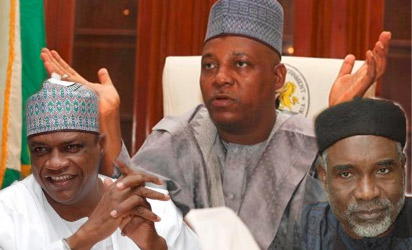
*Ndoma Egba
How do you rationalise the spirit of emergency declaration when the chief executives of the state are in place?
What is the impact of the state of emergency in our constitution? The impact is that certain freedom is curtailed: freedom of association, of movement, of speech, that you can be detained for a certain period; beyond that, you must go to court. That is the freedom that is affected? And why is freedom affected? Because for you to address freedom, to some extent, has to be curtailed for security agencies to do what they have to do effectively, and the security agencies, for the purpose of the state of emergency, may work with the governor in the state, but do not necessarily have to work with him, because it is basically a military operation and the governor has nothing to do with military operation. State of emergency provides the atmosphere for the military to operate.
In terms of funding, will come under budgetary or extra budgetary?
If the president needs more funds than what he can find in the budget, he will come to the National Assembly and, I believe, we will help because the issue of insecurity is perhaps the most significant issue today in our polity
So it is expected that the president will need support…
Definitely, the National Assembly will give Mr. President every support to bring this challenge under control.
48 hours after the president’s declaration, the National Assembly did not ratify the emergency declaration.
There is no provision in the constitution that says the president should publish the declaration. Section 305 of the constitution says (reading it): “ Subject to the provisions of this constitution, the President may by instrument published in the official gazette of the government of the federation issue a proclamation of a state of emergency in the federation or any part thereof”. The president’s broadcast was not a proclamation constitutionally. Until that gazette was issued, the president’s broadcast remained a statement of intent to declare a state of emergency. What he told Nigerians was his intention to declare a state of emergency. The emergency becomes effective when it is published in the official gazette, which is when the state of emergency takes effect. Let us see subsection 6; it says (reading it)”: A proclamation issued by the President under this section shall cease to have effect: (a) if it is revoked by the President by instrument published in the official gazette of the government of the federation; (b) If it affects the federation or any part thereof and within two days when the National assembly is in session, or within 10 days when the National Assembly is not in session, after its publication, there is no resolution supported by two-thirds majority of all members of each house of the National assembly approving the proclamation”. In fact, the constitution does not say that the president should make a broadcast, it says when he issues an instrument published in the official gazette. So it is when that gazette is published, then the two days or the ten days as the case may be become applicable.
Even the operational word “may by instrument”, does it confer sacro-sanctity on the action?
What it means is that it may or may not proclaim the emergency rule.
Management of emergency with the democratic structure in place.
That is what I have been explaining to you. It is a military operation. Whatever operation they want to carry out will not be carried out in every part of the state affected. They are just few locations.
Let’s talk about the challenges faced by the Senate.
The Senate is 14 years old. We have issues of institutional memory, because parliament is a very peculiar body. You take the normal capacity challenges of a 14-year-old institution, compounded by a massive loss of institutional memory, by a high turn over of senators. In the USA that we say we are fashioning our democracy after, before a senator loses an election, he must have done somethnig unforgiveable. Now in our 14-year history as a Senate, it is only two senators that have 14 years experience; that is, between 1999 and today, the Senate has lost 107 senators, the two are Senator David Mark and the Chief Whip, Senator Bello Gwarzo. And the Senate is a peculiar institution where institutional memory is the aggregated memory of individual senators and experience.
In the US, there are bills that are years old and they are not dead because the US Senate is never dissolved, but, in Nigeria, the Senate is dissolved every four years; and when dissolved, nothing survives; even bills that are here stand dissolved, everything has to start afresh. This is a major constitutional challenge. One, you have loss of memory; two, even if a committee was at the point of concluding an assignment, both the committee, its membership and its work all stand dissolved at the end of four years
This constitutional challenge, is it part of the constitution amendment that is going on?
We can’t just amend the dissolution aspect; you also have to agree on tenure, that is the only way to ensure continuity. You also have to agree on staggered election.
Many people believe the Senate can do a lot more than it is currently doing.
Yes, we could achieve more. The problems we have in this country are not what we could solve in quick fixes. Most of the problems have their origin almost in antiquity. Take the power sector, over 20 years, there was no investment in that sector. And the facilities are not self-renewable; so the facilities are old as there was no new investment in the sector. This government now inherited a problem that has been there that took 20 years to accumulate and we expect it to be fixed overnight. The security challenge did not start today, it did not start yesterday, it started when the contradictions in our polity were suppressed rather than negotiated. For almost 30 years of military rule, the contradictions were held down by the jackboot, they were never discussed. These are contradictions that ought to have been negotiated through a tedious process; when they now came up, people now think they can be fixed overnight. Take infrastructure, for instance, the roads did not get bad overnight , ditto education, the collapse of values did not happen overnight. We will be lucky if they are fixed in a generation. We should stop this scapegoatism and escapetism of the PDP. Some of the problems unfortunately may survive PDP. We pray they don’t.
Disclaimer
Comments expressed here do not reflect the opinions of Vanguard newspapers or any employee thereof.