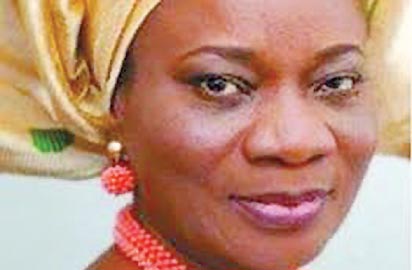
*Prof Modupe Adelabu
By Morenike Taire
Nigeria was heartbroken when the news of the demise of erstwhile Ekiti State deputy governor Eunice Oluwafunmilayo Adunni Olayinka, also fondly referred to as Moremi. It sparked a whole new spate of awareness about breast cancer, the monster that claimed the life of the quiet beauty, and about her successor, who would have to comfort her electorate as well as her teeming fans.
The unenviable lady that the role has been thrust upon is Prof Modupe Adelabu, , but it would appear Ekiti’s Kayode Fayemi is no stranger to titanic women, with First Lady Bisi Fayemi being one herself.
Prof Adelabu was born on May 23, 1950 in Ado Ekiti to Prince and Mrs. Samuel Adepoju Adejugbe. She attended Christ’s School, Ado-Ekiti (1962 – 1967) and Olivet Baptist High School, Oyo (1968 -1970). She holds a B.A. (Ed) ; MPhil ; and PhD, all from the Obafemi Awolowo University (OAU), Ile- Ife.
She started her teaching career as a Graduate Assistant in 1976 in the Department of Educational Administration and Planning , OAU, where she rose to the post of Professor in 2008. It turns out being a local princess is the least of her qualifications.
She had been the Head of the Department of Educational Administration and Planning of the Obafemi Awolowo University, Ile-Ife when the governor had first asked her to be his deputy , an offer she’d reportedly turned down due to the ill health of her husband.
She was later appointed chairman of the State Universal Basic Education Board, SUBEB. The new deputy governor has also served as a resource person for the United Nations Development Programme, UNDP; United Nations Children’s Fund, UNICEF; and United Nations Educational, Scientific and Cultural Organisation, UNESCO, on numerous issues bordering on education.
She has also been involved in consultancy work for the Universal Basic Education Commission in Nigeria as well as being part of the 15-member Education Reform Panel that worked assiduously on Ekiti State government’s reforms in the education sector.

*Prof Modupe Adelabu
Adelabu, who has consulted for the World Bank, the United Kingdom’s Department for International Development (DFID) and other international agencies, was also a foundation member of Board of Ekiti State World Bank Assisted Poverty Reduction Agency. She has also been involved in consultancy work for the Universal Basic Education Commission in Nigeria.
Her appointment has been described by party (ACN) enthusiasts as “a win-win strategy designed to inflict maximum punishment on the rancorous opposition in the state”.
Oshotimeyin, Gates, Lead at ‘Women Deliver’
As Girls’ & Women’s Health and Rights are in Focus at Women Deliver 2013 in Kuala Lumpur, while World Bank and Guttmacher Institute release new data on the value of investing in girls and women
Tuesday more than 4,000 global leaders and advocates from nearly 150 countries gathered in Kuala Lumpur, Malaysia, for Women Deliver 2013, the largest conference of the decade focused on the health and wellbeing of girls and women. The opening sessions of this three-day event highlighted the critical need to invest in girls and women to spur development worldwide.
The second day had global leaders announcing progress and new commitments toward expanding contraceptive access for women in developing countries. They also outlined plans for sustaining this momentum in the years to come.
The day’s events built on commitments and energy generated at the landmark July 2012 London Summit on Family Planning, where global leaders pledged more than US $2.6 billion to provide 120 million more women and girls in the world’s poorest countries with voluntary access to contraceptive services, information and supplies by 2020. Speakers at Women Deliver 2013 discussed strategies to reach women and girls in developing countries who do not want to become pregnant, but lack access to contraceptives.
“Putting women at the center of development and delivering solutions that meet their needs will result in huge improvements in health, prosperity and quality of life,” said Bill & Melinda Gates Foundation Co-Chair Melinda Gates. “When women have access to contraceptives they’re healthier, their children are healthier, and their families thrive.
At the morning plenary session led by Melinda Gates and United Nations Population Fund (UNFPA) Executive Director and Family Planning 2020 (FP2020) Co-Chair
Babatunde Osotimehin—government leaders from Africa and Asia highlighted concrete examples of progress on family planning and reaffirmed commitments to further expanding contraceptive access:
Senegal’s Minister of Health Dr. Awa Coll-Seck discussed the country’s dramatic progress in eliminating contraceptive stock-outs since the national family planning program’s roll-out in November 2012, doubling the budget to CFA 200 million with plans for further increases in 2013.
The First Lady of Zambia, Her Excellency Dr. Christine Kaseba-Sata, highlighted Zambia’s stalwart commitment to expanding family planning access in the country, which launched its national family planning program last month;?Indonesia’s Minister of Health Dr. Nafsiah Mboi announced the government’s increase in funding for long-acting reversible contraceptives, as part of its redoubled efforts to regain momentum on family planning access after recent plateaus.
National Coordinator for Malawi’s Safe Motherhood Initiative, Mrs. Dorothy Ngoma, discussed the government’s efforts to considerably strengthen the family planning component of safe motherhood efforts countrywide
“These countries show that we can make an impact on women’s access to reproductive health if we rally the necessary political will and financial commitments,” said Dr. Babatunde Osotimehin. “Expanding access to contraceptives is one of the simplest and most cost-effective ways to save lives and ensure the health and wellbeing of future generations.”
Women Deliver is a global advocacy organization that brings together voices from around the world to call for improved health and wellbeing for girls and women. Launched in 2007, Women Deliver works globally to generate political commitment and financial investment for fulfilling Millennium Development Goal #5—to reduce maternal mortality and achieve universal access to reproductive health.
Building from the groundbreaking conferences Women Deliver convened in 2007 and 2010, Women Deliver harnesses commitments, partnerships and networks to help prevent the approximately 350,000 deaths of girls and women from pregnancy- and childbirth-related causes that occur every year. Women Deliver’s message is that maternal health is both a human right and a practical necessity for sustainable development. Invest in women—it pays.
Snip off the Years
Tips to dressing 10 years younger
Unknown to many women, dressing younger does not entail dressing like a teenager or a hooker. Wearing micro miniskirts, ripped jeans and tight tees is not going to make you look younger. On the contrary, it often shows the loopholes and dates you more than you were dated before. Dressing younger is a fine art, and you might want to take a tip or three.
Watch your make up
Go easy on your make up once you hit the 30 mark. The older you are, the lighter your make up ought to be. Ignore those artists who tell you you can cover your flaws with concealers. Go easy on concealers and pancake and put more emphasis on your cheekbones and eyelashes.
Use cream blush rather than powder and splash out on mascara. The same goes for the hair. Ditch the Cindy Crawford mane and pay more attention to your own hair. Keep it smooth and sleek and colour it or get highlights for that shiny look. Another essential is to have your eyebrows always plucked to perfection for that groomed-within-an-inch… look.
If you are in your late 20s and over, you are pushing it on four inch high heels. Go rather for three inches, if you will, and block heels rather than stilettos. Better still, play with the classic look with kitten heels which, if well chosen and well worn, can be very, very sexy on women of any age.
Colours
On the other hand women tend to dump colours the older they get. There’s absolutely nothing wrong with colours, bright colours. Simply avoid over the top neons though. Wearing bright colours can mean you can wear less make up, so it’s a win-win situation.
Shapes
Classics are good, but they have no business being drab. A shapeless bell blouse might not be exactly what you need, but for some reason, it seems more ‘age appropriate’.
Just wearing something that really nips you in at the waist can give you curves in all the right places and a much more youthful silhouette. Conning the observer by playing tricks with your tailoring might be the most useful skill you might ever pick up.
Accessories are a Girl’s best Friends
To put classy into the equation, accessories are always on point . We don’t all have the money to throw out our clothes at the end of each season but everyone can update their accessories. Gold jewellery and patent leather were big last season but now it’s all about wedges, big bags and big sunglasses.
Invest in any of these trends and you can instantly update your jeans and shirts without breaking the bank. Pick an accessory style you’re comfortable with that works for you and run with it. One key focal piece is best, with a few other accessories worked around it.
Disclaimer
Comments expressed here do not reflect the opinions of Vanguard newspapers or any employee thereof.