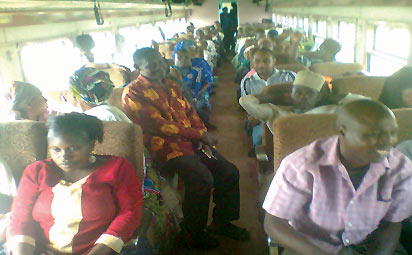
*Passengers in one of the coaches
In the first part of this report, JONAH NWOKPOKU noted that not only did the train which moved from Iddo at noon develop faults at Ijoko and Ibadan, but it didn’t wait up to 10 minutes at Jebba although 85 per cent of the passengers were still on the ground.
PASSENGERS ran helter-skelter, trying to gain entry through any available nearest entrance. Unfortunately, because the entrance doors were but small spaces, many people who rushed to enter at the same time could not gain access. Eventually, most passengers found their way in but chances remained that some passengers were left behind especially some elderly passengers who couldn’t run after the train. The train left Minna by 3:00 pm after waiting about thirty minutes. Its next stop would be at Kaduna and it berthed at that crocodile city by 7:00 pm.
Ayola who sat next to me and headed to Zaria told me she would alight. She said it is uncertain when the train would get to Zaria and he wouldn’t want to get stranded at Zaria since chances are she would not see a motorcycle or a cab if she arrived late. So she handed her ticket to me and alighted.
That proved to be a wise decision as the engine went bad again there in Kaduna. We spent another two hours there as the engineers rallied round to fix the problem. The engine got fixed around 9:00 pm and eventually got to Zaria by 11:00 pm. We railed into Kano by 2:55 am on Sunday morning, at about thirty nine hours after we left Lagos.
However, when I came down, I realised that the train had grown longer. It had added four more wagons along the way and that may have accounted for the sluggish movement all along.
The ticket checkers: Shortly after we cruised out of Abeokuta, a group of young men came into the coaches and began to demand for tickets from all the passengers. This was to become a tradition until we got to Kano. Each passenger stretched out his or her ticket to them and they marked it by digging a hole in it with a sharp punching machine.
It was then I realised that every luggage that got into the train was paid for. The size of the luggage was irrelevant. Those who were not charged for their luggage at the point of entry were charged onboard and a paper receipt with a hole dug in it was issued. There were a retinue of them and they handled the checks like campaigns.

*Passengers in one of the coaches
At every hour, a group of five young men accompanied by at least a Man O War security and a mobile policeman with an AK 47 rifle, surfaced to check the tickets. They could come anytime they wished. There was no designated time for ticket checks. Sometimes they came when everyone was asleep and guess how they woke people up?
They slapped you on the head and when you look at them, you simply hear ‘ticket’. If a passenger had lost a ticket, extra money was paid after negotiations and a paper receipt was issued and in some instances no receipts at all.
Exorbitant prices
The checkers, however, seemed keener on the luggage receipts. Most of the luggages were not paid for at the stations but onboard. And they charged exorbitant prices, most times more than the ticket fare.
Ibrahim was travelling to Zaria. He had some goods contained in a 10kg sack. He paid four hundred naira at Iddo for the load but was issued no receipts. So, at Osogbo, the ticket checkers came and demanded for his receipt and when he could not provide it they charged him one thousand, eight hundred naira.
The Zaria ticket Ibrahim had was worth one thousand, seven hundred naira only. He told them that he didn’t demand for a receipt because he didn’t know he was supposed to be issued with a receipt since that was his first time. But they paid no attention to whatever explanation he gave but seized his ticket and threatened to throw him out at the next station.
He caved in and parted with another three hundred naira which they collected and pocketed without issuing him a receipt. It was not over for him yet. When we got to Akere station in Niger state, another group of checkers came again and confronted him. This time they wasted no time in seizing his ticket but the passengers that were around intervened and made sure he was given back his ticket by bearing witness that he had paid for the goods.
Bolaji was headed to Kaduna from Osogbo. He realised he could not find his ticket immediately he got onboard. He said he didn’t want any embarrassment, so he paid additional one thousand naira. His original ticket was worth one thousand, fifty naira only. In sum, a lot of money was made on the way but whether this money is accounted for remains disputable.
Abandoned trains: Prominent features of all the railway stations from the Iddo terminus all the way to Kano were the abandoned coaches, relics of the once thriving Nigeria railway. There were carriages, goods wagons, passenger coaches, and some rusty engines abandoned on the platforms. One of the passengers who was most worried with this was Wale Moshood, a graduate of Accountancy, Lagos State University, who joined the train from Lagos to Kano.
Epitome of a grounded economy
He described it as a monumental waste and an epitome of a grounded economy. “This is not a way forward for Nigeria. I want to say something to the Federal Government. There is a waste of resources going on. There is money in this country and we can’t see it. We are just a little over one hundred and sixty million and we are suffering, despite the abundant resources at our disposal.
“From where we took off from Lagos to Kano here, I discovered one thing, there are so many abandoned coaches, there are trains that got accident and were pushed into the bush and there are some rails stockpiled along the way and abandoned. These rail properties are depreciating in quality and they could be very useful to our construction industry.
“Government is talking about unemployment, let them contract the evacuation of these rail materials to any company; that will provide employment opportunity to the youths because the evacuation would not take anything less than three years.” He said.
Vanguard had recently reported on the abandoned coaches and how people had converted some of the coaches to living apartments thereby threatening the safety of the terminus at Iddo. When the authority of the Nigeria Railway Corporation was contacted on what they were doing about the abandoned coaches, the Assistant Public Relations Officer of the corporation, Mr. David Ndanusa, who admitted that some people lived in the coaches noted that NRC is gradually evacuating the coaches through refurbishment. He also said that those that could not be refurbished will be turned into scraps.
“The refurbishment of coaches is going on now according to how funds are released to us and that is going on stage by stage. Those that cannot be refurbished will be turned to scraps. We are waiting for the availability of funds from the government so that we can move more of them into the workshop for repair.” He had said.
However, with the situation on ground nationwide, it remains to be ascertained if that was an official position as chances are that the authority may be having little or no plans for the abandoned coaches yet.
The uneventful return: The return train was to depart from Kano by 9:00 am on Monday. I had decided to return with a first class in order to have balanced view of the entire experience. The first class coaches were just four, containing about two hundred and forty people. Each contained sixty passengers only.
There were two first class seaters and two first class sleepers. Cubicles containing beds were built into the sleeper coaches. It looked quite comfortable. The seaters were supposed to have an air conditioning and television sets. But only one had an air conditioning and another a television set.
There was order in the coaches as there were security men guarding the entrances to forestall uncoordinated entries that characterized the economy class coaches. But then it still had its shortcomings. The coaches looked unkempt and few minutes after I sat down, I saw a giant oak-coloured bedbug crawling on my black jeans trouser.
Other passengers noticed and complained as well but an electrical staff who came there said the job of keeping the trains clean had been contracted out and that NRC is not to blame. The contractors, he noted did not really do a thorough job but only swept it at the end of the journey.
However, it still remained a huge contrast between the economy class coaches. The greatest challenge of the passengers in the first class coach was that the cold air that spewed from the air conditioning was excessive. This revealed the infamous widening gap between the rich and the poor in the nation.
The passengers in the two classes of coaches were a world apart. The only thing that connected them was that one locomotive pulled them, outside that, they appeared a thousand miles from each other. At the period that the passengers in the first class feared that they could catch pneumonia from the cold of AC, the heat emitting from the economy class coaches could bake bread.
Onboard I met so many regular users of the rail around 1980s before it finally packed up. One of them was a forty-five year old business man, Ibrahim Bello. He told me he extensively travelled by rail even as a child but at the moment he said, the services are but a copy of the prototype of what the railway used to be. He expressed concerns with the current management, saying the railway may die again if the current management state is not improved upon.
“That time journey by rail used to be fun, there is film and music, whether first class or second class but now it’s only the first class. But with the way the second class is now, they just need to increase management efficiency. They should also try to increase the maintenance of the trains. The congestion is not funny.
“For instance by the time I travelled last week, when I came, there was no place for me to sit and I had to sit close to the toilet. When I complained, they asked me how I would feel if I was told that there was no train and honestly it would be somehow if after leaving home to travel, you get to the station only to be told that there is no train.
But my suggestion should be that more trains should be provided now that they already know that people want to enter the train. Every week, let two or three trains move; because if this people continue to manage the train like this, stuffing people like this, this thing will not survive,” he said.
Except for an hour delay at Minna where the train made a stop to refuel the engine, there were few delays on that return journey. However, the congestion on the economy class coaches remained the same, if not more. But the train made Lagos about seven o’ clock in the evening on Tuesday; about thirty-four hours after it railed out of Kano. Safely we arrived, but not without being crushingly exhausted.
Disclaimer
Comments expressed here do not reflect the opinions of Vanguard newspapers or any employee thereof.