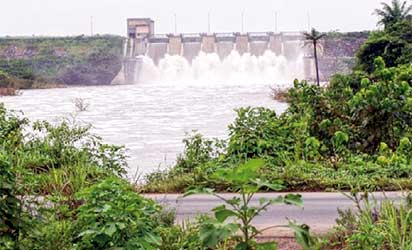
Ogun-Osun River Basin
IN the face of the current failure of food security, water supply and power generation, not a few are in haste to ask if the 12 River Basin Development Authorities RBDAs across the country, have lived up to their mandate. CHARLES KUMOLU reports
FOLLOWING the 1972-74 drought in Nigeria which many described as the worst ever experienced in West , it was not a surprise that the Supreme Military Council promulgated decree 25 of 1976, as a swift move towards the development of Nigeria’s water resources.
Accordingly, that gave birth to 11 River Basin Development Authorities,RBDAs, to harness the nation’s water resources and optimise its agricultural resources for food sufficiency.

Ogun-Osun River Basin
The RBDAs include; Upper Benue Basin, the Lake Chad Basin, Benin-Owena Basin, Sokoto-Rima Basin, Sokoto; Hadejia-Jema’are Basin, Kano; Maiduguri; the , Yola; the Lower Benue Basin, Makurdi and the Cross River Basin, Calabar.
Others are; Oshun-Ogun Basin, Abeokuta. Anambra-Imo Basin, Owerri; the Niger Basin, Ilorin; and Niger Delta Basin, Port Harcourt.
This development, reportedly raised hope among the populace, because it was assumed that the RBDs, would apart from agricultural needs, provide other basic needs associated with water resources.
Instructively, the RBDAs were primarily established to provide water for irrigation and domestic water supply, improvement of navigation, hydro-electric power generation, recreation facilities and fisheries projects. The basins were also expected to engender big plantation farming and encourage the establishment of industrial complexes that could bring the private and public sectors in joint business partnership.
Additionally, RBDAs were expected to bridge the gap between the rural and urban centres by taking development to the grass roots and discourage migration from the rural areas to the urban centres. These objectives were to be achieved through surface impoundment of water by constructing small, medium and large dams, which would enable all-year round farming activities in the country.
But nearly four decades after its establishment many are in doubt if the RBDAs, have really lived up to its mandate.
The performance of the RBDAs have increasingly been questioned because of the failure in power generation, water and food supplies.
N40 billion appropriated to RBDAs
For instance, a former Minister of Agriculture, Alhaji Said Aba-Ruma had at the 2009 public hearing on three water related bills at the National Assembly, regretted that the RBDAs were infective.
Abba-Ruma, who at that function disagreed with Senate President, David Mark that the nation needed more RBDAs, blamed policy inconsistency for the under-funding of the river basins.
He said that the river basins were established for different purposes by their founders, adding that successive administrations politicised their operations, thereby making them ineffective.
Similarly, the 2009 data from the budget office indicated that over N40 billion was appropriated to the RBDAs with over N37 billion of this marked for capital projects.
In other to ascertain if the RBDAs only exist as avenues where billions of naira are annually dumped, with little or no results, Vanguard Features,VF, embarked on an investigative trip to Benin-Owena River Basin Development Authority.
A visit to the Benin office located in the Government Reserved Area,GRA, revealed that corporate activities were going on, as most of the offices had presence of people.
Efforts to speak with the Relations Officer, Mr. Abu was not successful, as he was said not to be on seat. But a call to his mobile phone yielded results, as he referred this reporter to the Assistant Director of Information, Mrs. Adams at the Head office, located in Obayantor, 24 kilometres away from Benin.
Upon arrival at the expansive Obayantor office complex which is sited inside a forest, VF discovered that despite being located in a forest, there was large presence of staff who were going about their duties.
Though Adams was qualified to speak for the agency by the virtue of her position, she refferd this writer to the Managing Director, Mr. Mr Ijasan Lucas
The encounter with Lucas which was intermittently interrupted by power failure, hwever indicated that contrary to public opinion that RBDAs were failures in every ramification, this agency is actually living up to its mandate, adding that the peculiarity of its job prescription makes it impossible for its projects to be cited where they can easily be seen.
‘’The authorities boost agriculture, to fight water which involves flood control, hydro power generation. We do all these which are not within public view because agriculture is practised in the forest and not on the streets that is why people may claim not to be clear on what we do. Most River basin authorities have projects in the forests and not on the streets,’’ he said.
Asked if the RBDAs were really redundant as claimed by many observers who argued that abandoned water projects litter all the states of the federation, he said,”The question is very technical. We need to understand what is river basin. It means the basin of the river. And the agencies are named after certain rivers in the country. For instance, we have the Benin Owena River Basin which is named after Benin river and Owena River. We are talking about all the areas that are drained by those two rivers. It was named after these two rivers. The rivers covers the whole of Edo, Ondo and Ekiti states and some parts of Delta state.”
Fighting of drought
Explaining further Lucas said: ‘’We are supposed to develop the basins of those two rivers. The name is very technical and that is why most people don’t understand the river basins. We develop the basins of the rivers and its tributaries. The Authority came to be as a result of the drought of 1974, which necessitated for the creation of eleven river basin authorities in 1976 to fight drought. In periods of drought, the first casualty is always agriculture. Most people now look up to the river basins as an alternative means of sustaining agriculture in times of drought.”
Confronted with claims of inadequate food supply as a direct result of the near collapse of the RBDAs, he acknowledged thus: ‘’Our job also involves fighting drought, as well as boost food production.’’
Lucas however revealed that, ‘’the issue is that polices have been changing from time to time. In the eighties, the policy was to produce food and services.’’
Going down memory lane he said: ‘’ For instance, the Benin/Owena River Basin was known for the production of broilers, turkeys and vegetables among other things. But when the policy changed, the perception of the people now changed. We now create enabling environment for farmers to operate. The Act establishing us empowered us to acquire parcels of land and hold them in trust for communities, where we now prepare the land for farmers, who now grow their crops and pay us for our services at subsidised levels.’’
In addition he said, ‘’So we enable farmers to produce and sell in their names. We are key to the transformation agenda of Mr. President towards boosting agriculture. And it is also manifesting in our budgets because it is helping us to improve on our agricultural services. But the area which we are supposed to come in more is irrigation development. This is being done more in the north because the north suffers from drought first. But now irrigation development is spreading to the south.’’
Reminded that the mandate of generating hydro-electric power appears to have been abandoned, he disclosed that policy reversals was responsible for that.
Power generation schemes
‘’You know I told you about policy reversals in this country, though it is expected because policies are not supposed to be stagnant. Initially, when we had NEPA, the policy was that they were not interested in small scale power generation schemes. So most of the dams that were designed were built by river basin authorities and they had hydro power introduced to them, because of the policy of NEPA,’’he added.
Continuing, Lucas informed VF that, ‘’recently it was introduced that any dam that is going to be built in this country, would have hydro power incorporated into it. In fact, that has been introduced in two dams within our catchment area. All dams that are being designed now, would have small hydro power system. So, why it was not like that before was because of the policy of change. I expect that in the next one two or three years, there will be dams with hydro power.’’
Told that VF investigations showed that that the responsibility of managing the agency was supposed to be shared between the federal, state and local governments, but that has not been the case, as the apex government singularly funds it, thereby leading to inefficiency, Lucas explained thus: ‘’There is an Act establishing the agency which has been reviewed from time to time, and that Act recognises the Authority as an agency of the Federal government. The Authority as defined in the Act has a board. And it stated that membership should be composed of the federal, state and the local government. But with the change of policies, it is now the federal government that handles the management of the board. But the management of the River Basin has always been executed by the federal government and effected by civil servants, while the President appoints the managing director of the agencies.’’
RBDAs and flood control
When prodded on the issue of flood control, which the River Basins Development Authorities, RBDAs, Act Chapter R9 Laws of the Federation of Nigeria 2004, required RBDAs to control floods in their areas of operations, Lucas acknowledged that flood control is part of their mandate.
But he stated thus: ‘’ We have a department on that. There is a peculiar issue about flood, there is the Ecological Fund Office set up by the Federal Government. This agency has funds for the control of flood and erosion. That office does not have a field office in the states. The River Basin Authorities are their field offices. What we do is to identify projects and get it approved by the Ecological Fund Office, while we manage the projects. For instance, the flood of last year was a river Benue flood, which was peculiar. I am very sure that Nigeria is talking with the Cameroonian authorities on how to handle that.’’
Explaining further he said, ‘’there is an engineering programme saddled with the duty of managing reservoirs and dams. The issue is that if a dam is threatened by flood, the best option is to release water. But the water needs to be released properly to avoid the flooding. Any where we discover a flood prone area or a flooded area, we inform the Ecological Fund Office in order to provide funds for us to manage the situation. Some times we also include it in our budgets.’’
Despite this, an expert in flood management Dr. Akintola Omigbodun in a 2012 interview with Vanguard, said RBDAs are not doing enough on flood prevention and management.
‘’It is regrettable that the river basins are not working. For example, when I met the General Manager of Sokoto River Basin Authority, he told me that he only had three qualified staff to work with. Why should the government continue to award new contracts to build new dams, when they have not properly managed the ones they have?’’ he queried.
Strengthening his argument, Omigbodun said, ‘’they have not been performing their functions well. Even though the Ogun River Basin Authority is responsible for what we are experiencing here in Lagos, we will not take them to court because of my unpleasant experiences in Nigeria’s judicial system. The truth is that the flood in Lagos and some parts of Ogun State is entirely avoidable.’’
Despite puncturing some of the negative perceptions about the performance of RBDAs, Lucas acknowledged the existence of challenges, which in some ways militate against the attainment of set objectives.
Policy reversals
‘’Of-course our challenge is labour. We have a crop of technical men, who would be leaving the service soon. They were employed and trained in the early eighties but for a long time, there was no further employment. So, by the time this people retire, we would be faced with manpower crisis. Almost all the river basin authorities are faced with this. The second challenge is the issue of understanding government policies,’’ he stated.
On funding,-an issue many agree contitute a major challenge, the RBDA boss said, ‘’It will be too wrong to say that funding is the problem of river basins. But you may say that on the surface but that is not the major challenge, it is actually the appropriation of the fund, which makes it difficult for continuity in sustaining projects. We have most projects that are always delayed because of the appropriation of funds.
There is also need to understand what we are doing, but the federal government is helping us in that regard by ensuring that every River basin development Authority has an advisory committee.’’
Giving a breakdown of the composition of the committee, he said, ‘’ It is made up of the state government, local government, Agriculture Ministry, Water board and other stakeholders. The Authority was not set up as a revenue generating agency, but that does not mean that we are service providers. We use federal government money to purchase tractors. And these tractors are used to prepare land for farmers, who in turn pay economic rates. We have gone into table water production here as to sustain what we are doping, this a agency is not a drain on the government because the benefit of what we do is very evident.
‘’In the eighties we were known for food production, but a policy came in 19991 through the Technical Committee on Privatization that those projects be sold off. But when Obasanjo came that those projects should be revitalised those projects that were not bought. Sometimes we have revitalisation plans in in our budget. So that is how policy change affect what we do, but we are really working withing the confines of our mandate.’’
Meanwhile, the question at the moment is; how can the RBDAs be repositioned towards meeting its mandates in today’s Nigeria?
‘’it is actually the appropriation of the fund, which makes it difficult for continuity in the sustaining of projects. We have most projects that are always delayed because of the appropriation of funds. We need better appropriation of funds for our projects,’’ Lucas added.
Disclaimer
Comments expressed here do not reflect the opinions of Vanguard newspapers or any employee thereof.