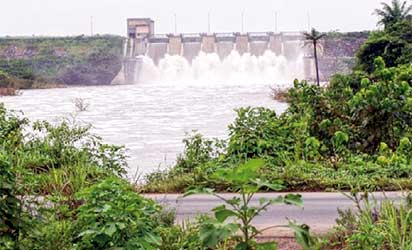
Ogun-Osun River Basin
IN the face of the current failure of food security, water supply and power generation, not a few are in haste to ask if the 12 River Basin Development Authorities RBDAs across the country have lived up to their mandate. CHARLES KUMOLU reports…
FOLLOWING the 1972-74 drought in Nigeria which many described as the worst ever experienced in West Africa , it was not a surprise that the Supreme Military Council promulgated decree 25 of 1976, as a swift move towards the development of Nigeria’s water resources.
Accordingly, that gave birth to 11 River Basin Development Authorities, RBDAs, to harness the nation’s water resources and optimise its agricultural resources for food sufficiency.

Ogun-Osun River Basin
The RBDAs include Upper Benue Basin, the Lake Chad Basin, Benin-Owena Basin, Sokoto-Rima Basin, Sokoto; Hadejia-Jema’are Basin, Kano; the Lower Benue Basin, Makurdi and the Cross River Basin, Calabar.
Others are: Oshun-Ogun Basin, Abeokuta; Anambra-Imo Basin, Owerri; the Niger Basin, Ilorin and the Niger Delta Basin, Port Harcourt.
This development, reportedly raised hope among the populace because it was assumed that the RBDs would, apart from agricultural needs, satisfy other basic needs associated with water resources.
Instructively, the RBDAs were primarily established to provide water for irrigation and domestic water supply, improvement of navigation, hydro-electric power generation, recreation facilities and fisheries projects. The basins were also expected to engender big plantation farming and encourage the establishment of industrial complexes that could bring the private and public sectors in joint business partnership.
Additionally, RBDAs were expected to bridge the gap between the rural and urban centres by taking development to the grass roots and discourage migration from the rural areas to the urban centres. These objectives were to be achieved through surface impoundment of water by constructing small, medium and large dams which would enable all-year round farming activities in the country.
But nearly four decades after its establishment many are in doubt if the RBDAs have really lived up to its mandate.
The performance of the RBDAs have increasingly been questioned because of the failure in power generation, water and food supplies.
Disclaimer
Comments expressed here do not reflect the opinions of Vanguard newspapers or any employee thereof.