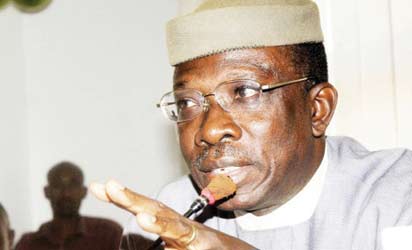
Patrick Ekeji
Former Green Eagles player, Patrcik Ekeji,was until April 9, 2013, the Director General of the National Sports Commission. He comes clean in this interview with JOHN EGBOKHANjjjj
Firstly sir, congratulations on your retirement. As a former Green Eagles player, give us your take on the rift between Coach |Stephen Keshi and his captain, Joseph Yobo, Can’t it affect the spirit of the team as they prepare for their next World Cup qualifying matches in June?
Thanks a lot. If you ask me, I think the issue is being overblown by the media Even in life, in a family of just two, there will always be some slight misunderstanding the husband and the wife. There will always be some issues. I have not spoken to Keshi, neither have I talked to Keshi.

Patrick Ekeji
But if there is any friction, Keshi is the coach, Yobo is the player, Yobo cannot disagree permanently with his coach, so I don’t think its a big deal, I believe they will sort themselves out and Keshi as the big boss, he was a player himself, he knows what he is doing, I don’t think its an issue that should distract our mission to get to the 2014 World Cup. Keshi is the coach, he is the person that takes the final decision, nobody can take that way from him. The press should learn to play things down and bring people together.
As the next Commonwealth Games approaches, what arrangements have been put in place to ensure that what happened in London Olympic Games does not occur again next year.
You will recall that after the Olympics that Mr. President conveyed a Sports Retreat, which was a very fantastic one and we at the NSC, in participants considered it as the starting point for our sports because it brought everybody together and Mr. President stayed with us for almost 10 hours. The outcome of the retreat was that there was need to have a High Performance Directorate, which will be responsible for preparing athletes for big events.
Mr. President has virtually approved everything that has been sent to him to establish that High Performance Directorate. Before I left, we’ve gone far with it, the next step now is to put a search for the High Performance Director and the search for performance directors in the newspapers, so that any credible person, who believes that he or she has the requirements is free to apply and the successful candidates will be given the job. We have tried to headhunt. The person that in the first instance we thought could act as High Performance Director, came but because of his commitment to a state, he said he was not going to take up the work. He said he’s committed to what he’s doing in Cross River State.
Of course, the Commonwealth Games is a prelude to the Olympics and of course some of the athletes, who will be going for the Commonwealth Games, will be gotten from the High Performance Programme, which is ongoing. And of course, the Olympic Games is the pinnacle of it. We are hoping that shortly the High Performance Directorate will start work. It is the duty of it to identify and train athletes. We have identified some athletes from the 1st African Youth Athletics Championships held in Warri. These talented athletes will be subjected to stiffer tests so that the very best will come out of them and these very best will now be admitted to the High Performance Programme for further training. They will get all the best in terms of welfare, training and exposure to world-class facilities.
Sorry to cut in sir, there is a challenge facing Nigerian sports. As someone who has seen it all, what is the biggest challenge undermining sports development in Nigeria.
There are two very big challenges and to isolate one from the other will not help us. The first challenge is that of administration. When I say administration, I need to explain it. For the ordinary people out there, when they look at sports administration, they zoom in on the National Sports Commission as that is where the problem is. But the problem is not at the National Sports Commission, per se.. NSC is a government body that is expected to come out with policies and these policies are now expected to be driven by other sub-players. For instance, at state levels, the state sports councils are not funded at all, not to talk of being properly funded. At the school levels, they have their programmes but the NSC, even as much as we try to admit them into our games, cannot make them to align their programme with what we have at the NSC. I can tell you that the National Sports Policy, which was passed in 2009, is one of the best in the world. But sadly, we cannot enforce those policies on these schools where the first talents are to be sourced form.
We cannot direct the Ministry of Education to follow these guidelines. For instance, schools are established everywhere in Nigeria today and many of these schools don’t have avenues for children to play. Many of these schools are run in flats. So children who go to school there, with nowhere to play, by the time they are 7 or 8, the talent is gone. And this is nationwide. So you will loose talents.
Now you go to the state sports councils, the National Sports Commission cannot tell the states sports councils how to run the place.
At the state level, there are many unqualified staff. At the local government level, they have sports committees, which are non-existent. Now at the NSC, what do you expect us to do with the products brought by all the other levels of sports administration. Because we are the ones who are responsible for taking these athletes out. Even in NUGA, for instance, many universities purchase athletes, give them ID cards as students. How can NSC control all of these.
Sir, are they not learning from what the junior national teams of Nigeria are doing?
All these so-called under this in our football are not really under the age. We have so much placed undue emphasis on achievement at youth levels. These are means to an end and thee end of sports competition are the Olympic Games, the World Cup and the Nations Cup or the Athletics or Boxing Championship. That is where our objective should be. To produce an established system that will produce champions.
The real problem of talent hunting is what we do with the talents discovered. If you don’t have the funds to take these talents to the next level, they will be a waste. The government is going to make provision for the talents to be further trained. With the appropriate funding, we will rise again. We must also look other countries where we can expose our athletes that are Nigerians but non-Nigerians. So the Diaspora programme is also part of it.
For you to succeed in all of these, you must have the structure, which is what we are putting together, I have driven it as far as I could, so the minister and the rest of the team, will take it from there.
Any regrets as you bow out?
I am not leaving with regrets, I will rather say I’m very happy. One thing that I feel very good about is that there are documents that new occupants can fall back to on the way forward. It was not like that before I came in there. I had to establish all these documents. When I came, there was no document to fall back to on the way forward. I had to establish those documents. I give certain examples. The National Sports Policy is something that you have to review overtime. After every National Sports Festival, I got the team to review the rules of the NSF.
So for every NSF, we were coming out with new rules and changes. You will recall that the moment I came in in acting capacity, I knew that we needed a National Sports Policy, but the one I met was the one that was established in 1989. I had to ensure that we reviewed it and actually got it passed. And of course there was also the challenge of the National Sports Commission. We only had the Department of Sports Development but of course, sports have gone beyond one department.
Even as a director, I pushed for the establishment of the Directorate of facilities. I went further to break down sports development from one department to five departments. That is not easy my brother. So now there are five departments and I know that we can still go further. I also ensured that we created the Paralympic Committee. Before it was special sports but it has gone beyond the level that I met it. What I achieved in 2009 when I came in in acting capacity and now as D.G., they took time.
Ques: But during these times that you achieved all these, we also lost our relevance in international sports bodies. In FIFA, we lost our man there, in CAF, we also lost our man there and we’ve not been able to get into these bodies again. It seems we are not playing the politics of international sports well.
Ans: I agree with you because we lost our man there and we all know what happened and how we lost him. We will not go into that. That was a self-inflicted injury. On the issue of the recent election into CAF, I can tell you that I understand international sports politics very well. I am on awardee of the highest honour of the Supreme Council of Sports in Africa and this is an award that you cannot get by lobbying. For you to get it, you would have served for nothing less than 30 years in sports and your achievements should be verifiable. Now, the loss that Aminu Maigari suffered the other day was self-inflicted. Getting into something like the CAF elections is not something that you get into abruptly. You have to lobby long before you even make your intentions known.
I can tell you that Amos Adamu, who is himself, a guru in international sports politics, started the journey to get into CAF and FIFA long before. I was there, I knew every step he took, we supported him and by the way,, the FG under President Obasanjo, had to writer a letter conveying Nigeria’s interest in that position to Hayatou. When we went for that election, we won. So this is not something you wake up one morning and say you want to win. I can confirm to you that I did not know of Maigari’s intention, either did the minister also know. By the time we got to know, it was too late.
As at December, we sat down at the NSC and said that there was need for the minister to go and familiarise himself with Hayatou rather than meet him at the Nations Cup in January.
Bolaji Ojo-Oba, whether anybody likes it or not, has contacts in CAF. And you need to use such a man. As the Chief Accounting Officer of the NSC, I made money available, and they went to Hayatou in Cameroon. He went to thank him for his support to Nigerian football. And came back. If the minister was aware at that time that Maigari was going to run and Maigari had made up his mind to run, that would have been a stronger reason for the minister to undertake that trip. We only got to know later and it was accidental. For goodness sake, people should give us credit.
If we had known, we would have gotten the Minister to do a letter to Hayatour, which would be signed by President Jonathan, conveying Nigeria’s interest in that office. But we did not know. We got to know he wanted to run when it as too late but we still gave him all the support. That is why I said these things are self-inflicted. Like I said, when things happen, people should ask questions. This is a privileged information.
Of course, the man who eventually won the position, has been on it fr over even years. So it was easy for him to win. We need to do things properly. We need to understand who has a role and use that person effectively.
The relationship between the NFF and the NSC , by the time I left, was not the best. Success of football is success for our sports. So we must try and do it well. If continues to succeed, it will rub off well on other sports. If we know that sports success is tied to football success, why would be at the NSC try to undermine the success of the NFF? It is not possible.
Disclaimer
Comments expressed here do not reflect the opinions of Vanguard newspapers or any employee thereof.