By Emmanuel Edukugho
The National Examinations Council (NECO) was established in April 1999 by Federal Government in line with decisions reached at the 49th meeting of the National Council on Education. This was in response to the national outcry for another public examination body indigenous to the country.
WAEC serves the entire English-speaking countries of West Africa. NECO came to break the monopoly of WAEC which had been conducting school examinations since 1952. NECO has the onerous task of conducting the school-based (June/July) and external candidates (November/December) Senior School Certificate Examinations (SSCE), the Junior Secondary School (JSS1) as well as the National Entrance Examination into Senior Secondary Schools (SS1) of Federal Unity Senior Secondary Colleges (NEEFUSSC).

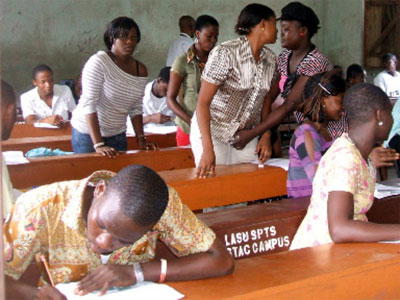
File photo: Cross section of students
NECO also conducts the National Common Entrance Examination (NCEE) and the Basic Education Certificate Examination (BECE). It was initially confronted with several challenges that sought to undermine its examinations causing crisis of confidence among candidates who felt WAEC seemed more credible, better known and better recognised, at least internationally.
Many students, at the beginning were either hesitant or reluctant to enter for NECO examination especially at the Senior School Certificate level, as they preferred WAEC particularly in seeking admission into tertiary institutions.
But as the years went on and with the appointment of a Research Professor of Educational Evaluation as NECO’s Registrar/Chief Executive in April 2007 in the person of Prof. Promise Nwachukwu Okpala, he had embarked on changes that brought about tremendous, positive turnaround of the organisation.
The vision, mission and core values of NECO were reviewed to bring it in line with international best practice in educational assessment as well as in tandem with its mandate. NECO’s question papers are now kept in only one place from where they were safely moved to the various examination centres, thereby reducing chances of question papers leakage.
Eliminating examination malpractices through use of highly customized answer scripts making it impossible for candidates to smuggle worked answer scripts into the examination halls. In the 2011 SSCE for school-based candidates, NECO became the first public examination body in this country to introduce and successfully deploy Biometric Data Verification machines for candidates that registered for its examinations. This new system has zero-tolerance for impersonation as a duly registered candidate can be identified through his/her fingerprint and other features.
NECO releases its results in a record time of 60 days from the end of a given examination. Its SSCE results had evoked a lot of public reactions because of the high failure rate which scared many candidates away due to stringent measures put in place to ensure credibility. For example, about 10.54 per cent of candidates had five credits and above including English language and Mathematics. “Students should be allowed to write two examinations which are parallel. Monopoly is not good for consumers as it severely restricts opportunity to make choices. With NECO, Federal Government provided opportunity for Nigerian youths and therefore not compulsory to patronise only one product,” said Maryann Amaju, an educationist.
Mr. Bass Musa, Proprietor, Lexington Group of Schools, Mebamu, Okokomaiko, Lagos, in his opinion, said there is no need for the continued existence of NECO.
According to him, NECO is of no use and should be scrapped. He wondered why NECO was established in the first place.
“It’s waste of time. What is NECO doing? Who is NECO? What has it done so far? Why NECO? Some universities don’t accept NECO for admission. It should be scrapped, so that the nation can face one direction and achieve good standard of education. They’ve used NECO to destroy the focus of our children,” Musa told Saturday Vanguard.
He said that things were done well when it was only WAEC in existence, and NECO created by government to compliment WAEC but it did not work as envisaged. “Some candidates will bring subjects from NECO and bring subjects from WAEC, joined them to get the required number of subjects and grades. This is not good for our educational system. In those days, there was HSC for direct entry into universities but no longer available.”
He added: “With two roads to a destination, one is likely to miss the proper road. NECO is not serving any useful purpose, so government can scrap it.”
Disclaimer
Comments expressed here do not reflect the opinions of Vanguard newspapers or any employee thereof.