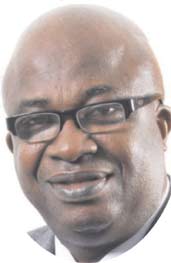
Dr Abayomi Ajayi
By YEMISI SULEIMAN
The world of infertility is full of compassionate people who have dealt with the struggle of infertility with couples on a deep, personal level. They have felt so touched by their experiences and challenges that they have pursued this career path with passion as is the case of Dr. Abayomi Ajayi, Managing Director/Consultant Obstetrician and Gynaecologist at Nordica Fertility Centre, Lagos.
One of Nigeria’s most respected fertility experts, Dr. Ajayi is a product of the College of Medicine, University of Lagos, from where he graduated in 1984. He completed his post-graduate training at The University College Hospital, Ibadan in 1994 with the Fellowship of the West African College of Surgeons in Obstetrics and Gynaecology. He joined the services of Lagoon Hospital, Apapa, Lagos as Consultant Obstetrician/Gynaecologist in February 1995 and held this position till October 2002 when he left to start Nordica Fertility Centre, Lagos.

Dr Abayomi Ajayi
Ten years on and with a good number of branches in different parts of the country, Nordica has continued to combat the plague of infertility by providing true ‘comfort centres’ where the pain of childless couples could be soothed emotionally and medically. They have also set up a non-profit group which gives free IVF treatment to people who cannot afford it. As Nordica celebrates ten years of putting smiles on the faces of couples, Dr. Ajayi takes us on the process of IVF, challenges involved as well as activities lined up for the anniversary.
How has it been in the last ten years?
It has been most rewarding; not in terms of money but I have had different kinds of encounters with people that I probably would not have had in my life. Like someone your size (Yemisi) trying to lift me up after she got pregnant (laughs). I like seeing people happy around me, so when I am able to make especially people who have waited for a very long while happy, that means so much to me.
Some people have money but they are not happy because they have a need in their lives; being able to assist them solve the problem is so rewarding for me. I don’t think I would have even hoped for anything else. In terms of awareness, it is better than where we were before; when we started ten years ago. We do a lot of awareness programmes on TV and radio for people to understand what IVF is all about.
What informed your choice of career?
As a kid, I wanted to be an aeronautic engineer but I have always had bad sight so, when I was told that I couldn’t fly (I was still in secondary school then), I started thinking of what else I could do. Then, we were asked to go to LUTH for a BCG and endurance test for the heart. I got there for the first time and something just clicked in me that yes, this is where I should come to. So, I reversed from aero to medicine. Then in medical school, it occurred to me that I could do O and G without stress so, I decided I was going to be a gynaecologist.
One day, during my training, we were doing a procedure on a patient who had infertility and I was not happy with the result we had. I started thinking that there must be a better way out. That was how I got into IVF and I decided again that was the only thing I would do, and I have been in it.
At what point did you decide to give free IVF treatment to some couples? What informed it?
That started in 2008 and what informed it was that before then, I was giving some free circles and some of my staff were saying that I should give more free cycles because anytime I did so, they got pregnant. One day, it occurred to me that these people I was giving free circles to are already inside and they have some level of comfort before coming in while some people out there don’t even have any hope; they won’t come near because of the money (involved). So, how do we get to those people? That was how the idea was born.
Our experience has been amazing because there are so many people out there that cost has made them to resign to fate, and this might just be the interface we need to be of use to such people.
How exactly does IVF work?
In-Vitro Fertilisation (IVF) means fertilization happens outside the body; that is the only thing that is different about IVF. We know that there is infertility because the sperm and the egg cannot come together for whatever reason, so what IVF does is to bring the sperm and the egg and unite them in a conducive environment. When sperm and egg come together, they form an embryo. Once an embryo is formed and it reaches the stage where it can be inside the uterus, we transfer from outside to the uterus; the development just goes on as it happens normally in the body. That is the whole essence of IVF. The snag is to do it in such a way that the body does not feel as if the egg has left the body.
Is there hope for those that have done it once and it failed? Is there hope for a second chance?
Yes, actually the way to do IVF is to prepare your mind for more than once. So, the recommendation is that if you are below thirty-five, you should prepare for two circles because the cumulative success rate for two cycles, when you are below thirty-five, is 65/70%. When you are above thirty five, you should prepare for three circles. That gives you a cumulative rate of the same 65/ to 70%. What we are looking at is your probability of going home with a baby. Some people will do it only once and be successful even at 43 but that is not the norm.
Of course, we know that this thing is not cheap and that is why sometimes people think if they do it once, it must work; but that is not the technology.
For how long should one try to conceive naturally before thinking of IVF?
The definition of infertility is when you are below thirty-five and you have tried for one year; above thirty-five and you have tried for 6 months, you should see a doctor. Now, when you have seen a doctor and proper assessment has been made, there are some people that the only sensible treatment for them is IVF, no matter the age or at what point it was discovered. For instance, if you have blocked tubes, the only sensible treatment is IVF. If sperm count is very bad, it’s IVF except you just want to pray and hope for luck to come. While I am not against prayer, I keep telling people that they should realize that sometimes, when you are waiting is your best chance. So, if you marry, you know how long you want to wait before you proceed to IVF.
Are there any risks involved?
Yes, there is no procedure that does not have risks. The commonest we have here, because of the drugs we use, is that the woman could have a condition called hyper-stimulation. Anybody who uses ovulation stimulation drugs will have hyper-stimulation which means, you producing too many eggs and that could make the woman really very sick.
The other problem that could result from IVF, which people see as complication, is that you can have more than one baby. It can be ridiculous sometimes, especially where there are no controls; you can have six babies at a time. So, we say in IVF, complications are rare but they are real.
Why does IVF fail?
Look at organ transfer, for instance. Someone needs a kidney and you are given a kidney. There is what we call the immune system in the body; even if the kidney was donated by the person’s twin sister, the body immediately senses that there is a foreign body and what it does is to attack because that is the way the body protects itself from bacteria.
The immune system also sees this as a foreign body because the embryo is from the man and woman and the woman’s body does not recognize the other as her husband’s own; it sees it as a foreign body and therefore what it does is to attack it and destroy it. The chances of destroying it are higher than the chances of accepting it; unlike when you use donor kidney, you give drugs to suppress the immune system. That’s why you find people who have organs donated to them always on drugs because the drugs suppress the immune system so that chances of destruction are reduced. But you can’t do that with IVF because we want the body to use its quality control system to tell whether the baby is normal. And, that is why we say IVF babies are normal babies because they go through the same quality control system (as natural conception). ing the doctor.
What are some of the activities lined up for the 10th year anniversary?
As part of activities lined up for the tenth year anniversary, there was an ‘Endometriosis Talk’ at the Ladi Kwali Hall, Sheraton Hotel, Abuja on April 2, 2013, with Dr. Keith Isaacson, immediate past President of the American Association of Gynaecological Laparoscopists as guest lecturer. There was a ‘Fertility Walk’ on April 5, at our Asaba office. On April 6, we held the anniversary party in the Asaba Office. Other activities will include team visit to selected media houses between 8th and 10th April; a novelty football match at the Legacy Pitch of the National Stadium, Surulere, Lagos on 13th April.
Disclaimer
Comments expressed here do not reflect the opinions of Vanguard newspapers or any employee thereof.