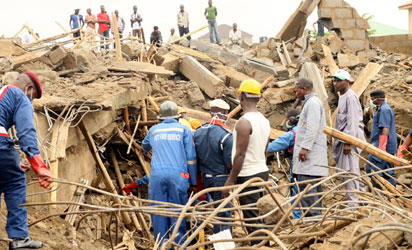
NEMA and NSCDC officials looking for victims from the rubble of the collapsed building in Kubwa, Abuja. Photo by Gbemiga Olamikan.
By VICTOR AHIUMA-YOUNG
THERE is no doubt the high rate of unemployment in Nigeria is a time bomb waiting to explode. But that the problem of joblessness is being compounded by expatriate quota abuse with appropriate government agencies not doing what is needed to stop it, is of serious concern to the National Union of Civil Engineering, Construction, Furniture and Wood Workers, NUCECFWW.
Leaders of the union also decried perceived government’s’ refusal to pay debts on financial contractual agreement with the contractors, lamenting that this has led to disruption of capital projects and contractors moving out of sites for lack of funds, compounding the job crisis.
In communiqué at the of the union’s 4thQuadrennial Delegates Conference, QDC, in Imo State, the cin-session condemned the high rate of casualization and contract staffing in the construction and furniture industry, and vowed to resist casualization and contract staffing as an employment model, describing the practice as deceptively exploitative and degrading.
Members upheld “the union’s advocacy for fair and sufficient compensation, fair and sufficient benefits and good welfare for all categories of its members through unrestricted legitimate rights to union activities, collective bargaining and other statutory provisions for interactions, engagements and resolution of issues with other social partners.”
Expatriate quota abuse/local content
According to the communiqué, conference-in-session condemned “the expatriate quota abuse by employers inthe construction and furniture industry that the abuse is not in tandem with the Nigerian Content Development Act, which states that Nigerians should be considered first in any employment before given it to foreigners or expatriates.
The conference-in-session demands that government should step up effort to check influx of the so-called expatriates into Nigeria. `The conference-in-session charges the Nigerian Immigration Service, NIS, and the Ministry of Labour and Productivity to ensure that there is true need for expatriates in any company before granting work permit to any foreigner.”
“The conference-in-session also demands that the Understudy Clause in the Nigeria Expatriate Quota law be respected while many of the companies should comply with the provisions of the Nigerian Content Development Act. The conference-in-session observes the refusal by the Asian and Korean firms to allow unionisation of their workers.
The conference-in-session vows to take whatever labour actions deemed appropriate when our collective resolve and might is undermined to ensure that the Asian and Korean firms respect the Nigerian Constitution, the Nigeria Labour laws and other international labour standards on Freedom of Association and Right to Collective Bargaining.”
Employment generation
On employment generation, leaders of the union lamented that unemployment was one of the greatest problems facing this country and commended the efforts of the Federal Government through the Federal Ministry of Trade and Investment to encourage local and foreign private investors on job creation.
According to NUCECFWW leaders in the communiqué, “the conference-in-session wants more concession to be granted on essential imported raw materials that cannot be locally sourced by manufacturing companies to jumpstart the economy as this will enable them generate more jobs in the country.
The conference-in-session demands that government needs to be more practical in her focus on the agricultural sector, as a way to enhance employment and job creation, stimulate food security and alleviate poverty as well as reduce crimes. The conference-in-session recommends that government should evolve a social security package for these unemployed youths as it is being done in other countries.
Non-payment for certified completed contracts
The issue of non-payment for certified completed contracts by both federal and state governments also came to fore during the conference which prompted the conference-in-session to express “worries on challenge that is facing the industry with the government’s’ refusal to pay debts on financial contractual agreement with the contractors.
Consequently, conference-in-session notes that this has led to disruption of capital projects and contractors moving out of site for lack of funds and the attendant job losses. The conference-in-Session also notes that many state and local government refused to embark on new capital projects that can boost the infrastructural development and growth of their states and local government areas, while the ongoing projects have also suffered stagnations.”
“The conference-in-session states that these actions have stifled development in the civil engineering and construction sector and the nation’s economy as a whole. The conference-in- session demands that governments at all levels, federal, state and local government, to without further delay begin payments of debts they owe contractors to save lives and jobs, develop the country and deliver dividends of democracy to the people.
The conference-in- session notes that Subsidy Re-Investment Programme, SURE- P, where state and local governments receive allocations for infrastructures and other developmental projects, has not positively impacted on many states.” The leaders of the union demanded demands that governments at all levels should without delay start embarking on new capital projects with direct bearing on improving the welfare and better the lots of their citizens., stressing that “all state governments’ must publish in Nigeria media, projects executed with these allocations that “can be verified by the
people specifically.”
Disclaimer
Comments expressed here do not reflect the opinions of Vanguard newspapers or any employee thereof.