Boko Haram
By CHIOMA GABRIEL
Recently, President Goodluck Jonathan succumbed to the pressures to grant presidential amnesty to members of Boko Haram sect.
Although he had earlier described members of this sect as ghosts, insisting that granting amnesty to faceless masquerades is not feasible but common sense eventually prevailed and the President set up a committee to look into the feasibility of such a pardon.
The terms of reference of the committee is :
*To consider the feasibility or otherwise of granting pardon to the Boko Haram adherents;

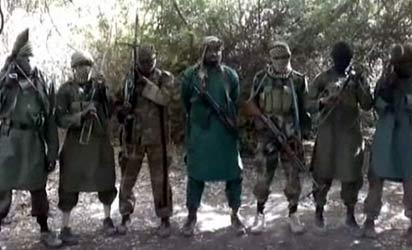
A picture taken from a video distributed to journalists in recent days through intermediaries and obtained by AFP on March 5, 2013 reportedly shows Abubakar Shekau (C), the suspected leader of Nigerian Islamist extremist group Boko Haram, flanked by six armed and hooded fighters in an undisclosed place.
*Collate clamours arising from different interest groups who want the apex government to administer clemency on members of the religious sect; and
*To recommend modalities for the granting of the pardon, should such step become the logical one to take under the prevailing circumstance.
This development however,is generating a fresh wave of controversy. Meanwhile, in agitating for the amnesty, many had referred to former President Yar’Adua’s amnesty to Niger Delta militants. But comparing the unpopular activities of Boko Haram sect with that of the Movement for the Emancipation of the Niger Delta, MEND, has left sour taste in the mouths of many.
Reactions and counter reactions have continued to greet the amnesty proposal with many arguing that Niger-Delta militants had a clear motive and limited their anger to mainly non-human targets while the Boko Haram sect mainly targeted civilian populations and so far, has caused an estimated 2,600 deaths in the last 18 months. Also,thousands of innocent and unarmed civilians had been reportedly injured, while scores of religious, military, and educational infrastructure had been destroyed.
Nigerians across professional divides are opposed to the pardon as the terrorists remain faceless. Many questions have cropped up over the matter. Is the President granting amnesty to those protesting the killing of their leader at the beginning of the insurgency or is the amnesty meant for a group that wants all Nigerians to become Muslims? If the terrorists are ghosts as the President proclaimed ,what then is the guarantee that the violent attacks would cease?
For those who want this amnesty, many are therefore suggesting that first, the ‘ghosts’ make themselves human by publicly renouncing violence and sticking to it. But what would be a guarantee for sustaining this renounciation? The group, they argued, must keep to its promise for a period not less than 60-days to indicate its seriousness and commitment to viable peace even as its leadership and main financiers should be made known to the security and intelligence agencies. Another question that comes to mind at this point is which of the insurgents would the government be dealing with?
The school of thought that suggested conditions to be met by the sect further argued that once the conditions are met, the government may, as a matter of national security, engage the group and offer presidential amnesty.
Moreover, it must be borne in mind that even the insurgents have not accepted the amnesty being offered to them. Several times in the past, they called for ceasefire during which period they perpetrated their worst attacks.
Even as the federal government is still gauging the decision whether or not to grant amnesty , the sect has said it is also thinking of whether or not to accept the offer, meaning that the group has distanced itself from the amnesty calls by some northern chieftains. This, some analysts believe, casts an aspersion on those who play the advocacy role for Boko Haram as there is now skepticism about their calls. Many observers believe that there are ulterior motives behind the calls.
Minister of Information, Labaran Maku, also recently stated that no decision had been taken yet on amnesty as the Federal Government is still working on the proposal.
Maku did not elaborate on the workings of the Amnesty Committee and many believe government is probably playing safe going by Maku’s utterances.
The setting up of the amnesty committee came after a meeting President Jonathan had with the Northern Elders Forum (NEF) over the menace of the terrorists.The Northern elders called for amnesty for the insurgents who had been waging war against the Federal Government since 2009 when their leader, Muhammad Yusuf, was killed by the police after his capture following the outbreak of crises in Maiduguri, Borno State.
The Sultan of Sokoto, Alhaji Sa’ad Abubakar is holding a prominent position in the amnesty committee .
Others who would work in this committee include the Chief of Defence Staff (CDS), Admiral Ibrahim Ola Sa’ad; the National Security Adviser (NSA), Col. Sambo Dasuki; representatives of the directors-General of the National Intelligence Agency (NIA) and the Department of State Security, DSS .
One cannot say definitely what would become the outcome of the amnesty proposal especially with a splinter group of Boko Haram rejecting the amnesty option, stating that it is not what they bargained for and it will not deter them from pursuing their cause.
Although, a prominent northerner, General Muhammadu Buhari has accepted the amnesty proposal as a right step in the right direction,the spokesperson of the splinter group, Abu Darda,told the BBC Hausa Service that his group doesn’t believe in the democratic form of government being practiced and in the constitution, but in Islamic law (Sharia) and described the efforts of the Sultan as a waste of time.
Meantime, the leader of the Boko Haram and the Shurah Council, comprising of 14 members, which is the highest decision-making organ of Boko Haram, Abubakar Shekau, on Wednesday dismissed amnesty , saying instead that it is the Federal Government that needs amnesty from Boko Haram and not the other way round.With this trend, the big question is, how far will this amnesty go?
Many still argue that what matters more is for all those who were injured, or who had their homes and properties destroyed to be fully compensated and for President Jonathan to look at ways to foster a sense of nationhood to the people of Nigeria by ensuring basic human and security needs are met.
Disclaimer
Comments expressed here do not reflect the opinions of Vanguard newspapers or any employee thereof.