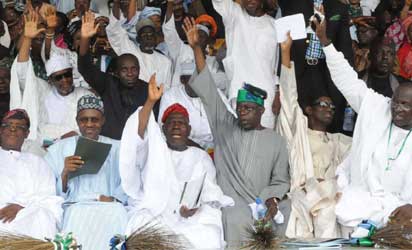
From left: Aremo Osoba, Gen. Muhammadu Buhari (rtd.) Chief Akande, Asiwaju Bola Tinubu, Malla Nuhu Ribadu, Senator Lawal Shuaibu and others ACN, members at the Action Congress of Nigeria (ACN) National Convention held at Onikan Stadium, Lagos Island. on 18/04/2013. Photo: Bunmi Azeez
BY OCHEREOME NNANNA
THE surprise is that they are still going at it, moving forward. It is a pleasant surprise. Thursday, April 18th 2013 was a day of history for the Action Congress of Nigeria (ACN).
On that day at the Onikan Stadium in Lagos Island, Chief Bola Tinubu, its National Leader, led 4,761 delegates of the Party to vote to dissolve it into the All Progressives Congress (APC), an event rhapsodically described as the “last congress” of the ACN.
The occasion was attended by all the major component allies in the imminent merger – Dr. Ogbonnaya Onu, National Chairman of the All Nigerian People’s Party (ANPP) and his group; Major General Muhammadu Buhari, the leader of the Congress for Progressive Change (CPC) and his clique and Governor Rochas Okorocha, the factional leader of the All Progressives Grand Alliance (APGA) and his followers. All parties to the merger have signified their intention to take similar steps and dissolve into the APC before the June 2013 deadline it set for itself.
Barring any unforeseen circumstance, the fusion now seems unstoppable since the biggest party in the amalgamation, the one with the most to lose – the ACN – has taken the bold leap of faith first. Supporters of this merger have reasons now to hope for success.
This is the furthest any move towards the merger of political parties has gone in the history of such political ventures in Nigeria. Do not mind what happened in 1998/99 when the All People’s Party (APP) and the Alliance for Democracy (AD) presented the AD candidate for President and the APP candidate for Vice President under the platform of APP only for the parties to go their respective ways soon after they lost the presidential election. The organs of the parties never fused, and the parties never presented any other common candidates except for the presidency.
The next and final challenge before the merger, though, will come when the candidates for election are being chosen at all levels, particularly the presidential candidate and his running mate. If the merging parties are able to overcome this hurdle, setting aside the usual sticking point of individual ambitions, then we may be talking quite viably of the first successful merger in the history of this country. We may also be talking of an organic emergence of a dominant two-party system.
The challenge of fielding candidates will not be easy to overcome. It is at this stage that the real motives of the constituent allies in the venture will be revealed. Along with the issue of who produces the presidential candidate and running mate, there will also be the challenge of who controls the party organs at the national level.
So far, Buhari has not hidden his ambition to run for president again in 2015. Indeed, it would seem that using the APC to gun for president for the fourth time in a row is his main purpose of joining the merger, having discovered he cannot go it a lone with his severely limited northern Muslim appeal.
This is where the ACN in particular needs to watch it. If Buhari is allowed to run as the presidential candidate of the APC and he wins, Tinubu in whatever capacity he finds himself will lose everything he has fought for since 1999. Hausa/Fulani-led political parties, such as the defunct Northern People’s Congress (NPC), National Party of Nigeria (NPN) and Shehu Yar’Adua’s faction of the defunct Social Democratic Part (SDP) always nursed the ambition of swallowing their allies from other parts of the country, with their Western Nigeria allies considered as “prime catches”.
Hausa/Fulani political forces, whether in the military or civilian political settings always dream of primary alliance with the West, with the North as the senior, dominant partner.
It is this notion of being the underdogs of the North that the Awoist Western political establishment has always fought with all their strength. So, if Buhari takes over and predictably re-launches the old-style northern bid to dominate the much bigger Tinubu Yoruba political group, it may lead to a major crisis that will threaten the APC’s survival as a new national political party.
One of the challenges the APC will face is this basic North/West configuration it is taking off with. The idea that the North West and South West coming together with their real or imaginary population advantages will grab the presidency is the basic assumption driving this merger. APGA and ACN’s followers like Okorocha and Senator Chris Ngige from the South East are mere “political fillers” to give the party the semblance of national spread. The Minorities, the kingmakers of Nigerian politics, do not seem to have any pride of place in the APC so far. The Minorities, historically, have always gone with dominant national parties such as the People’s Democratic Party (PDP).
Apart from that, the Igbos, the ethnic group with the strongest presence nationwide, are not inside the eye of APC’s storm. The fear that in sharing of political offices Tinubu and Buhari will sideline them will make the Igbos and the Minorities to maintain doubts as to their proper places in the APC. Even in the North, the ANPP and CPC are actually minority, opposition parties, since they collectively control only four out of nineteen states. PDP is now the party of the North’s mainstream, while Buhari is its outsider. The APC has a long way to go in becoming a national political party that can viably rival the ruling PDP.
Most importantly, the APC has not yet shown what motivates its constituent members into this merger beyond the common desire to snatch power from the PDP at the centre. Ideologically and structurally, the merging parties look just like the PDP. What difference are they going to make if they succeed in achieving their objective? What programmes are they going to pursue to get Nigeria out of the traps of poverty, corruption, dependence on oil, infrastructure deficit, fight insecurity and terrorism and make life more abundant? Why should the electorate abandon PDP and switch over to the APC? We have not been told.
If the only selling point of the APC is to grab power from the PDP then it will not sell.
Disclaimer
Comments expressed here do not reflect the opinions of Vanguard newspapers or any employee thereof.