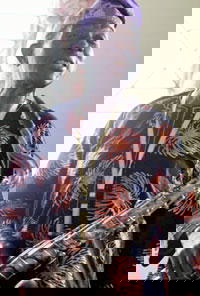
Pa Ajilo
By AYO ONIKOYI
We continue from last week, our journey through the mind of one of the great music makers and managers the country has ever had. Chris Ajilo was at the Vanguard Corporate Office some weeks back and he opened his heart for the whole world to see the road he had travelled in life.
He was accompanied by Beautiful Nubia who granted us an interview but when it was Pa Ajilo’s turn, he kindly declined. “I have been interviewed too many times. There is nothing new to be said about me that hasn’t been said before.
Everything you want to know about me is in the book”, he said, referring to “Reminiscences of a Nigerian Pioneer Musicologist”, an autobiography of his life he launched in January of 2013. “It is my gift to the future. It took me two years to complete and I am proud to say I wrote the book without assistance from any quarters.”
“I am not only a musician, I am a Copyright man, a Trade Unionist, a man that makes use of his hands and his brain” he said. “Read the book and you will share in my experience, the journey I had to travel through life”. So, we took a journey into the mind of a great man through pages of his own autobiography:
Taking music to the next level
Right after the West End Cool Cats experience he became obvious to Ajilo musicians were not being placed in their pride of place in the scheme of things and in the face of seeming economic boom in the country he began a quest to find identity for musicians.
His band, Chris Ajilo and his Cubanos was formally launched on August 1, 1955. The member were Johnson Omooba, trombone, Tex Lati Oluwa, double bass guitar, Lander Sasore, bongos, Akanni Martins, guitar, Candido D’Ajax, conga drums, late Bayo Martins, jazz drums and vocals.
Later, Tony Obbs and Marco Bazz on alto sax and trumpet respectively joined the band. The band embarked on many tours across the West African sub-region and it was during his first recording in Accra, Ghana that he met a woman he fell in love with, Sarkiorkor Ayittey.

Pa Ajilo
“The band recorded six songs which include Iku Eko, Anna’s Trick, Irin Ajo, Gbo Temi Sisi, and two others as instrumentals” Pa Ajilo wrote.
After their first recording in Accra under the Decca Record Label, Chris Ajilo and his Cubanos continued on more tours, transversing the length and breadth of the country and some cities in the African sub-region. It was on one of such tours that Chris Ajilo had his first encounter with the law, when he was charged for manslaughter for being knocked down by a truck, whose driver did not even turn up for the trial. The development halted the progress of the band and the band did not come together to function as a unit until the end of the case.
Birth of music unionism
The inaugural meeting of what was to be the Nigerian Union of Musicians held at the premises of the late Bobby Benson in Yaba, Lagos. Amongst the musicians present were late Hubert Ogunde, Willy Payne, E.C. Arinze, Chris Ajilo, Steven Amaechi, Eric Onugha, late Zeal Onyia, Amaefule Ikoro, and unionists present include Tunde Amuwo, late Akinremi Cole, late Aboyade Cole.
Their objectives were simple as events of late 1950s demanded. Foremost on their menu is the interest of all musicians; working conditions of music professionals; enlightenment of musicians about professionalism; establishment of a music school and registration of the Body.
These objectives were to be further expanded after the problem the Union faced during the country’s preparation for the Independence celebration in 1960. During the months leading to the Independence Celebration the hottest debate and expectation was who would be contracted to perform at the Independence celebration and when members of the Union got wind of the government’s plan to contract United Kingdom based bands to perform, the machinery of the Union was put to test and it proved itself adequate in squashing the government’s plan even though some of its members worked against the collective stand of the Union.
“ Through the concerted and united efforts of the musicians who stood by the decision of the Union, Nigerian musicians proved that unity and good devoted leadership would always bring success into the industry” wrote Ajilo, who by that time had moved up from his position as First Vice President to the President after the former President, Bobby Benson, resigned for his contrary stand to the collective stand of the Union.
The Nigerian Union of Musicians later grew in importance and subsequently got affiliated with the Nigerian Trade Union Congress, then headed by Chief Michael Imoudu. Chris Ajilo remained the President of the Nigerian Union of Musicians and an executive member of the Nigerian Trade Union Congress.
Fighting piracy
Since the birth of music and other intellectual works of art there has been what is called piracy, which according to Chris Ajilo is simply “ the unauthorised duplication of other copyright owners sound recording for profit”. Chris Ajilo identified Chief I.K. Dairo as the forerunner of the fight against piracy, as the leader of Juju Musicians Band Leaders Association.
Chief I.K. Dairo reportedly led a crusade to have some pirates arrested but his effort was chequered by some of the musicians who felt the pirates were doing them a favour by promoting their works even if it was without their consent. This development, according to Chris Ajilo, led to the formation of Performing Musicians Association of Nigeria, PMAN.
As a man who has studied music, managed music and have promoted music, getting involved in its politics and many intrigues that come with it, Chris Ajilo identified the following as being the causes of piracy: lack of the artiste’s enlightenment; poor marketing strategy from Record Company; overzealousness from the artiste for quick returns and dishonesty from record dealers. The music master went into details to explain each of the causes in his book.
Students and disciples
During Chris Ajilo’s sojourn abroad and at home, the music master met and interacted with so many other artistes who in one way or another shaped his life. He has the bragging right of saying he learned from the masters just as he too groomed so many music Greats who grew out of his hands.
His first band, Cool Cats Band, was formed in 1953 in Birmingham and the original group consisted of Kazool Anifowoshe, a.k.a. Karl Moody, trumpet, late Sammy Lartey and Bobby. The Cool Cats Band was later reborn in Lagos in 1955 with more musicians joining the group.
Ajilo’s first student, as he recalled was a Nigerian sailor back in 1955 by the name of Gabriel Macdonald. Tajudeen Animashaun, the legendary Baba Ani who played with the Egypt 80 of late Fela Anikulapo-Kuti was also one of Chris Ajilo’s students. Others include Kabaka Layi Ajayi, Don Kemona a.k.a. Don Amechi.
The turning point
Success was never at any point thrust on Ajilo, his life was a gradual process with each moment to savour through hard work and dedication. Whatever he achieved he must have merited it at some point in his life. However, Ajilo noted “ A remarkable turning point in my life came on the invitation from Phonogram Records Limited through its recording engineer, late Etim Udoh” who engineered Ajilo’s clinching of the recording company’s staff music producer.
His brief was simple: scout for good recording artistes and promote then on the company’s recording label. This, was a mission Ajilo took with great intensity and it was therefore not surprising, that the result came with resounding success. Those who had left the recording company came back and others who joined prospered. Notable are Chief Stephen Osita Osadebe, Douglas Olariche, Mike Ejeagha
As he recalled in his book “ There are certain qualities in an artiste’s cassette that could qualify the artiste as being good for recording. These include the quality of music and meaningfulness of the lyrics; good voice; clear diction and good personality”. Ajilo had series of run-ins with artistes he prevailed upon that they should improve either their diction or voice before they could be considered for recording. He held this position from 1979-1996 and later as consultant from 1992-1996.
Disclaimer
Comments expressed here do not reflect the opinions of Vanguard newspapers or any employee thereof.