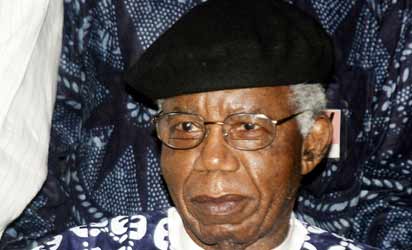
Late Prof Chinua Achebe
By Douglas Anele
In his thought-provoking riposte on Nigeria entitled The Trouble with Nigeria, Prof. Chinua Achebe explained that the principal reason for the horrible state of affairs in the country has nothing to do with geography or climate or the kind of food Nigerians eat. Rather, he says, the trouble with Nigeria is the recurrent blizzard of mediocre and corrupt leadership.
Now, the title of our discourse today is almost identical to that of Prof. Achebe’s little book except that, unlike the latter, it unambiguously suggests that there is something definitely wrong with Nigerians. Also, our title draws attention to the fact that the trouble with Nigeria is connected to both the leadership and the followership.
Obviously, Achebe was essentially correct in his diagnosis of the fundamental problem of Nigeria. What may not be quite obvious is that there are peculiar character traits in the generality of Nigerian people which not only encourage mediocre leadership but actually breed and reproduce it.
Given that Nigeria has drifted further backwards since Achebe’s little book was published in 1983, it is imperative for us to analyse afresh how things stand presently, especially in the current administration of President Goodluck Jonathan. For starters, it can be justifiably argued that in several areas President Jonathan’s government is manifesting the kind of leadership failures that Achebe discussed in The Trouble with Nigeria.

Late Prof Chinua Achebe
For example, I and several other concerned Nigerians have been calling for the eradication of indiscipline and drastic reduction in the astronomical cost of running the owambe democracy we are operating presently. But Mr. President seems indifferent to bourgeoning indiscipline from his subordinates and to the financial haemorrhage and inefficiency caused by his over-bloated cabinet. As a result of this, the leadership of the National Assembly, state governors, presiding officers of state legislatures, and others down the line are following his footsteps by wasting available scarce resources in appointments of doubtful value vis-a-vis effective delivery of quality service to the people.
One of the most important qualities a good leader must possess, aside from above-average intelligence and healthy disdain for power and wealth, is the capacity to make wise judgment especially with respect to decisions that might have adverse consequences on peoples’ perception of the direction the leadership is moving. In this connection, a lot of Nigerians are becoming increasingly convinced that President Jonathan is basically unpatriotic and egoistic, because he appears to put narrow selfish Machiavellian considerations above long term interests of Nigeria when taking important decisions.
For example, the President worked actively for jettisoning of the zoning arrangement of his political party, the Peoples Democratic Party (PDP), which would have meant the emergence of a northerner as the party’s flagbearer in the 2011 presidential elections. The zoning arrangement, despite its weaknesses, was a pragmatic way of ensuring that the presidency rotates between the north and the south at least every eight years. However, by sabotaging it he portrays himself as a leader who rejects agreement when it does not suit him.
More tellingly, the President, like a typical Nigerian politician desperate for elective office, must have made some promises to prominent northern elements he successfully recruited to back his action. And the concessions based on egoistic political calculus would compel him to make choices that are detrimental to the collective interests of Nigerians. It is very unlikely that President Jonathan would have worked against zoning if at that time the system favoured his ethnic group.
Another case of misjudgment against President Jonathan was when he attempted to change the name of my illustrious alma mater from the University of Lagos to Moshood Abiola University, without even consulting immediate stakeholders of the institution – staff, students and the alumni association. Shortly after he announced the decision and the students’ protests that followed as a result, I demonstrated that the name-change, probably motivated by a futile desire to please the Yoruba establishment, was a horrible act of bad faith.
Clearly, Mr. President grossly underestimated the significance of the designation, ‘University of Lagos,’ not only for staff and students of the university but for a broad spectrum of the Nigerian public as well. Right now it appears that common sense and reasonableness have prevailed: according to Chairman of the newly reconstituted Council of the University, Prof. Jerry Gana, the President has corrected his mistake; University of Lagos remains University of Lagos – never mind the ill-advised statement of an official of the Federal Ministry of Education that the ministry has not received any directive to that effect.
An important lesson for Jonathan from that unfortunate event is that it is wrong to take people for granted or place politics above established academic tradition in arriving at decisions that would adversely affect the image and brand of a well-established educational institution. President Jonathan has been accused of bias in favour of his geo-political zone with respect to a number of key appointments.
Veteran columnist, Dele Sobowale, reports that under Jonathan’s watch, among several other important positions, the new chairman of PDP’s Board of Trustees and the Chief of Staff in Aso Rock are both from Edo State; also his two most powerful Senior Special Advisers are from Edo and Bayelsa states. In Nigeria, arguments about ethnic distribution of official portfolios tend to be more emotional than rational, because issues of merit and track record are sacrificed on the stinking altar of “ethnic balancing” and “federal character.”
In 1970 the United States’ government started implementing something akin to the federal character system called “affirmative action” to take care of historically disadvantaged groups like black Americans and women who were for decades (even centuries) denied certain fundamental rights by extant laws. The policy was successful largely because the officials in charge tried hard to sustain merit within the system. In our own case, the federal character provision in the constitution has been terribly bastardised and misused by little-minded military dictators, cash-and-carry politicians and ethnic irredentists to dismantle structures created for meritocracy in favour of mediocrity.
To be concluded.
Disclaimer
Comments expressed here do not reflect the opinions of Vanguard newspapers or any employee thereof.