By Adisa Adeleye
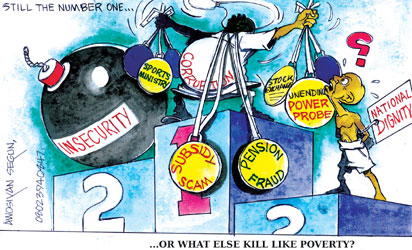
The statement that Nigeria is a poor country with widespread poverty is axiomatic. It is estimated that more than 75% in the Nigerian population live in squalor and could hardly make a decent living from what they do. This situation calls into question the general assumption that a country blessed with crude oil and other mineral resources and also endowed with natural human talents would have anything to do with deepening poverty and its attendant sufferings and deprivations.
If it is believed in certain quarters that there might not be a direct link between poverty and Boko Haram insurrection, there is that indirect connection between idle hands and those bloody fingers that detonate deadly bombs. It is true that the fire of insurrection is constantly stroked by idle hands and empty brains.
Here in Nigeria, we may not need the experience of the former President of the USA, Bill Clinton and the decisive writings of newspaper columnists to see clearly that all is not well with Nigeria as a nation. Even within the rank of government apologists, there is this belief that things could be better in the prevailing circumstances.
I hold firmly to the believe that poverty is a fall-out from inflation and corruption and the poor official response to these evils. As noted earlier in this column, inflation is regarded as a process of rise in prices. Thus, inflationary process would come about as a result of changes in demand or supply conditions, or both. However, the essential feature is that demand exceeds supply at the existing price. 
This is likely to occur once the zone of full employment is reached (3% of unemployment or less but no exact percentage would be given at the point where the inflationary process might commence). For example, if there is increase in demand without increase in output, there might be increase in price temporarily until output is expanded to meet increase in demand. Similarly, if the output is reduced, even at the existing level of demand, competition among buyers might push up the price temporarily until adjustment is effected.
In the Nigerian context, if inflation is understood as “too much money chasing too few goods”, it stands to reason that the answer lies in increasing the number of goods that money can buy. Precisely, this means that increase in output is the direct answer to avoid increase in prices.
Inflationary process in a developed economy would always be at the point that when full employment is reached, but in Nigeria there is large scale unemployment and idle capacity in the manufacturing sector. Thus, the effective measure to combat abnormal rise in prices is injection of funds into the national economy to stimulate effective demand and thereby increase investments in the real economy. The manufacturing sector would be influenced to increase output through re-activating idle plants and getting more hands on production.
However, to the surprise of many developmental economists, the official reaction to inflationary process and unemployment is a blind adherence to a tight monetary policy which includes a depreciated Naira.
It may be assumed that the defensive mechanism of a Nigerian whose income is threatened or affected by inflation is to find alternative means of maintaining a status-quo. Thus, the temptation to earn more money by all means, right or wrong. The punishing exchange rate of N157 – N160 to a $ has consigned many Nigerians to the users of second-hand articles or cars as prices of new commodities are beyond their reach. If corruption means earning money through non legitimate means, then the temptation of many Nigerians to defend their income threatened by (inflation) through all means becomes understandable.
The inequitable distribution of national income has created the zone of ‘Very Rich Nigerians‘ and that of ‘Very Poor Nigerians‘. There is no buffer zone of the middle-class to soften the anger of “the poor” against “the rich”. From the zone of the poor have emerged the corrupt (those who want to create more wealth), the armed robbers, the kidnappers, and the destructive agents of insurgencies.
It looks as if the power of money is the only thing recognized in Nigeria as the decider of everything. In an environment where education is not cheap, where healthcare is expensive, and the standard of living is higher than the reach of ordinary people, and where social services are painfully inadequate, the road to anarchy is wide, smooth and tempting. Taking into consideration the destruction of life and properties in the North; the kidnappings and ritual killings in the South; and armed robberies everywhere; the difference between the Hobbesian “State of Nature”, and the Patriots description of a “failed state” is not too wide.
It must be emphasized that the current situation of the country is not an analysis of the failures of President Jonathan but rather, a lively discussion on what Nigeria our dream should look like, and what it is at present. A situation where Nigerians cannot move freely in their country and where foreigners could be kidnapped and killed mercilessly could not be described as an ideal one.
The truth is that Nigeria’s problems have been politicized and sectionalized, but vaguely analysed. The subject of Security which should be of national concern is treated as a party affair, for the PDP government alone to solve. This would get us nowhere as events unfold that insurgency has become more sophisticated and violent. Also, Nigeria‘s social problems have become more complex and more extensive to be left in the hands of a political leader, however clever and intelligent.
If the analysis of a ‘failed state‘ as described by the illustrious members of the Patriots seem offensive and frightening, it is up to the present leadership to devise means of preventing the rush to anarchy by trying other progressive policies that would appeal to more progressive elements in coming to the aid of the country.
There is no running away from a meeting of Nigerians to discuss amicably about happy relationships. You may call it any name that is suitable or convened under any atmosphere that would satisfy the yearnings of all Nigerians who would like to live a life of happiness and prosperity in a place called United States of Nigeria (USN). Some even envisage a new constitution which will ensure and preserve the federal nature of the country and not a unitary one being operated at present. It could be named Jonathan’s Constitution like Macpherson‘s Constitution.
Disclaimer
Comments expressed here do not reflect the opinions of Vanguard newspapers or any employee thereof.