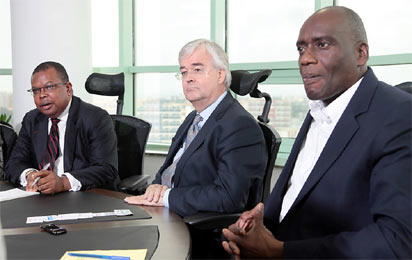
*From right Mr Seyi Bickersteth Senior Partner KPMG Nigeria, Mr Andrew Michael, Global Chairman KPMG and Joseph Tegbe at a media chat in Lagos.
By Omoh Gabriel, Business Editor
Recently, the Global Chairman KPMG, Mr Andrew Michael,was on a working visit to Nigeria. He had an interactive session with some journalists at the KPMG head office in Victoria Island. He was supported by Mr Seyi Bickersteth, Senior Partner, KPMG Nigeria and Joseph Tegbe. Andrew spoke on several issues and the prospect for Nigeria in the global economy.
Introductory remarks
I will like to start from the global environment of banking and then relate that to Nigeria. I think this is the first time in a number of years that we are not facing any crisis moment. I think we are no more facing any implosion in the global banking system or things that are sought of out of control.
I think the mood in the international business community at the moment is that we are probably going to get back into a growth pattern in the latter half of this year and that has largely driven the soft landing in China and the regeneration of Chinese growth.
The very fact that we are seeing a re-industrialisation of the United States, where the existence of shale gas is moving tremendous investment in manufacturing back into the US, we are seeing stability in Europe, there is no immediate risk of a currency implosion and the social and political risk that we are sure of in the Middle East are probably more manageable now than they have been.
So, businesses are actually saying, now where can I find growth and how can I diversify my business model to take advantage of the new opportunities that the emerging world presents? Interestingly, because of the lack of confidence in the global market at the moment, there is a huge amount of cash which will be moved into several asset classes. Initially, they are going to be moved into the stock market, then they will move into the property market, then they will start to move into real business investment, into economies such as Nigeria.
So everyone is watching where this cash goes and the real question is what are the factors that will actually drive this growth and people are looking for a growing middle class, they are looking for predictable regulatory environment, and they are looking for stable and transparent corporate governance economies.
In the last few weeks I have been to Mexico, Indonesia, India and then Nigeria, and their similarities are remarkable-between those economies and these are the ones attracting a lot of interest. In the last few years, we have talked about BRICS as been the area of focus, but if you talk to international investors, there view will be that the BRICS with the exception of China has been quite disappointing, that they have found it difficult to invest in these countries.
Their regulatory environment is unpredictable and that they have not been able to get return on their investments. People now talk about the MIINT Mexico, Indonesia, India, Nigeria and Turkey. They are the four countries that the international investors are really focused on for growth and investment.

*From right Mr Seyi Bickersteth Senior Partner KPMG Nigeria, Mr Andrew Michael, Global Chairman KPMG and Joseph Tegbe at a media chat in Lagos.
The offers are intense and we are getting a huge amount of enquiries about these countries. People want to know how to do business in these countries, how to access the markets and how to take advantage of the long term growth that is coming.
If you are a CEO and you are seating in London, New York or Frankfort because the market is growing and the cash inflow to these market, the market are putting pressure on the CEOs to try few new markets where they can find growth. Particularly, in things like consumer markets, financial services and food and energy are the ones that they are really focused on in these emerging economies.
They know that they have to be here and they know that they have to have a long term view of the market. So, they are actually studying they market entry plans for these countries. So these are the macro trends that we are actually seeing in economies around the world.
For companies like KPMG, we are focused on making sure that we participate in these high growth markets. We have to make sure we have the right expertise and services that are actually required by international and local investors who are starting to look beyond their country boarders.
One thing that interested me about Nigeria this week is the amount of pan-African investments that I have seen in the country that are based outside Nigeria. We have seen also a lot of Indian investments where our business models have worked very well. These are my opening comments. I will like to know if there are any particular questions that any individual might have.
I will also like to put ASIAN to MIINT because of the recognition of free trade in those countries. Singapore, Malaysia, Thailand, Vietnam, Miama and Indonesia is a large market of about 750 million people where there is common infrastructure, planning and customs regime.
Investors are looking at that and I think they can compete with China. I think part of the point for Nigeria is that it actually competes now for investment with Indonesia, South America and Mexico. When international investors look at these countries, there are certain features that they will like to see, which actually influence their investment.
Let me take you on KPMG’s impression of Nigeria. Most times when global CEOs go into a market, they don’t just give a pat on the back of those managing these economies domestically. What is the biggest ambition that has brought you to this market as a global CEO?
Well, it is probably a broader perspective on Africa. We see Africa as its time has come, it is going to be the engine of growth of the global economy for the next twenty to thirty years. We actually regard the Nigeria practice as the best practice in Africa, so if we can replicate what happens here and leverage the skills that we have across broader Africa, then that is a smart business strategy for us to employ. We have been here telling international investors about project Africa and that we can actually tap skills and talent and business models here into other markets. So, what we are doing is more broadly across Africa.
People see Africa as the engine of growth and agriculture is one of the major area of focus because they say Africa is going to provide food for the world. So, are you looking at investing in agriculture?
Certainly, I think 43 percent of people here are employed in the agricultural sector and there is going to be a tremendous capacity to be more efficient and productive over time. It is one area we are looking at. We are also looking at consumer markets, financial services, energy (downstream), we will also see how we can assist in converting petrochemicals into fertilizer for agriculture.
Then you start to look at manufacturing because if you have a fit and competitive energy base, then you have the ability to start to utilise the substantial population that you have here. Agriculture is just a small part of what we are looking at. We are looking much more broadly at the services and the financial markets in particular.
You just mentioned the financial system, if you look at the stock market that is just coming up now, do you think the current growth will continue?
I think part of the growth of any economy is that you have to have access to capital. You are going to be constrained locally if your market is not liquid or if there is no efficient governance and capacity. The pleasing thing today is that in the international market, there is a great appetite for companies with good exposure in the high growth economies. The ability to be able to list in London and Singapore for example, shows that a stock is attractive. Nigerian companies must convince investors in other exchanges that they have the governance and capacity to attract investments.
Seyi cuts in Let me just say something else too. I think part of the problem that we had during the last crash was that we had too many foreign investors in the local market and during the global financial crisis, a lot of them pulled out to be able to recover their investments in their country.
AS Michael explained, we have seen a much stronger economy now, so people are feeling much more confident, there isn’t a need to cover back losses. We have seen them coming back as their economies recover and they are investing again. Also aligned to that is that we now have a capital market which is transparent, accountable, which retail and institutional investors can believe in.
I think the reform that we have made in our capital market in the last two to three years is beginning to have effect on the market. I think the answer to your question is that if those things can remain, we will see a much more better market much more than it did the other time. But remember that in the capital market, we have boom and burst periods. But I am sure we will not see the bubble burst like we had the other time because quoted companies now have strong fundamentals.
In addition to what he has said, the reforms you have seen in your stock market has ensured increased corporate governance practices by local companies. Again, that will also shield these companies from the kind of shocks that we experienced the other time.
Joseph Tegbe cuts in.
I think part of the challenges we have had globally is the lack of US investment into China. This is because we had this Chinese back door listing issue where you have many Chinese companies come to the US market and these companies had very low governance structure and the monies they raised were lost by fraud, a situation that led to US investors refusing to invest in China. So investors are looking for economies with the lowest risk of poor governance and transparency and integrity.
I am directing this question to Mr Andrew. What is your opinion on the power sector reform in Nigeria, particularly the recent sale of the DICOS and GENCOS? Seyi
My own opinion is,philosophically and fundamentally, I am for a compression of the public sector. So, anything that compresses the public sector and expands the private sector is what I like to see in Nigeria. I think that at the end of the day, our salvation is going to lay in that direction.
You can say what you want to say about the private sector, but we know especially with a country like Nigeria that the private sector is much more efficient and effective than the public sector. So whatever we can do to privatize government assets is okay by me.
I for sure welcome the sale of the power assets. What we have to ensure is that we sell these assets at the right valuation, and that the process for doing it is very transparent. For what I understand, the process is being handled by someone I have a lot of respect for-Mr. Atedo Peterside.
The process has been very transparent, you are not going to satisfy everybody in this particular deal. My own opinion is that we move forward. We need to move forward because if we don’t, we are going to have a real problem. It has been shown quite clearly that the public sector cannot deliver the amount of megawatt that we need to form and effective industrial base in this country.
We need the resources and the expertise of the private sector. So, on overall bases, I will like to say it’s something that I welcome, the process has been fair, valuation from what I understand has been fair. Let’s move on and deliver the power objective that we say we want to deliver.
Still on the power sector reform, there is this impression that the Federal Government set up a body which did a very fantastic job. It disbanded and put it up again even with the new Power Minister and the private sector is uncomfortable.
I will tell you this without going into why this taskforce is been disbanded. We all know how government works, but I have been in functions and interacted with very senior people in government. The conclusion is that deregulation and privatisation is the way forward. Government has no business in business, that is the reality.
If we look at it, we have priority sectors such as education and health sectors, which are major sectors for this country. The kind of Gross Domestic Product (GDP) contribution from those sectors is very minimal so the thsrust of the reforms is that we change the way we use to do business.
The key thing is that proper due diligence has been done, and liabilities are properly accounted for because all these agitations are coming from unions and pensioners. When this is done and the liabilities are settled properly, there will be no problem.
The reality is that we are generating just 4, 000 megawatt, there is a company that is just been set up in Dubai, where they are getting Coal for aluminium smelting from Australia, that company alone requires 6,000 megawatts for operation. Here we are talking about 4,000 megawatt for the entire country.
It is time to move forward. Let’s face it, there will be vested interest from government, public and private sectors that will not want us to go ahead with the reforms in the power sector. These vested interests are very strong. We have seen them in pension and the petroleum subsidy saga.
I think the most important thing for us as a nation is to focus on the goal we want to achieve for the common good. What is good for all of us is to have enough power so that we can generate the middle class that we want to generate and develop the SMEs that should be the focus. Let’s say to government deliver on your promise, deliver the deliverables in the energy sector and let us move ahead.
Government cannot deliver, they have been there for so many years let’s try something else. Mr. Andrew, given what you must have red about Nigeria and this is your first time of coming. Can you juxtapose what you have seen with what they have told you? What I see is a very vibrant economy and a very good class and sophisticated business people.
A see a very large population who are very nationalistic and very focused on the direction of the country, I see unity, and I see huge potential having studied the amount of oil reserves, the agricultural sector and the stability in the banking system and the entrepreneurial ability of some of your large companies.
What I have seen so far is very positive. I think you have a brand image that is still negative, there is still this global perception about security and corruption issues, which are largely been addressed. The reality is peoples thinking out there is very different from what is happening here. What strike me also is the need for investment in infrastructure and some other things that need to be put in place.
There is a need to invest in rail, sea ports and airports to attract more international investors. From day one I sure the need for internationally standard infrastructures, But having come from India, Indonesia and Mexico, I can tell you that you are at the same level, they are also fighting for investments in these critical sectors.
Mr. Andrew looking at Nigeria which earns 90 per cent of its revenue from oil and the US which was a major buyer of Nigeria’s oil is developing its own energy, very soon it will the energy self sufficient and Europe is facing sovereign debt crisis, if you were to advise Nigeria what will you tell our government to do?
Let me cover the energy sector first. I think the very disruptive force in the energy sector now is the discovery of share gas in the United States, which is basically providing the US with a huge competitive advantage over the rest of the world because it now can produce gas for $4 while in the rest of the world it is $15.
Oil cost 15 times more than the shale gas and if you get the US to reduce its import reliance and became an exporter, that change the focus on oil in the world economy. But this will take a long time to happen. There is going to be environmental issues, safety and the US needed to satisfy its local market before it start to look at the global economy.
But over the long term when shale gas is efficiently exploited around the world, you can see a long term adjustment in the oil price downwards. So my advice is to make sure you diversify the economy and to make sure you actually put your risk on any particular commodity and use the competitive cost advantage of other economies to drive other sectors of your economy.
You this by making sure that other sectors in your economy are competitive using the advantage you have to access to low cost and efficient amount of oil reserves. Seyi cuts in My own advice is this you have a window of opportunity, it is not growing bigger it is narrowing you better make use of that opportunity to diversify the base of your economy. I have always had the opinion that if you take oil out of the equation we will be a much better country.
What happen now is that some guys dig a hole in the ground and tell the Federal Government, you take 60 per cent and we will take 40 per cent and then everybody goes to Abuja and queue up and say where is my own allocation and then they go on and spend. It is not going to work that way.
That is not the real world, the real world is to say develop your own economy, concentrate on your competitive advantage and develop your entire value chain. WE have people with sufficient energy and entrepreneurial skills to develop this country without the hang on of oil that we have now.
Oil still will play an important part but use it to develop your infrastructure, educate your people and diversify your economy. Government has virtually moved away from the airline business and the companies we have in that sector, locally and internationally have huge debt overhang.
From your understanding of that sector, how can we salvage the situation there? I can tell you that you are not going to solve the problems in aviation with government been a top player, with government buying 30 aircraft and say we are going to have Nigerian airways and so on. We have all gone through this before, when I was growing up I knew that we once had Nigerian Airways.
We all knew what happened that that effort. What has to happen is that you have to empower and trust the private sector so that people can put their money there and make sure that it works. Richard Branson came and made an investment into Virgin Nigeria, the only thing he asked for was let me use MM1 as a regional hub and the Federal Government of Nigeria agreed to this, then we had a change in regime and vested interest decided to frustrate the agreement.
They guy walked away and we handed the industry to people who do not have experience in that sector. What do you expect? The whole thing collapsed and we are in a situation where we are in now. Government going back there will not make it work, if they set up a company now in the next 10 years it is going to fail.
What government has to do is to put incentive in place for people to go into the aviation industry, which is not an easy investment to do. They say if you are a billionaire and you want to be a millionaire, go into the aviation industry! In all your interventions you keep saying vested interest, how do we deal with this interests as a consultant advising the government?
It is not only my responsibility it is the responsibility of all of us. If you look at the track record of KPMG for instance, you know what we did with pension, the issues that we raised as regards to pension and fuel subsidy. We have done our part not only as a firm but as individual wherever we find ourselves.
As journalists you have a responsibility to educate people responsible. I respect a lot of you because of what you write in your columns. We need to clean up the judiciary and I am happy with what has happened in recent time
in that area. What I am saying is that the fighting of the vested interest is the responsibility of all of us and you as journalists are also included.
It is a battle that we can win if all of us say enough is enough. Just like Michael said, if you go to Indonesia and Malaysia they are facing the same problems. The key issue is how do we ask for accountability? Let’s go back to the aviation sector. Even the private sector companies in the sector are not effective what is then the solution?
Look we’ve got to have a regulator that is effective. Not the one that is on holiday all day. You must have a regulator that will say I am standing above the frail and I am going to insist on standards. But you and I know what has been happening in that industry. Back to what Andrew said the business model of operators in the aviation sector is flowed!
I use to tell people to tell me they want to go into that sector that it will not work, to go international go for a low cost carrier model and stick to regional and domestic market because your are incapable of competing with international careers. For them it is an ego thing, they want to compete with the likes of Emirates, Itihad, Kattah Airways or even British Airlines. For your information even the big airlines in Europe are suffering.
Disclaimer
Comments expressed here do not reflect the opinions of Vanguard newspapers or any employee thereof.