By CHARLES KUMOLU
ALL over the world medical tourism has become a major source of income. Saudi Arabia, India, Germany and even Dubai earn very high revenue from medical tourism as a result of the huge investments their governments and individuals made in constructing and equipping hospitals, laboratories and other medical centres with state-of-the-art facilities.
Nigeria loses billions of naira yearly through Nigerians who travel abroad for medical check up and treatment. It is common knowledge that teaching hospitals, general hospitals and other medical centres lack basic facilities to attend to patients. In the past few years, however, the Federal Government has made some efforts to improve the facilities of teaching hospitals.
Global medical tourism
Recently, the President of the Nigerian Medical Association, NMA, Dr. Osabon Enabulele, disclosed that India earned over $260 million from medical tourism from Nigeria alone in 2012. He noted that India is projected in 2013, to realise between $1 billion and $2 billion from the global medical tourism market that is collectively worth over $20 billion.
His assertions indicate that Nigeria which is one of India’s largest patron will greatly contribute in percentage to this expected revenue. The NMA President stated that the decision of Nigerians, particularly political office holders, to seek for improved medical healthcare abroad is costing the country over $500 million annually and that a breakdown of the figure shows that an average Nigerian traveller on a medical tourism spends between $20,000 and $40,000 on a trip.
In his lamentations, Enabulele explained that about 5,000 Nigerians visit India and other countries in Europe and America every month in search of various medical diagnostic services such as Magnetic Resonance Imaging, MRI, Computed Tomography, CT, scan, Electrocardiography, ECG, mammography and dialysis services as well as treatments to medical conditions that can be satisfactorily managed in the country.
This situation, if not redressed, will continue to drastically reduce the nation’s foreign exchange which could otherwise be utilised in improving infrastructure. This is why analysts want indigenous and foreign investors to see Nigeria as an investors’ haven in medicare.
Observers are of the view that with a population scattered across the world yearning for medical attention, the privileged few who can afford to travel abroad for efficient diagnosis and treatment will have no need for frequent trips abroad.
For instance, the Governor of Kogi State, Idris Wada was involved in a vehicle accident and received satisfactory medical care and attention in the country. This move was described as worthy of emulation and a good example to the high and mighty in Nigeria.
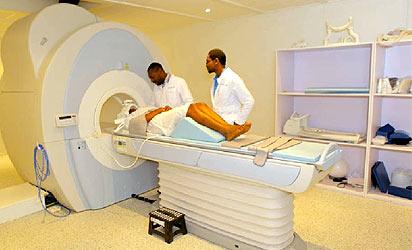
One such private initiatives that has provided state of the art equipment in medical diagnosis is the Lifebridge Medical Diagnostic Centre located in Abuja, the Federal Capital. The Minister of Health recently visited the institute and was overwhelmed by the various hi-tech equipment available there. They include the Magnetic Resonance Image, MRI, scanner which is the first 1.5 Tesla installed in Nigeria till date. What is available in Nigeria are the .32 and .35 models.
The machine is able to image the brain to show areas affected by disease and stroke as well as cancer. It can also show blood vessels within all parts of the brain and the neck. These images can then be sent to any part of Nigeria and the world. The MRI is safe for pregnant women and babies.
Others are: The 64 Slice CT computerised scanner. This equipment is the sharpest in its class and can capture the image of a beating heart in five seconds. It can also be used for whole body examination and screening for colon cancer. Internal injuries are very clearly seen as well as brain injuries due to accidents.
*Mammogram machine: This equipment detects and confirms breast cancer.
*Ultrasound and Echocardiagram: This machine picks up the internal structure of the heart and changes due to hypertension and heart failure.
*Ultrafast Digital X-ray Machine: It can handle 69 patients x-rays in one hour. The completely computerised machine does not require any darkroom or processing of films.
*Dialysis Machine: This is a six bay dialysis unit with adimea computer software which guarantees the real time monitoring of completeness of treatment.
The Medical Director of the centre, Dr. Philip Ume-Ezeoke, a consultant physician laments the situation where high profile Nigerians travel abroad for cure to ailments that are readily available in Nigeria. He gave an example of a medical facility in Kaduna where ENT surgeons receive patients from abroad on daily basis.
Knowledge and expertise
If these foreigners appreciate the knowledge and expertise of our consultants and consult them for medical attention, why should we ourselves not realise that we don’t need to travel abroad for what is available here with us even at reduced cost.
Ezeoke, who specialised in accident and emergency medicine, stated that Lifebridge has two fold mandates – detect diseases and refer Nigerians to appropriate specialists because people are not really aware that these services and specialists are available in Nigeria and also make available the latest technology-based equipment in diagnosis as good as, if not better than, those they attend abroad at much higher cost.
He asserts that the 1.5 tesla MRI scanner in the centre is called the ‘cold magnet’, a new Japanese technology that they acquired as the first in Africa and the third outside Japan. “The expertise to manage, consult, select and advise is here,” he said.
Accordingly, all services in the Diagnostic Centre are interconnected across the three floors, with a top of the range G.8 computer server and network. The centre has uninterrupted power supply, ensured by 2no 350KVA generators and a 160 KVA UPS battery bank. A dedicated water treatment plant ensures water quality, a situation rarely seen outside the University Teaching Hospitals.
No wonder the Minister of Health, Professor Onyebuchi Chukwu, after a visit to Lifebridge Medical Diagnostic Centre commended the promoters for “the quality and scope of their intervention”, describing it as a practical demonstration of private sector investment and support of President Jonathan’s health programme.
Disclaimer
Comments expressed here do not reflect the opinions of Vanguard newspapers or any employee thereof.