By Prince Bola Ajibola (SAN)
The former Judge of the World Court, HE Judge Bola Ajibola delivered this paper at Metropolitan Club, Lagos recently
CORRUPTION is a global phenomenon. It is not an exclusive problem of any nation or society; neither has it just surfaced in Nigeria.
What bugs my mind is the sheer magnitude which corruption has assumed in present day Nigeria, and appallingly so under our democratic dispensation, a situation which calls for more drastic actions than rhetorics. Indeed, as some people are wont to say, “corruption has been democratised in Nigeria.”
That corruption has permeated all levels of our national life is an understatement. One is sad to see us carrying on as a nation that is bereft of any sense of shame. Indeed, what we are currently experiencing is corruption in absolute terms, and by that I mean the glaring deficit in enviable national character and general moral rectitude. It is a problem that runs through our social strata and most unfortunately, our youths have caught the bug. This is the more reason why the problem is putting the future of the country at stake.
One thing that should be of immediate concern is the negative reckoning this has put us in development ratings among the nations of the world. For years on end, we remain a net importer of petroleum products despite huge deposits of crude oil, of which we are incapable of producing what is barely required for local consumption. The result of the turn-around-maintenance in our refineries and the huge financial votes which accompanied them remain a pathetic mystery. Today, despite our huge reserves of oil and gas, despite our huge deposits of tin and bauxite, iron and gold, and a plethora of other solid minerals, our nation is still ranked among the countries with Low Human Development in the world, hence my allusion to the word backwardness.
Specifically placed in number 156 in a serial ranking of 187 countries, Nigeria is ways behind Libya, Mauritius and Tunisia which are ranked 64, 77 and 94 respectively and are among the High Human Development countries; we are behind Algeria, Egypt, Botswana, South Africa, Morocco, Ghana, Equatorial Guinea and Congo, which are all placed in that order among the Medium Human Development countries; and even among the Low Human Development countries where our country is placed, we are still behind Kenya, Sao Tome and Principe, Angola, Cameroon, Madagascar and Senegal!
Material endowments
Those are just the African countries. You cannot imagine how many nations of lesser human and material endowments across the continents of the world are ranked ahead of Nigeria, and who by implication are running the affairs of their countries in much better ways than ours. Such is the level of degradation we have thrown ourselves as a people.
Never mind that there is always a paid official of the government whose job it is to dismiss such statistics as mere rubbish.
The common belief today is that security challenges pose the greatest threat to our existence as a nation. Of course armed insurgency and threats to national peace by Boko Haram, militants in the Niger Delta and kidnappers are fallouts of a festering tradition of greed, galloping corruption with reckless impunity in high places.
As Socrates stated, “the unexamined life is not worth living”, it is high time we began as a people to excoriate and excommunicate people found guilty of corruption, particularly in our professional and social gatherings, if any serious and meaningful progress will be made in tackling the scourge.
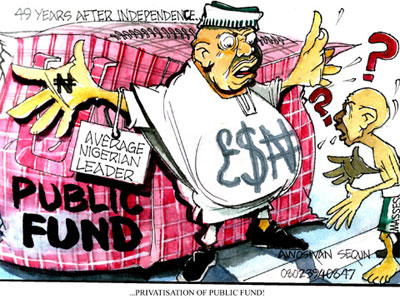
Permit me to say that the brand of corruption in Nigeria today transcends the stealing of public funds, the stashing away of which has earned us the seventh place in the world, according to a recent survey.
It is also embalmed in the kinds of wages our leaders allot to themselves, thus appropriating as we were once told by one who should know, and that is the Governor of the Central Bank, that some 25 per cent of budgeted recurrent expenditure goes to the political class and their appendages.
Of course they would retort that that is what the law says they should earn, but who made those laws? It beats my imagination to think that this is the same country where I served as Attorney-General and Minister of Justice for more than six years without taking any salary and even employed two Legal Practitioners to work for the Government in my office as Minister and paid them from my pocket.
The story of political office holders, whether in the executive or legislature is a sorry departure from the glorious order of old. Today, you are confronted with an exhaustive list of advisers and special advisers; assistants, special assistants and senior special assistants alike. We have surely created ingenious ways and outlets of draining resources out of our petro-dollar dependent and monolithic economy. Our pains as a nation are without doubt, self-inflicted.
Bastion of hope
The story is not radically different in the judicial arm, which unfortunately is relied upon as the bastion of hope. Beginning with a period of horrendous “plea bargaining”, it needed no soothsayer to realise that those acts practically open a Pandora’s Box in terms of the massive public funds pilfering that followed. Some members of judiciary condoned through technicalities with the sole aim of truncating justice, and that in essence bolstered a high degree of criminality, particularly in public service.
The most recent evidence of judicial malfeasance was exhibited in the case of John Yakubu, who was alleged to have stolen N32 billion of police pension funds. According to reports, he claimed that the prosecutors lied; all that he stole was N20 billion. He was found guilty and sentenced to a disgusting two years in prison. Confusion worse confounded, he was given an option of fine – to pay a paltry sum of N750,000.
That was the height of making a mockery of not only the Criminal Procedure in our courts, it also cast a serious aspersion on the judicial system as a whole. As Jean Rousseau observed, “it is not the criminal things which are hardest to confess, but the ridiculous and shameful”. I am still seriously perturbed about how one can rationalise this one case of John Yakubu.
How many people have died in this country without having received a penny of their pensions after many years of waiting? How many have collapsed and died while waiting on long and endless queues to collect peanuts as pensions?
I should like to conclude now by appealing to the government to take bold steps towards bringing corruption to its barest minimum in this country.
It was John Locke who said that “the freedom of men under government is to have a standing rule to live by; common to everyone in that society… and not to be subject to inconstant, unknown, arbitrary will of another man”. That aptly applies to our current condition and what we are required to do. Government should provide for all and be fair to all.
Our educational system ought to be made more functional and guided to address our national needs and aspirations. Government must necessarily diversify the economy to widen its revenue base. And all accruing revenues must be judiciously spent and meticulously accounted for. We should be done with impunity and governmental arrogance.
No section of the populace should be made to enjoy undue advantage over the others; no part of the federation, no part of any state or local governments should enjoy excessive patronage to the detriment of others.
There should be no double standard. The nation must entrench the rule of law. It is extremely imperative. As our late elder statesman, Chief Obafemi Awolowo once stated, “the government is like the sun, it must shine on everybody”.
However, in conclusion, permit me to end with the euphemistic statement once made by Winston Churchill when Britain was facing the adverse effect of Second World War that: “gentlemen, we are progressing backwards”.
Disclaimer
Comments expressed here do not reflect the opinions of Vanguard newspapers or any employee thereof.