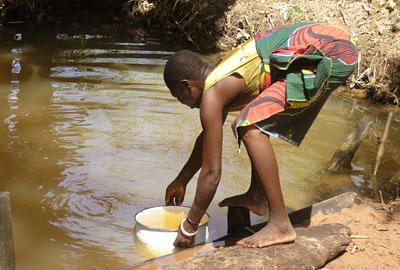
Nigerian woman fetch water from a local pond, which is a source of drinking water making her susceptible to Guinea worm larvae infestation. Photo by E. Staub, courtesy of the CDC and The Carter Center.
By Jude Njoku
No fewer than 334 million people representing 39 percent of the population of sub-Sahara Africa lack access to clean drinking water. Similarly, about 600 million people which is approximately 70 percent region’s population, lack access to sanitation.
Against this backdrop, WaterAid has called on the Nigerian government to support the ambitious target of providing access to water, sanitation and hygiene for all Africans by 2030. The call came at a time Nigerians joined others across the globe to mark this year’s World Water Day which had ‘International Year of Water Cooperation’ as the theme.

Nigerian woman fetching water from a local pond, which is a source of drinking water making her susceptible to Guinea worm larvae infestation.
WaterAid Pan_Africa Programme Manager, Mr. Nelson Gomonda, said: “330 million Africans today live without access to clean water, so the road to travel is long, but we can for the first time see the end in sight. With more than 1,000 African children under the age of five dying every day from diseases brought about from a lack of water and sanitation, Africans will not accept failure. We have to reach this target.”
WaterAid stressed the need to recognise the framework that replaces the Millennium Development Goals in 2015 to reflect the contribution of water, sanitation and hygiene to other areas of poverty reduction, including health, education, gender equality, economic growth and sustainability.
The Group which enjoined the UN to set a new global target to achieve universal access to water, sanitation and hygiene by 2030, also wants the global body to identify ways of accelerating future rates of progress on sanitation if the goal of universal access is to be met by 2030.
Meanwhile, the Nigerian Bottling Company, NBC has expressed its commitment to a sustainable environment through the promotion of programmes that contribute to access to water and water security. To mark the World Water Day, NBC which has water stewardship as a major focus of its corporate social responsibility strategy, partnered with the Federal Ministry of Water Resources, Federal Ministry of Environment, host communities and select schools to contribute to access to clean water. The event held simultaneously at five of its locations across Nigeria.
Specifically in Lagos, NBC donated water storage materials to Agidingbi Senior Secondary School, Ikeja and a demonstration of the unique method of purifying water to make it potable. Speaking at the handing over of the equipment to the school, NBC’s Ikeja Plant Manager, Mr. Dayo Omotosho, said that the bottler’s interest in water sustainable schemes extends to the communities where it operates.
“Given the nature of our business as a bottler of beverages of the Coca-Cola Company, NBC appreciates the importance of water. We appreciate the fact that our ability to grow is related to the availability and quality of local water resources. Therefore, we consciously invest in programmes that contribute to water access and promote water security and by so doing, contribute to the long-term socio-economic development of communities.
“Access to safe water contributes to healthy communities, which in turn releases the full potential of the people in these communities to thrive in their various enterprises. Access to water, therefore, is a major contributor to vibrant and productive local economies.”
Other locations where NBC marked the WWD were Abuja, Kaduna, Owerri and Asejire. The Vice Principal of Agidingbi Senior Secondary School, Mrs. Gladys Nsaka said that NBC’s initiatives on WWD will help the school make better use of water, and enhance the students’ knowledge about water optimization.
“We appreciate NBC for this gesture and promise to encourage our students to cultivate the habit of proper handling of water. Water is very precious: the more water is wasted, the more expensive it gets,” she added.
Disclaimer
Comments expressed here do not reflect the opinions of Vanguard newspapers or any employee thereof.