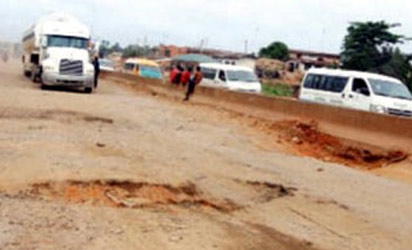
Lagos – Ibadan Expressway
By Akintola Omigbodun
The Federal Government of Nigeria, FGN, has announced its intentions of making new arrangements for rebuilding the Lagos-Ibadan expressway. This expressway has been in use for over 30 years and motorists and transporters currently face unpredictable journey times once an incident occurs that leads to the partial or complete blockage of either the northbound or southbound carriageway.
The incident could be the collision of two or more vehicles, or the malfunction of an articulated goods vehicle or fuel tanker that results in goods or fuel spilling onto the road surface. Sometimes, the fuel tanker catches fire.
When the expressway was being planned in the 1970s, its engineering designs had a road pavement with an asphalt layer as road surface, below which was a crushed granite layer above laterite soil. However, the FGN decided to reduce project costs to meet available resources and the expressway was built without the crushed granite layer. Within a few years of use, the road pavement failed resulting in uneven, corrugated or broken road surface in places.
Attempts to restore the road surface with additional layers of asphalt were not successful as degradation of the road pavement continued. It was only in the mid 2000s that, starting from Warewa, the asphalt layers were removed and the road pavement rebuilt with a crushed granite base course and fresh asphalt layer on top. Currently, the northbound carriageway has a good road surface from Warewa to a short distance beyond the Redemption Camp.
The incidents causing partial or complete carriageway blockage are due in part to poor driving habits, poor vehicle maintenance and poor road surface. There are substantial social costs in lives lost and economic losses include additional fuel costs for vehicles that are delayed, wasted man-hours for persons delayed and increased charges for transportation of goods.

Lagos – Ibadan Expressway
For example, in the late 1990s, an articulated tipper could make two return journeys each day between Lagos and Ibadan for delivery of granite to Victoria Island, Lagos. A prudent estimate would allow for only one such delivery today. In making policy decisions on how to rebuild the expressway, the FGN should consider not only the initial project costs but also what would be the costs of not building to optimum designs.
There is a population of about 200,000 persons within a land corridor 2km wide on either side of the expressway between the old Toll Gate in Lagos and the Sagamu interchange and the expressway is a road that they must use once they leave their neighbourhood. This population will grow to about 1.2 million persons within the next 30 years and the expressway must be able to meet the needs of the population in addition to all the other traffic from outside the area.
The expressway should be rebuilt with six lanes on each of the northbound and southbound carriageways between the interchange at Ojota, Lagos and the Sagamu interchange from where it should continue to Ojoo in Ibadan with four lanes on each of the northbound and southbound carriageways. U-turns at road-surface level should be eliminated and replaced with interchanges or ramp and bridge structures across the expressway as appropriate.
The Ogun State Government, OGSG, should be encouraged to identify and acquire the land corridor for as well as build an east-west road from Ogijo on the Ikorodu-Sagamu Road to an interchange on the expressway somewhere between Arepo, Punchplace and Magboro. Interchanges should be provided to serve the population at Ibafo and Mowe, the interchange at Mowe should be at the southern gate of Redeemer’s University where the road from Simawa meets the expressway.
The interchanges near Arepo and the southern gate of Redeemer’s University would be significant in that they lead to routes for moving traffic from the expressway to the Ikorodu-Sagamu Road in the event of an incident on the expressway. Interchanges should also be provided north of the Redemption Camp to serve the OGSG industrial estate and at Akinlapa near Ibadan where the Ibadan Circular Road would meet the expressway.
Two-lane roads should be provided outside of the expressway right-of-way for local traffic between interchanges in urban and semi-urban areas. Bus stops, bus shelters and pedestrian bridges should be provided at population centres as well as parking areas at 10km intervals for articulated vehicles. These parking areas should be considered as an extension of the expressway and there should be no charges for their use.
It is essential that articulated vehicles are not parked on the carriageway shoulder. Recovery and emergency services vehicles should be provided at these parking areas. Given what has been achieved in other places on the reconstruction of Badagry Expressway in Lagos and the Airport link road in Abuja, the FGN should be able to rebuild the Lagos-Ibadan expressway as described above in five budget years.
Disclaimer
Comments expressed here do not reflect the opinions of Vanguard newspapers or any employee thereof.