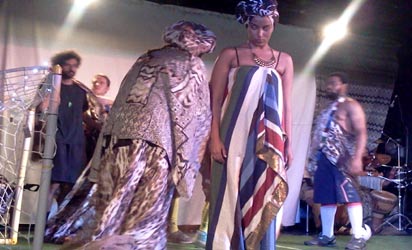
*A performance on the occasion.
By MCPHILIPS NWACHUKWU
There are several ways one can be an ambassador to one’s nation. Apart from the conventional posting of career diplomats to other nations of the world as ambassadors, academics and work qualify at several levels as ambassadors to their nations where ever their works find themselves outside of the shores of their home countries.
Specifically, in the humanities, theatre practice and profession have come to be typified as one of the most vibrant and dynamic ways that cultures, histories and traditions of peoples of one country are exported to other countries all over the world either as literary applications via playwriting or stage/film productions.
One of such theatre practitioners in Nigeria is Professor Emmy Unuja Ikanaba Idegu of the Department of Theatre and Performing Arts, Ahmadu Bello University, Zaria. In far away Israel last month at ZOA Theatre, Tel Aviv, one of his plays, The Legendary Inikpi was staged as a Command Performance as part of the activities to commemorate the 20 years of the restoration of diplomatic ties between Nigeria and State of Israel and for the celebration of Nigeria’s 52nd independence in Israel.The play was performed by the African Israeli Stage based in Israel.
The Legendary Inikpi is a play that captures theatrically, the war between the Igala and the Beni people from 1515-1516 Nigeria. History has it that the Ata Igala (the Igala King), Ayegba Oma Idoko was a bosom friend to the Oba of Benin to whom he always made eunuchs for his palace.
Somehow, there was some misunderstanding that made this hitherto cordial relationship sour. It turned bitter when the Ata Igala thought the messengers he sent to his friend the Oba who did not return home were captured by the Oba preparatory to taking war to Ida the traditional and administrative headquarters of the Igala kingdom and if possible, annex Igalaland.
The Ata Igala, Ayegba Oma Idoko consulted the oracle and the ancestors divined that nothing short of the life burial sacrifice of his most cherished child, Princess Inikpi will suffice. Historically, the Ata Ayegba Oma Idoko was said to have resisted the oracle demand for a considerable length of time until Princess Inikpi got to hear about it.

*A performance on the occasion.
She walked up to her father and agreed to offer her life via the life burial sacrifice to save both her father and the entire Igala kingdom from the fierce battle ahead. Agonizingly, Ayegba succumbed to the ancestors’ demands on Inikpi’s agreement.
Princess Inikpi was thereafter buried alive by the river Niger bank at Ida where till date her statue stands at the very spot of the sacrifice. After the sacrifice, the Bini forces were crossing the River Niger to Ida to battle and annihilate the Igala people when they saw the town in flames. What was the need of taking war to a burning people and town they thought, and went back home. Till date, the battle never came to Ida. The Ata Igala, Ayegba Oma Idoko and the Igala people lived in peace thereafter.
Using this story as his historical material, Emmy Unuja Ikanaba in the play graphically represents this unique aspect of the Igala history and he calls to question all over again, the imperative of selfless sacrifice for the general good of a people.
Emmy Unuja Ikanaba Idegu, Professor of Indigenous Performance and Playwriting is becoming an undisputed advocate of the study of Israeli theatre in Nigeria. Starting his theatre journey that has so far spanned about three decades, not until December 2008 when he was invited as Guest to the most popular Israeli theatre festival, the Acco Theatre Festival and to also present a paper at the Theatre Studies Department, University of Tel Aviv.
He used the occasion of his presence in Israel in 2008 to interact with a lot of his professional colleagues and attend several live stage productions, films and street/community theatre performances. During the said visit Professor Idegu gave out copies of his plays to quite a number of people.
According to him, this way, he was exporting his plays including The Legendary Inikpi, Omodoko, and Tough Man that all have Igala history, tradition and culture as their backgrounds. It was this visit and the gift of The Legendary Inikpi to quite a number of Israelis, that eventually caught the fancy of the African Israeli Stage who saw in the play the global thematic thrust of selfless sacrifice, and thereafter, the play was translated into Hebrew and performed with English sub titling on Tuesday October 16th 2012.
Nigeria celebrated 20 years of the restoration of diplomatic relations with the State of Israel and also celebrated her 52nd year of independence in October 2012 in Israel. As part of these two great memorable events, The Legendary Inikpi was staged as command performance.
The cast was composed basically of Israelis with two or three Israelis of African descent. The actors were Kais Nashif, Netzanet Mekonen,Hadar Levin, Liad Frank, Uri Sagi, Vincent Adeyinka, Omer Cohen Eden and Idit Biney.
The musicians were Pascal Izik Neuton, Ophir Baron, Pierre Shain and Milo. Stage and Costume Designer was Tali Itzchaki. Light Designer was Shachar Verechzon. The Multi Media section was made up of Liad Frank, Yoni Cohen and Gai Aisner. While the translation from English to Hebrew was done by Lihi Barzel-Melamed. And the entire production was directed by a vibrant Israeli director called Yaffa Schust er.
Every play text has its originality in story, thematic thrust, setting, audience and similar dramatic elements. When the play text leaves the confines of its original status, it is left for the director to interpret all these elements to suit the demands and exigencies of the new abode.
The original story in The Legendary Inikpi, is selfless sacrifice. Selfless sacrifice itself is a universal phenomenon. Though the play talks about the selfless sacrifice of Princess Inikpi to save Igala Kingdom from annihilation by the Bini invading forces.
The audience which was made up of Nigerians, Israelis and other foreign nationals was very receptive. In the audience were diplomats of other nations led of course by the Nigerian Ambassador to the State of Israel, His Excellency Ambassador David Oladipo Obasa who spoke very well about the play.
In fact, he buttressed the selflessness of Princess Inikpi and explained the audience the imperative of this history to the Igala Kingdom, to Nigeria and of course the universality of the message. The production of The Legendary Inikpi by the African Israeli Stage was not devoid of cultural challenges and directorial license to the interpretation of text outside of its immediate Igala setting. Within the Igala context of the play for instance, you can never have a woman Ohioga Ata as ifa consultant. But here in the production was a powerful female Ohioga Ata that stunned the audience with her superlative performance.
At a point when she came on stage as the Ohioga Ata to announce the demands of the ancestors that Inikpi be offered for sacrifice, the entire audience went still and calm. She so acted the role that she unambiguously carried the charisma, aura, serenity, reverence and awe that the playwright confessed he never saw any male Ohioga Ata, not even in the production of The Legendary Inikpi that he directed a couple of years ago
Simply put, it was a transparent artistic success. One of the most difficult members of the audience for any director is to have the playwright right there. Most difficult because being the author and creator of the work, the director’s interpretation should be seen to at least be close to the original intention of the playwright.
The second challenge with the play production has to do with all historical plays. Both the play text and its production must be close to the history being represented via dramaturgy. For an Israeli Troupe, performing an Igala historical play on both levels, they did very well.
Disclaimer
Comments expressed here do not reflect the opinions of Vanguard newspapers or any employee thereof.