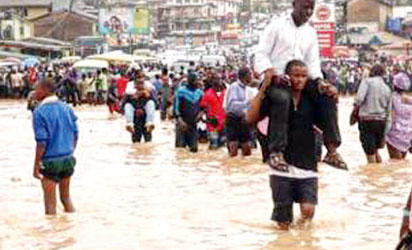
*File Photo: Flood victims
By Kingsley Adegboye
The recurring flood ravaging the coastal communities across the country has continued to generate heat in Nigeria, as no fewer than 25 million people have been rendered homeless while property and farmlands worth hundreds of million naira have been swept away by the disaster.
Subsequently, the governments of the affected states have relocated their victims to relief camps while the federal government, agencies and individual donors have intervened by way of cash donations and relief materials to cushion sufferings of the victims at their various camps.
Environmentalists and experts have blamed the cause of the flood disaster on the federal government, as it has abysmally failed to explore proactive measures in tackling perennial flooding in flood-prone states of the federation.
They say no matter how much of relief materials are being provided by the governments, agencies and other sympathisers as a way of showing concern to the victims, the environmental impact of the floods on the society, economy and victims will linger on for a very long time.
In his view, Mr. Leslie Adogame, former Executive Secretary, Nigerian Environmental Society NES, and now Executive Director, Sustainable Research and Action for Environmental Development SRADev noted that it has been estimated that no less than 300,000 hectares of farmlands and agricultural produce worth billions of naira have been lost to severe flooding as no less than 400 communities have been completely submerged under water across Nigeria.
Pointing out that the floods which began in early July and have reportedly killed 137 people and displaced over 120,000 people so far, are obvious combination of global climate change and natural occurrence not without environmental impact.
According to him, “the environmental impact of flooding can be quite wide-ranging, from the dispersion of low-level household wastes into the fluvial system to contamination of community water supplies and wildlife habitats with extremely toxic substances.
“Beyond the food crisis and the anticipated deepening of poverty which may result from this, my greatest concerns are the environmental implication which in most cases is a combination of all impacts of excessive flooding.
“The flooding episodes which have been summarily described as a national disaster would worsen the already poor environmental conditions in all the states including the worst hit Kano, Jigawa, Cross River, Taraba, Adamawa, Rivers, Bayelsa, Delta, Edo, Niger and Anambra.
“Hazardous and toxic Chemicals such as paints, pesticides, gasoline other industrial wastes are more likely to be put into waterways, and may in most cases find their ways into fresh water sources thereby causing major pollution. There are likely to be increase of water-borne and water-infested diseases as a result.
“Cases of diarrhoea may rise particularly for children since these flooding of course would bring a lot of pathogens from upstream sewage into the communities, particularly as these floods are known to disrupt normal drainage systems in cities and typically overwhelm sewer systems.
“Deeper additional gullies would be created, large number of people would become “environmental refugees, a situation which would further worsen disease and epidemic situation around the camps. Dangerous reptiles like snakes will pose more threat just as increase in mosquitoes is likely. Generally displaced people especially children and women are going to be worst hit due to exposure to harsh environmental conditions like intense heat, contaminated water, foods and others.
“Furthermore, the health of our waterways will be dangerously impacted significantly as many rivers and creeks get eroded, contaminated and littered with debris. Aquatic stability would be distorted as large numbers of fish would have died or left stranded as waters recede. Residential homes would be more flood-prone and vulnerable to collapse as buildings’ foundations become weaker due to flooding current and increase in water table.
“Due to over saturation of the water in the soils, landslides or general earth instability is imminent in those zones, particularly in the absence of forecasting and early warning systems. Building of new dams is not the solution. We must look at ways to redevelop our cities to make them smarter, greener and more resilient to the impacts of extreme weather events such as this.
“Reassessing design and development regulations must be part of the solution. Traditional catchment management has concentrated on preventing floods. We need to look at alternatives by focusing on minimising the damage rather than the occurrence.
“There is a need to identify ways of living and working in flood-prone areas, while protecting high value assets. People living in flood prone areas should be helped to be ‘flood ready’. Environmental evaluation of the flood hazard, therefore, sets the stage for the strategic environmental assessment SEA, of redeveloping flood prone areas.
“Specifically, recurring losses and negative intrusions into environmental systems could be avoided, or at least minimized, by identifying, measuring, and interpreting the magnitude and significance of environmental impacts associated with flooding.
For Dr. Akintola Omigbodun, an expert in flood management, who was a guest at a Vanguard Media Ltd forum recently, said the best thing is for the government to perform its functions.
He pointed out that: “I don’t think the government is deaf to newspaper publications, even if they are deaf to letters because I have written in the past and present on how to avoid the present damages that the flood is unleashing all over the country”.
“What we are saying is that they should take corrective measures so that we don’t experience this kind of disaster again, because the chances of occurring again are real.
Disclaimer
Comments expressed here do not reflect the opinions of Vanguard newspapers or any employee thereof.