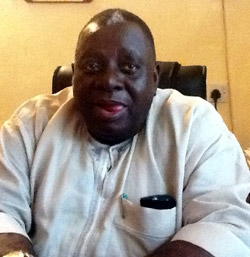
Chief Thompson Okorotie
Chief Thompson Okorotie is one of the founding fathers of Bayelsa State and secretary of the Bayelsa Elders Forum. He spoke on the gains and challenges confronting the country as well as its prospects.
The Ekeremor born politician, who was also a major player in the Second Republic and former Chief Whip of the old Rivers State House of Assembly also bared his mind on the administration of Governor Seriake Dickson.
Nigeria will be 52 come October 1st what would you say are the gains of the last five decades?
I believe that this country has made giant strides. There has been a lot of development. Whether some people like it or not, I say so because if you take one sector, education, this country when it became independent it had only one university, today you will be talking about not less than forty universities.

And that is also an index for growth. In 1960, when we became independent, our population was small, today you know what our population is now and yet in that educational sector, there is still room for development but it also marks a great departure from what it was on independence in 1960.
I remember vividly, that was the year I went to Lagos from home, there was euphoria the Empire Day was going, the Union Jack was coming down, the green white green flag was going up and there was so much excitement. You can see so much hope in the air. For some people, those hopes are yet to be achieved but for optimist like me, a lot of the hopes have been achieved.
Sometimes as individual when they say you have too many problems, when the problems end I say that is when you are dead. So, as long you are alive so it is with a nation. As long as you are alive you are bound to have problems.
There have been giant strides in education, in the economy, in science and technology. There are several things that have happened to this country that were not there, the explosion in the telecommunication.
However, you must also say the leadership problem has been a major setback for this country because from beginning of independence, we probably had a respite during the parliamentary period; Zik, Tafawa Balewa, Ahmadu Bello, Chief Awolowo and all that, we had very honest and focused leadership. But they were also a problem to us because the three big tribes now took action that rapidly became evident as oppression to the other numerous tribes.
We are told that we are at least 250 tribes in Nigeria so these three tribes because they were at the helm of affairs at independence amass things to themselves.
Appointments, political and economic, civil service appointments, distribution of amenities, infrastructural development, they translated into appropriating funds that went to areas of these ethnic tribes that itself caused problem because there was bottled up anger and displeasure in the other tribes and they were much more in number and in geographical expression than the three. And so that is part of the problem we have today.
What other problems do you think have confronted the nation since independence?
The leadership problem is fundamental, I believe that this country must face it and so I will politely say have not finished treatment on the leadership issue. There is also the followership problem. Nigerians are becoming increasingly impatient and that orientation is wrong and it must be corrected.
That is resulting in their attempt to put the problems of previous administrations on one person, on Goodluck Jonathan which is not fair.
This country has been there and people have been leading until he arrived. The first scientist to be President of this country and in some areas he has been quite professional about this leadership.

Chief Thompson Okorotie
The courage that he showed during fuel subsidy alone no other president not even the military leaders attempted it. We had to beg him, its enough now, the man was adamant. He did not care whose ox was being gored, he didn’t bother at all because all he was after was the interest of the country.
But then democracy is something that even if the majority is wrong and the minority is right as long as it is democracy, at some point you must bow to the so call will of the people.
To that extent, Nigerians must be patient with their leaders because they can push them to make mistakes and they have done it several times over. So, the leadership is not just the leader. No leader operates in a vacuum.
The leaders that are succeeding in other countries are having the support of their followers; the citizens have responsibilities which I am urging government to bring out.
The citizens’ responsibilities are also in the constitution. The citizens may not be aware; they should be told what the citizens’ responsibilities are. They keep on seeing the problems of the leader what about your own problems. They say in our parlance that when the two hands wash each other they become clean.
The other problem of the country is of course religious and tribal. A great deal of nepotism but by far the most serious problem is religious intolerance. If you go to the Middle East that is the home of Islam, Churches and Mosques are opposite each other and are peaceful. Why is our own different?
We are too intolerant and that is a big problem which we must look at. It is the Church and the Mosque that must do self examination. The government must encourage them so that they can narrow the gap. However a lot has been done to resolve this issue just that the results are not too evident.
That is why sometime I support Pastor Ayo Oritsejafor statement that the Boko Haram is not a religious matter, it is political because the leaders are saying something different from them.
The leaders are saying that their responsibility is that of tolerance that they don’t want to kill, Islam is not this, Islam is not that but these people are hiding under Islam and they have a request that we don’t even understand that western education is a sin and yet they are using products produced by western education to fight. That religiousintolerance must stop.
Lopsided federalism
Also there is issue of the structure of the federation. The federation is lopsided in terms of a normal federal structure. Up till now, there is a measure of militarization.
There are some practices for example; in a true presidential system local government administration is not under federal govt. We say we have three tiers of government, why would federal government allocate funds directly to local government and yet it is not even in a position to supervise their work?
Local government administration has collapsed. In 1976 when the system was introduced, it was meant to be the closest government to the rural people that would solve their problems so that you will now solve the problem of rural-urban migration because the basic amenities are not there- light, water, housing; they are not there so they are all running to the urban centre to pursue the good life.
Meanwhile the urban centre was not planned to accommodate the sudden influx, so, their facilities are breaking down. I think that local government should be left for the states to create the number of councils they can cater for that way we will see greater progress at the local government level because a government that is close to them will be working with them in partnership.
Now you have to find very careful ways of working with the local government because they will soon tell you they are a tier of their own and yet the 1999 constitution, in section 7, states very clearly that the state house of assembly has a responsibility for creating and establishing a local government system.
In other words, the establishment of local govt, the creation of it is the responsibility of the state house of assembly but the constitution contradicted it by going to the end of the schedule and now listed the number of local governments in each of the states. In other words, the work that was given to the state house of assembly on one hand was limited by the other hand because you cannot create local governments outside the number that has been placed on that schedule in the constitution except you amend it. And that is the amendment I am calling for so that the states can be left to create the local government areas that they are in a position to fund.
Prospects
This country has great prospects; it even has the potentials of becoming a world power because the indications are there. You go to the United States some of the outstanding performers in the sciences are Nigerians.
There was a year I travelled to the United States and we were taken to the space centre in Atlanta and we went round the place and someone said that place you can’t get through it, they showed us a glass, the engine room proper and they said there is a Nigerian there. You know that some of the best scientists in the world are Nigerians.
There was a year when government was looking for the best scientist from the United Nations to enable us set up our atomic energy branch and the United Nations wrote back and said what are you talking about, one of the best is a Nigerian and is based in Italy, an Akwa Ibomite.
They brought him in but Nigeria was moving files when the man was looking for laboratories. After six months he said sorry I can’t take it again he went back. So the issue is really managing it.
As for our potentials they are great because population is even an asset like they say when you are more the merrier and when you have an intelligent group of people like Nigerians, they are great brains, there is no where they go they don’t excel.
Population is an advantage, so this country should never talk about division because it cannot be a proper option. Division cannot help us it is being together that it will do better. After all, the most populous country, China with almost 1.5 billion people is the strongest economy today in the world.
What about India, it is the second most populous country in the world; you see how well it is doing. India products are all over the world, their industries are doing well and so it is a matter of our looking inwards. Let us add value to the raw materials we have.
We have been sending out our natural resources raw outside for other countries to develop their economies, they produce them, they turn them into products and bring back for us to buy at higher cost. Nationhood for Nigeria would be a robust one. The leadership should continue to mobilise the resource we have for result that will help the country.
How would you assess the leadership of Goodluck Jonathan…
(Cuts in) Perhaps the area I didn’t mention is that one of the factors of instability is frequent incursion of the military, the incursion was said that it also made the civilians to become more corrupt. Because when the army came in apart from the fact that they normally ran a narrow government, they also stole money and go away.
At a time, they were saying when they are broke they come back. They stage a coup. So the civilians when they come they are not sure when the army is coming back so that they try to quickly amass as much wealth as possible.
But as I had stated earlier, Jonathan is the first scientist that was produced as a president and I can only talked about his two years, because that is when he took over the mantle of leadership.
I want to categorically say for any objective observer Goodluck has done well in two years. He has done well. His transformation agenda despite the attempt at making the place ungovernable for him is on steady course.
The economy is being transformed, the agricultural sector for example, he introduced the cassava bread. If you know the amount of money we send to other countries by importing flour for bread if that money is conserved through this new policy the economy becomes stronger.
If we produce the oil, if we have our refineries working and don’t import oil the country will be better. These are areas we need to put together and those are the attempts he is making to achieve economy independence because what we have is political independence to a large extent.
If you are economically independent that is when your political power becomes stronger and that is when you are reckoned with in the comity of nations throughout the world.
On the argument that the presidential system of government is too expensive Well, I think that for Nigeria, from the way I see Nigerian power seekers, authority hunters, the presidential system is still the best option because it provide checks and balances. If we have not perfected the system, a time will come when we will perfect the system.
If almost 250 years of independence in America they are still amending their constitution, we have just started. Parliamentary system is putting too much together in one location. I don’t think that is the best thing for us if we say it is too expensive we should cut the cost in the presidential system. Let it be that somebody is checking the other person.
It works even if somebody say there is rubber stamping somewhere, it will be worst under parliamentary system because everything will be concentrated in the parliament. I don’t think it is the best for this country.
Disclaimer
Comments expressed here do not reflect the opinions of Vanguard newspapers or any employee thereof.