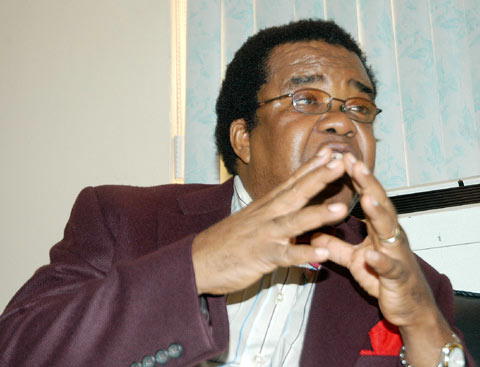
Prof Bolaji Akinyemi
When a lawyer tells the court, “it is settled law”, it is because his arguments are weak and that he has no precedents to cite. However, , believe me when I state that it is settled that where a political entity encompasses a multiplicity of groups of different fundamental identities, a federal political structure that provides for separate structures around these different identities is the most appropriate response. I will cite several examples to buttress this assertion. In fact, the refusal or inability to adopt this appropriate response is what was responsible for the breakup of the Soviet Union, Yugoslavia, Czechoslovakia, Sudan, etc.
As far back as the 1500s, federalist thought had crept into the literature of political thought. Johannes Althusius regarded as the father of modern Federalist thought argued in his 1603 masterpiece, “POLITICA METHODICE DIGESTA” for the adoption of federalism to secure the rights and freedom of his people against the tyranny of the Emperor.
From the 1500s till now, Federalism had been canvassed by such scholars as Ludolph Hugo (1630-1704), Baron de Montesquieu (1689-1755), David Hume (1711-1776), Abbe Charles de Saint-Pierre (1658-1743), Jean-Jacques Rousseau (1712-1778), Immanuel Kant (1724-1804), James Madison (1751-1836), Alexander Hamilton (1755-1804), John Jay (1745-1829), John Stuart Mill (1806-1873), Pierre-Joseph (1809-1865), and Altiero Spinelli, Ernesto Rossi (1944) and Chief Obafemi Awolowo.
From then on, the doctrine of Federalism has influenced the rise and fall of States all over the world. The most important of the Federalist states being the United States, Canada, India, Nigeria, Australia, Russia etc. In fact, right now, there is a Forum of Federations made up of Australia, Brazil, Canada, Ethiopia, Germany, India, Mexico, Nigeria and Switzerland, domiciled in Canada.
Federalism developed as a realist rather than an ideological doctrine in the sense that it was addressing specific problems of structural governance arising out of practical issues. As empires and states with multi-national complexions arose, the issue of how to govern from a centre while keeping the loyalties of the constituent nations was a matter of public policy. It was in response to this problem that the doctrine developed.
While attention has been focused on Eastern and Western thought, it is incumbent on me as an African scholar to explore African political thought. Both the Fulani and the Yoruba empires exhibit variants of federalist structure. The outcome of the Fulani Jihad under Othman dan Fodio led by 1809 to the establishment of a Sokoto Caliphate/Empire of 30 emirates which owed allegiance to the Sultan at Sokoto while enjoining considerable independence. The Yoruba empire, owing spiritual and political allegiance to Ife, spread from Warri to present day Togo and had a complex structure of independent kingdoms whose royalty was subject to confirmation by Ife.
These two were not the only examples of multinational empires in pre-colonial Africa. The ancient Ghana, Shongai, Mali and Zulu empires were multinational entities. Extensive research still needs to be done as to whether governance in these empires had unitary, federal or con-federal characteristics.
Great Britain, which imposed what ultimately turned out to be a federal structure on Nigeria, was ambivalent about the experiment. It was not a case of following a blueprint of federalism. While it is quite true that the British were aware of the federalist experiments in the United States (in which the British were not involved), Canada (where the British had a hand), India (where the British had a hand), and Sudan (where the British had a hand), not only did the British not experiment with federalism in such multi-national states as Ghana, and Zimbabwe, Britain did not experiment with federalism in Britain itself, until recently, which was composed of England, Wales, Northern Ireland and Scotland.
But how many Nigerians are aware that during the governorship of Sir Hugh Clifford, (1919-1925), Britain had to urgently make a most strategic intervention. Sir Hugh had proposed that either Nigeria was turned into a unitary state with a centralized government or dissolved into two separate countries. Richmond Palmer who was then the Lieutenant-Governor of the Northern Provinces petitioned London against Clifford’s proposals. The Colonial Office upheld Palmer and overruled Clifford. The status quo was maintained.
The reason why the Colonial Office overruled Clifford need not detain us here except to point out that it was most irregular and unheard of, in the British service, for a junior officer to have the temerity to petition against the position of a senior officer, and certainly, most unprecedented for the colonial office to overrule the senior officer.
The debate continued to rage within official British circles as regards the internal structure of Nigeria. Today, most Nigerians would trace the genesis of the advocacy of the six-zonal structure to former Vice-President Alex Ekwueme. In fact, the first proponent of the idea was a British colonial officer, the same Richmond Palmer who was a Lt-Governor in the Northern Protectorate, in competition with other proposals from British officials working in Nigeria.
In addition, dispersal of authority assists in dispersal of nodes or centres of development. This is evident in the way development had spread all over Nigeria. With development engineered by government, projects by the private sector has tagged on, thus creating a boom in the infrastructural sector.
Under the theoretical classification of Federalism, there are two types of federalism (according to the Stanford Encyclopaedia of Philosophy): firstly is the Coming Together federal type which is “arranged to constrain the centre and prevent majorities from overriding a member unit”, then you have the Holding Together federal type which develops “from unitary states, as governments devolve authority to alleviate threats of unrest or secession by territorially clustered minorities”. Given the fact that Nigeria grew from a colonial state into an independent Federal state, it did not really fit into a neat classification. It was more or less a hybrid product.
There is another classification which emphasis the end product rather than the previous classification which emphasized the process.
According to the Stanford Encyclopedia of Philosophy, there are two types of Federalism namely “separate (split or compact) federalism” which is federalism where “decisions made centrally do not involve member units at all” and “interlocking (or cooperative) federalism where member units are involved in central decision making. An illustration of the first is the present Nigerian constitution where the Senate is made up of members elected directly by the people and not appointed by state governments. An illustration of the second is the independence federalism of Nigeria where regions appointed members into the Senate which like the British House of Lords,
exercised the power of legislation with the House of Representatives. A third type of federalism is the asymmetric one where some units of the federation are granted special priviledges usually in language and cultural areas or in parliamentary representation. Professor Itse Sagay(see THE NATION ON SUNDAY, 19/08/2012,p.18) has drawn attention to sections 7 and 14 of the Constitution of the Mid-Western Region which granted special representational privileges to minority areas namely Akoko Edo, Isoko, Warri and Western Ijaw. The priviledge was that only indigenes of these areas could represent the areas.
As part of the bonding mechanism in our present day Nigeria, where there are settlers in almost every state, these settlers could be given a quota of seats in each State Assembly.
Nigeria, made up of 250-300/350 nationalities (depending on which study one consults) of disparate population sizes, was obviously a prime candidate for federalism. (See Is’haq Modibo Kawu, A struggle for the soul of Nigeria, Vanguard, August 16, 2012, p. 17) for the problem about classification of Nigerian nationalities) Apart from the fact that the British colonial administration had run the colonial territory of Nigeria as a Federation and was determined to hand over an independent Nigeria as a Federation, the Nigerian leaders themselves were determined to inherit an independent Nigeria as a Federation. Some may argue that neither the British nor the Nigerian leaders had much choice. But it should be borne in mind that around this time, the French, on the eve of independence broke up its West African Federation and its Central African Federation into independent constituent states. I believe that the British and the Nigerian leaders were genuinely committed to the concept of Nigeria as a Federation.
Having accepted the inevitability of Nigeria as a Federation, it must be conceded that at independence, Nigeria was an imperfect Federation. Given the piecemeal process by which Nigeria was brought into existence, one would have expected that the internal structure of Nigeria would have been more complex than the three-region structure at independence. As earlier alluded to, there was a debate among British officials as to how many internal units Nigeria should be divided into. The most theoretical proponent of Nigerian federalism who also was a practicing politician, was Chief Obafemi Awolowo, who argued in in 1947 in his PATH TO NIGERIAN FREEDOM, that Nigerian federal structure should be based on the internal nationalities. This led him to later propose that Nigeria should have 18 states. Apart from the Fulani/Hausa, Yoruba and Ibo nationalities who were regarded as having had their own regions confirmed, the so called minorities who should really be called other nationalities mounted a spirited campaign to have regions/states of their own before independence. The British lukewarm-ness towards creating more states/regions/zones from the beginning had to do with the British disdain for huge bureaucracies and the fact that Britain had a limited budget to run Nigeria, without looking for subsidy from London.
The lukewarm-ness of Nigerian leaders, except Chief Awolowo and his Action Group, precisely had to do with the fact that the Nigerian leaders and the British colonial authority believed that Awolowo’s Action Group would be the beneficiary of any exercise in state creation as it has been the most consistent and most persistent advocate of the right of minorities to their own states. This perception was confirmed by the electoral success of the political allies of the Action Group in elections held in minority areas.
Major exercises in state creation, in the post-independence period did not follow the nationality-driven agitation for state creation. Gowon’s states suffered further mutation in 1976, when further states were created. Two issues were thrown up by this exercise. Two major nationalities, the Ibo and the Yoruba were further fragmented into several states. The Ibo was split into Anambra and Imo states while the Yoruba was split into Ogun, Ondo and Oyo states in addition to the existing Lagos state. The other issue was that an attempt was made to use the nationality factor to address the minority nationalities. The Benue-Plateau state was broken into Benue and Plateau states; the North-Eastern state was divided into Bauchi, Borno and Gongola states; and Niger state was created out of Sokoto.
The point which I wish to make has been made. There was no consistent application of any coherent principle in the various state creation exercise. Every exercise in state creation created new minority groupings while satisfying the aspiration of some. Looking at the nationality configuration of Nigeria, it was an error of political judgement to have propounded a theory of federalism based on the nationality factor. But let me add here that even Chief Awolowo in his proposed 18 state structure for Nigeria ended up modifying his concept in the sense that seven (7) of the eighteen states he advocated ended up being classified by him as “mixed language states”.
What in fact we seem to have done in Nigeria is adopt the German model of federalism without being explicit about it. Article 29 of the German constitution laid it down that no single state will be more than 30% of the population or territory of the nation and that “the division of the federal territory into [state] may be revised to ensure that each [state] be of a size and capacity to perform its functions effectively.” In breaking the Fulani/Hausa, Ibo and Yoruba nationalities into fragmented states, Nigeria sought to address the mischief of the instability of the first Republic and the civil war where it was felt that it was the size of the regions that contributed to the instability and the ensuing civil war.
However by giving the impression that creation of state is driven by the agitation for recognition of nationality identity, long after it had been repudiated, various Nigerian governments, whether civilian or military, for cheap popularity had embarked on state creation exercises, and thereby fuel the agitation for the creation of more states.
The paradox of the whole exercise is that each new state which satisfies the aspiration of a nationality creates new minorities which breeds new agitations. The political atmosphere and intra-personal relations are further poisoned by the language of propaganda employed to justify the agitation for new states. The language of propaganda usually centres around allegation of persecution of the nationality making the allegation. They usually allege that members of the nationality are denied employment and promotion opportunities, and that development projects are not cited in their areas. These allegations usually breed antagonism and the successful cases are usually accompanied by expulsion of nationals of the nationality from the public service of the state from which the new state is being carved out.
The division of existing state assets between the old and the new state is usually acrimonious.
The crux of the matter is to what extent can Nigeria continue down the path of state creation? Is there a maximum number of states that Nigeria can be divided into internally? Going down the historical path of state creation in Nigeria, the answer would have to be, NO, as a) the issue of economic viability had never been an evaluatory factor especially after 1967 when fiscal federalism was abandoned as a revenue distributable principle in Nigeria, and b) Nigerians have the capacity to split an atom beyond the capability of physics and physicists. Nigerian tendency to adapt and reduce everything to its level of absurdity has led to an unending agitation for state creation.
Then there is what is called a two-sided federalism which as is obvious from the term is a federation made up of only two parts. Examples are the Federation of Bosnia and Herzegovina, Czechoslovakia made up of the Czech Republic and Slovakia until the dissolution in 1993, Cyprus made up of the union of Greeks and Turks before the invasion of the island by the Turkish army, the United Republic of Tanazania made up of the union of Tangayika and Zanzibar, and Iraq which in 2005 granted federal status to the Kurdistan region.
Then there is “intra-state federalism” which is characterized by governments of component states being represented in federal political institutions. For example, this is the German experiment where the state governments appoint their members to represent them in the Senate. This should be distinguished from the pre-1966 Nigerian experiment where even though the regions appointed the Senators to represent them, they were not appointed as members of the regional governments.
What then should we regard as True Federalism? In Nigeria, it has become a mantra that is preventing us from adopting an ingenious adaptation of the elements of federalism to the realities of the Nigerian political situation. This is not to deny that federalism should have some common characteristics such as propounded by the principle of subsidiarity. An analysis of the Federal Governments of the United States, Canada, Brazil, Australia, and India may raise the issue whether that includes a limited central government given the complexities of globalization.
The proposal for the adoption of Zonal Federalism will lead to the same skewed Federalism which we inherited at Independence. It will address the concerns of the majorities as the North-West zone will cater for the Hausa/Fulani, the North-East will cater presumably for the Kanuri, the South-East for the Ibo and the South-West for the Yoruba. Whose interests will the North-Central and South-South zones represent? Under the circumstances, the only accurate description of the North-Central Zone is non-Fulani, and the only accurate description of the South-South is non-Ibo and non-Yoruba. In other words, we know what they are not and not what they are. Just as was the case in 1960-1966, Zonal Federalism will totally ignore the aspirations of the minorities.
I will not, in this lecture, take up the issue of the legitimacy of that Constitutional Conference on the grounds that it was boycotted by the mainstream of the proposed Western zone. The issue of legitimacy has been raised in terms of the military midwifing the 1999 constitution. The late Chief Rotimi Williams, SAN, put it pithily when he said that the 1999 Constitution told a lie about itself when it said “We the People….” Whereas it should have been “we the military….” True enough. But on the same grounds, every constitution since 1979 has told a lie about itself.
The struggle for state creation is driven by what I would call identity federalism: a cry by a group for its identity to be recognized. The antagonism that accompanies the agitation is because to make a compelling case, the group desiring the recognition has to employ identity-differentiation politics.
The crux of the issue is this: Should the demand for identity recognition need to result in state creation? A utilitarian appraisal of federalism in fact recognizes the richness of its flexibility while not detracting from its raison-d’etre: the need for a bonding of disparate communities for the common good.
A good illustration is the constitution of the German Federal Republic which recognizes three different types of states. Bavaria, Saxony, and Thuringia are called “Free-state” (Freistaat); Berlin, Hamburg and Bremen are called “City-states” (Stadstaaten)”, while the remaining thirteen states are called “area states” (Flachenlander).
This German example suggests a possible way forward for the Nigerian project. A cry for identity recognition will not be satisfied by the creation of a Local Government. The term “Local Government” does not have the same gravistas or panache needed to satisfy or uplift. We can toy with such terms as “canton”, “city-state”, “local-state”, “Ogoni state”, “Jugun state” or whatever other coinage we can come up with. Each will be headed by a High-Commissioner and each will have full autonomy over local issues, such as primary and secondary schools, local roads, local hospitals and such issues as will pass the test of subsidiarity. It will have its own direct allocation from the Federation account and all of these will be guaranteed by the Constitution.
For this to work, however, we will need to revisit the revenue allocation formula to enshrine the principle of revenue derivation. The Constitution can create a development fund to which all states will have access so that no state will fall below a development safety net.
Let me dwell on two more issues that are in the centre of the debate about Nigerian federalism. The first is the issue of State Police. Three arguments have been adduced in favour of this proposal. The first is that it is in tandem with the doctrine of federalism.
The second is that this was our practice up to 1966. The third is that it is a more effective way of policing as the members of the police would be drawn from the local community.
These are cogent reasons but they are controvertible. The first argument that it is in tandem with federalism has already been addressed when I dealt with the issue that there is nothing like TRUE FEDERALISM. Canada, a federation, does not have state police. Nigeria has to adopt a federalism that is in tandem with its political and cultural realities. During the first Republic, the Native Authority Police was used to suppress and oppress opposition leaders. Their rallies were broken up, they were hauled into prison and some were murdered. Have we learnt any lesson from the past? Are our political leaders more tolerant now than the pre-1966 political leaders?
The answer lies in this empirical fact. When INEC conducts an election in a state, the margin of victory is acceptably narrow. When SIEC conducts elections in the same state, the governing party usually wins with a margin of 90%-100%. Present day political leaders especially at the state level have a high intolerance and vicious level, that there are many elite refugees in Abuja and Lagos having been driven out of town by their governors. If they could do this without state police, then you can imagine what they would do with a state police under their control.
For the avoidance of doubt, let me also say that I am opposed to the alternative proposal being flouted by the Northern Governors Forum that Governors should be allowed to issue instructions to the Commissioners of Police and that these instructions should be obeyed. That is like a State Police through the back door, with the Federal Government picking up the bills. A good compromise is a constitutional amendment that calls for the personnel and officers of the Nigerian Police based in a state to be drawn from the inhabitants of that state but they will still operate as members of a unified Nigerian Police Force.
The last issue is that of Resource Control. From unification in 1914 to 1967, Nigeria operated a revenue derivation policy which allowed the regions to keep the proceeds of economic activities in their regions. This was the formula freely negotiated and agreed to by Nigerian leaders. The fact that the formula was changed to enable Nigeria to fight a civil war did not mean that the formula should not have reverted to the pre-civil war formula once that war was over. Anyone who has visited the Niger Delta area, who has seen the devastation in the area and who witnesses the continuing health hazards to which the people there are subjected, will not begrudge them resource control. It is immoral to continue to oppose a revenue distribution formula based on the derivation formula.
This nation is lost and drifting. And we the elite are to blame. In every nation in the world, it is the elite who work out a grand vision and develop a grand consensus around that vision to propel the nation forward. It is the elite that constitute the engine of change. In Nigeria, gross ethnicism has destroyed each and every attempt by the Nigerian elite to produce a consensus to drive the nation forward. I am not talking about a consensus to loot. That consensus is already there. I am not talking about a consensus to oppress the poor, the widow and orphans. That consensus is already there.
It has to be a consensus on building a nation where the poor, the widows, orphans and the oppressed will be protected. The consensus must be on how to narrow the gap between the rich and the poor. The consensus should be on how to grow and distribute the common wealth such that no group is favoured, none discriminated against and all develop a sense of belonging. A consensus based on equity. A nation where one zone occupies the no. 1 post, another zone occupies the nos. 2 & 4 posts, another zone occupies no 3 post, another zone occupies nos 5 & 6 and Secretary to Government posts, but two other zones have no posts is not an equitable nation.
Here are the words of the last stanza of the 1960 national anthem which we jettisoned:
O God of all creation,
Grant this our one request,
Help us to build a nation
Where no man is oppressed,
And so with peace and plenty
Nigeria may be blessed.
Professor Bolaji Akinyemi, DPHIL, (OXON), CFR, was former Minister of External Affairs and member, Committee on Electoral Reforms.
Disclaimer
Comments expressed here do not reflect the opinions of Vanguard newspapers or any employee thereof.