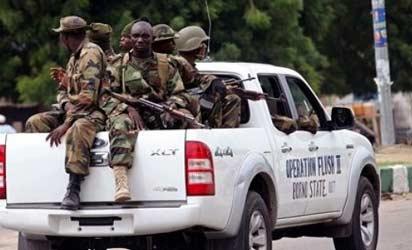
*Soldiers on patrol
This is the fifth edition of the serial on OWEI LAKEMFA’s latest work: “One hundred years of trade unionism in Nigeria”. The fourth part was published yesterday.
AUGUSTINE Bamidele Dania, one of the affected workers explains why “Suddenly, they stopped beating us. We never knew what was happening.
Without knowing that it was Lt. Colonel Gowon who had just arrived from Dodan Barracks. They told us to put on our dresses that the Head of State would like to talk to us. Then they took us to a big hall. Gowon asked us who is the leader of the group. Comrade Goodluck came out.

Soldiers on patrol
He explained everything. Gowon was unhappy. He said we were innocent, harmless workers. The incident he said, is an embarrassment to his regime. He asked us to go to the hospital and gave us some money. I don’t know how much others were given. I remember they gave me two pounds to take a taxi to any hospital for treatment.” Although Goodluck had confronted armed policemen and soldiers before particularly during the 1964 general strike, this was the closest he came to death in the hands of armed men.
Goodluck, born on July 11, 1923 came from a polygamous home. His father had five wives while his mother alone had six children. His father, an itinerant trader was a Moslem who wanted his children educated both in Western and Islamic education.
Goodluck said of his childhood: “I can remember very well we attended an Arabic school. We all carried our wooden slates to school and wrote with black ink. We were taught to read and write the Arabic alphabets and to learn by heart, portions of the Koran. Some of the teachers or Alfas were vicious. They beat us with snaky whips or sometimes with knotted twine tied to a cane. And when you were unable to recite portions of the Koran, by Jove, you would have it on your head or back.”
Demobilisation of the military
Goodluck attended Lagos High School, Tokunboh, then the CMS Grammar School, Lagos where he passed out in December 1944. He wanted to join the army after school but was unsuccessful because the Second WorId War was ending and the British government was thinking of demobilisation. On January 17, 1945, he joined the Post and Telegraphs (P&T) as an accounts clerk. In 1948, he and some radical P&T workers participated in a one-day strike. Goodluck, Akanbi Giwa, later a Major in the Nigeria Army and John Mmaha, a UAC staff on secondment were arrested and charged for obstructing Henry Fajemirokun, a P&T clerical staff from Ile-Oluji. The threesome had called Fajemirokun, who was to found the successful Henry Stephens Group of Companies, a “Black leg in white trousers”.
Seven days imprisonment
Although Goodluck, Giwa and Mmaha were defended by young bright lawyers like Frederick Rotimi Williams, Bode Thomas and Remi Fani-Kayode, they were found guilty of the offence and sentenced to seven days imprisonment or to a fine of ten shillings. They paid the fine. Goodluck was to say later “That was the first baptism we had as trade unionists and it decided my future.”
He then went to work in a timber company in Sapele, taught at Abbot College, old Bendel State and returned to Lagos to work as a columnist in The Statesman. His career as a full time unionist began when he was appointed on a salary of two pounds monthly as secretary of the West African Soap Company (now Lever Brothers) Union. The union had been decimated by the failed 1950 Mercantile workers strike led by the bold trade unionist and later lawyer, Nduka Eze.
Goodluck was a strong and decisive labour leader who would not sell out nor buckle under pressure. When during the 1964 general strike, Prime Minister Tafawa-Balewa issued threats to labour leaders and went on to sack workers enmasse, Goodluck at a rally on June 10, 1964 told the affected workers: “The dismissal notices you have received are so many scraps of paper. You can keep them as souvenirs to show your children and remind them that today is a turning point in the history of this country.” As part of the conditions to end that strike, Government withdrew the sack letters and pledged not to victimize any worker who participated in it.
Successful trade union organiser
Goodluck has been the best and most successful trade union organizer in Nigerian Labour history. Apart from having been president of the central labour organization, the Nigeria Trade Union Congress, NTUC, from 1963 to 1975, he was General Secretary of numerous workers unions including UAC, CMS Bookshop, Dorman Long, University of Lagos, Ikeja Asbestos, Nigeria Enamels, Flour Mills and the Public Works Department, PWD.
When the four labour centres in the country voluntarily merged into one centre, the Nigeria Labour Congress, NLC, in December 1975, he was elected its national president and presided until the military regime which would brook no opposition banned the NLC in 1976.
When in 1977, the military restructured the 721 workers unions into into forty two large industrial unions, half of them were led by Goodluck protégées while one of them, Alhaji Hassan Adebayo Sunmonu was elected the founding president of the new Nigeria Labour Congress, NLC, at its inaugural conference on February 28, 1978.
Goodluck, a bespectacled radical was one of the founders and Vice Chairmen of the left-leaning Socialist Workers and Farmers Party, SWAFP. The party was established in December 1963 by the NTUC and the Nigeria Youth Congress, NYC. He contested in the 1964/65 elections as a SWAFP candidate in the Lagos constituency. With the ban on political parties by the military, Goodluck channelled the energies of the socialist cadres in SWAFP into the trade union movement. He gave them basic trade union education at the Patrice Lumumba Labour College, Yaba and told them, as he was wont to “You go to the field and organise, the workers shall pay you.”
The military regimes that ruled the country from 1966 were suspicious of Good luck. This became more pronounced with his often-repeated public statement that “The civilians have ruled and failed, the army is still ruling, after the army, it should be workers turn to rule.” He was to elaborate further: “I made the statement in 1970 during Gowon’s era when it was apparent and clear to the ordinary man on the street that the number of millionaires among the militarymen were more than those in the condemned civilian regime of Tafawa Balewa.
“As a result of this, it was my candid view that if a disciplined body like the army could fall into disrepute to the extent that everybody became fed up, it was felt that, if the bourgeois civilians had tried, the bourgeois army had also tried and they have failed, why not the workers turn.
Intellectuals and the oppressed group
And when I say the workers, I was not restricting myself to the trade union converting itself overnight to a political party. Rather, I was having in mind the workers and their natural allies like the poor peasants, the intellectuals and the oppressed group as a whole.”
To break Goodluck’s resolve and break opposition to dictatorial military rule, the Gowon regime seized and detained him without trial for fifteen months. Rather than break him, the detention strengthen Goodluck who returned to ressume his leadership role. Goodluck could also be humorous. In April 1968, Z.B.O. Odugbemi of the NTUC accused the union of not utilising trained cadres properly. Odugbemi titled his series of public memoranda “Before the Cock Crows.” Goodluck’s simple response to this blackmail was “Let the Cock Crow”
General Henry Adefowope, Labour Minister for three years from 1975 who was to play a pivotal role in labour-government politics in that period was Goodluck’s classmate at the CMS Grammar School. He said of him: “Wahab has always been a go-getter and always forthright. He never hesitates to tell you what he thinks about you… during our school days, we enjoyed ourselves thoroughly. While we were at school, our own particular set consisted mainly of rascally students… he turned out to be one of the leading trade unionists we have in the country”.
In 1974, like Imoudu, Goodluck was one of the key players in the trade union movement who worked for workers’ unity. Both men were mass mobilisers. They put their fate in workers hands. Their most favoured weapons were mass meetings. Once such meetings or a competent organ of the movement took decisions, they ensured their implementation with religious devotion.
Imoudu was doubtlessly the most charismatic labour leader in Nigerian history. He was known as Labour Leader No.1. On the other hand, Goodluck was known as the “Goodluck of Nigerian Workers.” Although less charismatic than Imoudu, he had better organisational skills, better education and a deeper political understanding.
NDUKA EZE
One of the most remarkable labour leaders in colonial Nigeria who then walked away from trade unionism following a failed strike, was Nduka Eze. He was a consumate organizer, mobiliser and mass educator who inspired the youths of his day. Eze made great contributions to the Labour Movement perhaps his greatest being his pioneering the unionization of the workers in the private sector and establishing the first national federation of workers in that sector; the Mercantile Workers Union. Eze was a radical nationalist in the 1940s at a time when the British colonialists were desperate to hold on to their colonies and were not prepared even to tolerate conservative nationalists.
Radical nationalist
To train Nigerian workers and youths in alternative political and economic thoughts in contrast to the capitalist education system run by the colonialists, Eze and his comrades established a scholarship system that enabled teenagers, workers and radical students to study in Eastern European post primary and tertiary institutions, free. To formalize this, a National Scholarship Board was established in 1950 with Eze as Secretary.
There was, however, a major challenge that had to be overcome; the colonialists were strict in the issuance of passports, and travel to Eastern Europe was a criminal offence. So Eze and his comrades had to devise means of getting the beneficiaries first to London before making their way to either Czechoslovakia or East Germany. For this, a liaison office was run in London. When the authorities were not convinced what the beneficiaries were going to do in London and refused them passports, Eze and his comrades found ways of getting round officialdom.
In July 1951, intelligence officers raided the scholarship office and arrested Eze and an official, Comrade Onwurika for being in possession of blank passports and forms. They were charged, found guilty and fined. But an Immigration Police corporal, Ajayi Busari, who was found to be their accomplice was jailed for three years. Eze had joined the United African Company (UAC) in 1941 as a Manager-in-Training. He decided to stake his bright future in the British conglomerate by championing the workers cause. He became their secretary within two years. In 1947 he left the UAC to become a full time unionist.
Magnetic personality
He had a magnetic personality and is credited with influencing many young radicals and pro independence activists including Osita Agwuna, the man who made the famous “Call To Revolution” to uproot colonialism, and Mokwugo Okoye, the intellectual power house of radical politics. Eze helped to build the the radical anti colonial Zikist Movement and became its President General. To give the nationalists and workers a voice of their own, he ran the Labour Champion, the country’s first labour newspaper.
!949 was quite a tragic year for labour and the country; on Friday, November 18, trigger-happy colonial policemen entered the Iva Valley Mines in Enugu and confronted striking miners. The police that day murdered 21 of the miners and injured 51 others. What became known as the Iva Valley Massacre shocked the country and brought nationalists, unionists and all strata of the country together to demand justice under a coalition called the National Emergency Committee (NEC).
Disclaimer
Comments expressed here do not reflect the opinions of Vanguard newspapers or any employee thereof.