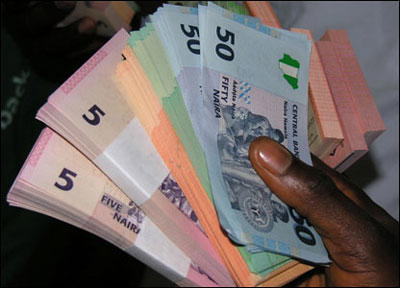
Polymer naira notes
By OUR REPORTERS
The polymer currency was introduced in Nigeria because it does not tear easily and it is water resistant but to Bilikisu Abubakari, a cloth seller at Idumota Market, it is bad money.
“It cannot be spent when it is worn out. When old, the pictures and figures become blurred. When torn, I cannot spend it. I throw the currency away when they are bad and such is waste of money in this season of hardship. The paper money is better because when cellotaped, you can spend it. But the polymer money is the opposite. The polymer currency should be changed to the paper currency”, she told Financial Vanguard.
That is the view of some Nigerians on the performance of the polymer currency five years after it was introduced. Mrs. Janet Enodiana, a vegetable trader at Salami market, Afromedia, Lagos is also one of such persons who believes polymer is poor currency.
“I do not prefer it to the paper currency. It is bad money. If it gets torn, faded or burnt, you cannot spend it. Customers reject the money from me. Look at the hundred naira note, you can spend it when it gets torn. I think it should be changed. It is not funny at all because it affects adversely business transaction.
But most people believe that the polymer is good money that is printed badly and treated badly by the people. Among those who believe that the problem with the currency is poor printing quality are Mrs. Mary Oshioniake, a Nurse and Mrs. Titilayo Hungbo, a teacher at Ojo High School, Lagos.

Polymer naira notes
“It has the advantage of resisting water. Mostly when I am drenched by rain or when I wash them in my clothes, they retain their shape. Its disadvantages are so many. Its quality is very poor. The colour and pictures get worn out easily. I have had incidences where people reject the money when it is cello-taped and faded”, Oshioniake said.
According to Mrs. Hungbo, The nature (of the polymer currency) is good but there should be good printing quality of which pictures and writing should be permanent instead of fading. Mr. Isiaka lamidi an Electrician however does not agree that the currency is poorly printed.
“Nigerians are to blame for this unwholesome attitude. For instance, some people will pick a blade and cut it all in the name of wanting to know whether it can cut or not. These are bad attitudes that must be corrected if we must get the best out of these currencies.
Remember the currencies cannot tear If nobody cuts it. So our attitude towards the currencies is what should be looked into. Normally, the currencies are to be properly arranged in a purse and this will prevent them from been squeezed”, he said. His position was corroborated by a Hair Dresser, Mrs. Oluwaseun Adesina and Mr. Johnson Igbeikutu an Auto Mechanic.
“The problem is that Nigerians don’t have good maintenance culture. This affects the way we handle and use our currencies”, said Igbeikutu. I can recall that when the polymer currency was first introduced, many people because they cannot tear it, decided to use blade to cut it. Some even go to the extent of using fire to burn it at the edge.
“So what this implies is that we need to always see our currencies as national identity and give it the deserved honour. The currency fades because many people expose it to water, most especially when the currencies are washed with cloth. So people should often be often educated on how to keep and use the currencies.”
According to Adesina, “The government has played its part by changing the currencies from paper to polymer; but it should not stop there; rather it should see to the proper maintenance of these currencies. And to Nigerians, we need to protect these currencies from exposure to any substance that may deform it. We have our ways of protecting our valuables, so we should treat these currencies just as we keep our valuables”.
The polymer currency was first introduced in Nigeria in 2007, with the N20 denomination. It was later extended to the N5, N10 and N50 denominations in 2009. Although, it was first introduced in Australia to checkmate counterfeiting of the country’s currency, it was introduced in Nigeria because of its durability and cost of printing.
According to the Central Bank of Nigeria, the polymer currency does not tear easily and it is not soiled easily. And compared to paper money, it is cheaper to print. This, according to the CBN would help to free-up resources for other use.
The N20 note was chosen to test run the strength of the polymer currency because it is believed to be the most used currency in the country. It is usually used by public transport operators in giving change (fare balance on excess) to their passengers. Market women and traders also use it frequently in their daily transactions than any other currency denomination.
The money changers, who help split larger denominations into lower ones at a fee at bus stops and vehicle parks have more twenty naira notes in stock and in more demand from their customer base concentrated around commercial transport operators. The apex bank therefore believe that the N20 note is the best test case for for the polymer.
In 2009, while announcing the extension of the polymer currency to the N5, N10 and N50 notes, the CBN Governor, Mallam lamido Sanusi, said that the cost of printing the notes has been reduced while the polymer notes have been found to last longer in circulation.
But five years down the line, investigations show that while the polymer is indeed stronger and hence does not tear or soiled easily, the features on it are vulnerable to fading when it stays too long in circulation, and this results into lose for the holders.
That is why majority of the people interviewed, though acknowledged the durability of the polymer currency and the poor handling by Nigerians, call for improvement in the printing quality.
The other alternative is that the apex bank should not allow the polymer stay too long in circulation before withdrawing it. They however maintained that either of this measures must be complemented with increased enlightment campaign to minimise poor handling of the polymer currency.
Disclaimer
Comments expressed here do not reflect the opinions of Vanguard newspapers or any employee thereof.