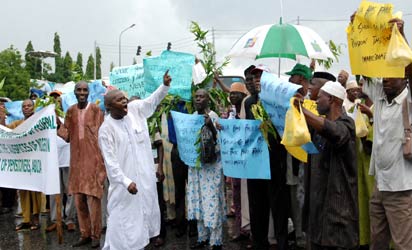
*Cross section of pensioners defying the downpour during a peaceful protest against non-payment of their entitlements at the Federal Secretariat, Abuja. Photo by Abayomi Adeshida
his is the eleventh edition of the serial on OWEI LAKEMFA’s latest work: “One hundred years of trade unionism in Nigeria”. The tenth part was published yesterday.
JOHNSON: The Anti – Apartheid Labour Minister
Chief Joseph Modupe Johnson (JMJ) the ex-soldier, former radio broadcaster and businessman was elected chairman of the Ibadan District Council in 1948. His election was spectacular because he was a Lagosian, but people in the Ibadan province preferred him as their leader. He was Labour Minister from 1957-1964 a period of serious Labour turmoil including the crippling general strikes of 1963 and 1964. Johnson’s greatest contribution to Labour was on the world stage.
Nigeria became independent on October 1, 1960, at its first attendance of the International Labour Organisation, ILO, Conference in Geneva nine months later, Johnson, as Nigeria’s Minister of Labour and head of the Nigerian delegation personally moved a motion that apartheid South Africa should be thrown out of that tripartite United Nations organisation.

Protesters at Ojota
He stood up at the ILO Conference and pronounced that the resolution was in the name of the Government of Nigeria and that “of the 40 million people of Nigeria.” He said the Nigerian people “have good will, love and affection towards other people irrespective of the colour of their skins, (and) believe in the equality of all races, abhor racial discrimination in all its forms and with all its trappings, wherever and by whomever it is practiced.”
The motion by Johnson and some amendments made on the floor read:
•“Whereas the International Labour Organisation, dedicated to the pursuit of lasting peace based on social justice, has stressed the need for freedom of expression and of association, and the right of all human beings irrespective of race, creed or sex to pursue both their material well-being and their spiritualdevelopment in conditions of economic security and equal opportunity, as fundamental to the attainment of the aims and purposes of the organization,
•“Whereas the organisation has adopted a series of Conventions and Recommendations calculated to implement these aims and purposes, especially as regards the promotion of freedom of association, the abolition of forced labour, the elimination of discrimination, the free choice of employment, and just and favourable conditions of employment,
•“Whereas the Government of the Republic of South Africa, in spite of its long association with the International Labour Organisation, accepts and practices the policy of apartheid, which said policy subjects indigenous African citizens to racial discrimination to their economic and social disadvantage, in contravention of the principles, aims and purposes of the International Labour Organisation.
“Now, therefore, this Gener
al Conference of the International Labour Organisation, meeting in its forty-fifth Session in Geneva, this day of June in the year nineteen hundred and sixty-one, hereby –
“1. Condemns the racial policies of the Government of the Republic of South Africa.
“ 2. Expresses the utmost sympathy with those people of South Africa whose fundamental rights are suppressed by the apartheid policy of the Government of the Republic of South Africa as well as those courageous people who irrespective of race and colour are opposing apartheid.
“ 3. Declares that the continued membership of the Republic of South Africa in the International Labour Organisation is not consistent with the aims and purposes of the Organisation.
“ 4. Resolves that the Governing Body of the International Labour Office is requested to advise the Republic of South Africa to withdraw from membership of the Organisation until such time as the Government of the said Republic abandons apartheid which is against the declared principles embodied in the constitution of the International Labour Organisation, and further requests the Governing Body to ensure speedy implementation of this resolution”.
Employer delegates
At the ILO Resolutions Committee meeting, 163 delegates voted for the Nigerian resolution, none against while there were 89 abstentions. Most European government and employer delegates including those of United Kingdom, France, Belgium, Australia, Italy and Spain abstained as did the United States and of course, South Africa. When the final report was presented, there were 6,664 votes in favour, with none against and no abstentions.
The other Nigerian delegates to that momentous ILO Conference were Messrs Tom Edogbeji, Aitkins Salubi, Tijani. M. Yusuf (Government) Mrs. Moore (Employers) and Comrade Lawrence Borha (Workers). Twenty nine years after Nigeria moved that motion, Nelson Mandela, newly freed from apartheid jail after twenty seven years, stood before the ILO Conference on Friday June 8, 1990 to thank the international body for its actions and declared that: “The apartheid system can no longer be sustained. Those who were imprisoned have had to be released. Those who were driven into exile shall return to the country of their birth. Those who were condemned to a position of slavery shall be masters of their destiny. The tragedy is that those who were killed by the apartheid system cannot be resurrected.”
Enahoro: Pan Africanist as Labour Minister
Chief Anthony Eromosele Enahoro, foremost nationalist born on July 22, 1923 has the distinguished records of being the youngest editor of a national newspaper when at 21 he became the Editor of the Ibadan-based Southern Defender. He moved the motion for Nigeria’s independence in 1953 and was such a thorn in the flesh of the British Colonialists that they jailed him at least thrice for political activism.
He was indicted in an attempt to unseat the Tafawa Balewa government by force and became a fugitive in Britain. But in 1967 when the country faced secession, he was appointed Minister of Information and Labour. His tenure in the Labour Ministry which lasted until 1975 was quite turbulent. The end of the Civil War in 1970 witnessed severe food shortages, prices of commodities had skyrocketed and there was hyper-inflation. The workers who had not had wage increases since the 1964 Morgan Commission Wage increases began major agitations for increased salaries. The government established the Adebo Commission to address workers agitations. Salaries were increased and arrears paid.
But Adebo could not address a lot of workers demands. So on September 13, 1972 the Government with Enahoro as Labour Minister set up the Jerome Udoji Commission. The Government accepted Udoji’s recommendations of unified salary structured, establishment of a National Public Service Negotiating Council and the increase of the N400 per annum wage to N720. The Udoji Commission and Government whitepaper on it led to one of the most serious labour crises in the country’s history. Within a few months of the Commission’s Report, there were 86 strike actions while from January to March 1975 there were 381 disputes and 197 strike actions. The Enahoro ministerial work simply sank into near hopelessness.
But Enahoro’s greatest contribution to Labour was at the continental level. Following the Second World War, the cold war set in and battles at every level conceivable in the world were fought on that basis. Nigerian and African workers were caught in these endless battles; they were split on ideological lines and their unions and Labour Centres hopelessly factionalised. The continent’s trade unions became major battle grounds for the Soviets and Americans; Western and Eastern Europeans, capitalists and socialists.
In the specific case of Nigeria,
workers were split amongst four labour centres; the United Labour Congress, ULC, which was rightwing, the Nigeria Trade Union Congress, NTUC, which was leftwing, the Nigeria Workers Council, NWC, which was affiliated to a pro-Christian international, and the Labour Unity Front, LUF, which was torn amongst the various tendencies.
At the continental level, African trade unions were split into three ideologically opposing camps; the All African Trade Union Federation, AATUF, the Pan-African Workers Congress, PWC, and the African Trade Union Confederation, ATUC. The trio belonged to different union internationals and Africa workers had no shared platform. It appeared an hopeless situation.
It seemed nothing could be done. That was until the1972 African Labour Ministers Conference in Kampala, Uganda when Enahoro tabled the matter and proposed that the African Ministers should look at the possibility of spearheading the creation of a single, independent continental organisation of African trade unions.
The founding General Secretary of the unified continental Labour centre, Denis J. Akumu of Kenya documented Enahoro’s call and its effects thus: “Following this call and under the auspices of the OAU, a conference was held to discuss the unification of the African Trade Unions in Addis-Ababa (Ethiopia) in April, 1973 where the birth of the Organisation of African Trade Union Unity, OATUU, was realized. The Constitution (Charter) of the Organisation was adopted and a new Executive Committee to steer the affairs of the Organisation for the following three years were elected. Nigeria was represented in the new Executive Committee. Among the main provisions in the adopted Charter included (1) the principle of non-affiliation to International Workers’ Organisation and (2) the realization of single viable trade union organisation in each country and especially in those states where plurality of trade unions still existed.
In the same year the Conference of the Labour Ministers and Sessions of the Council of Ministers and the Assembly of Heads of State and Government which were all held in Addis-Ababa (Ethiopia) during the Tenth Anniversary Celebrations of the Organisation of African Unity (OAU) endorsed the documents establishing the OATUU and further granted it a consultative status within the OAU machinery. In other words, the birth of the OATUU had the support and the blessing the highest decision-making organ of the continent which is that of the OAU Assembly of Heads of State and Government.” When the country went through trying periods under the regimes of Generals Ibrahim Badamosi Babangida and Sani Abacha, Enahoro emerged to lead the opposition against them and for the enthronement of democracy.
Adefowope: Importing Dictatorship into Unions: General Murtala Ramat Mohammed became Head of State on July 29, 1975 following the overthrow of General Yakubu Gowon. The new regime decimated the armed forces, weakened the judiciary by carrying out mass sack and carried out series of purges in the public service which destroyed it as job insecurity set in.
Delegates conferences
It appeared that the only institution untouched was the Labour Movement. The regime then turned its attention to Labour. It had in place as its Labour Minister, a serving Major General, Henry Edmund Olufemi Adefowope, an ex student of the CMS Grammar School, Lagos and a Glasgow University, Scotland-trained medical doctor. Before the Mohammed coup, the four Labour centres in the country; the United Labour Congress (ULC), the Nigeria Trade Union Congress (NTUC), the Nigeria Workers Council (NWC) and the Labour Unity Front (LUF) had decided to merge into a single Labour centre.
The four centres had held their various Delegates Conferences, dissolved themselves and took resolutions to jointly found the Nigeria Labour Congress (NLC) as the Sole Labour centre in the country. Labour Leaders then fixed December 18-19, 1975 as the inaugural day of the NLC which elections will be held.
But strategists of the General Muhammed regime thought that the merger of the existing four Labour centres into a single one would make Labour too powerful for the new government, it therefore decided to stop the process. On December 4, 1974, fourteen days before the NLC inaugural Conference, Adefowope invited Labour leaders and the Nigeria Employers Consultative Association (NECA) to a Conference at the Senate Chambers in Lagos where he unfolded “The New National Policy on Labour” with the following Principal objectives:-
(i) “The need to give a new sense of direction and a new image to the trade union movement in Nigeria;
(ii) The desirability of removing completely from the trade union arena ideological or external influences which have plagued Nigerian trade union unity for more than a quarter of a century;
(iii) The need to rationalize the structure and organisation of trade unions and to ensure that they are self-sufficient financially in future and not dependent upon foreign sources of finance;
(iv) The need to provide facilities for trade union education in order to improve the quality of trade union leaders and the general knowledge and understanding of the purposes of trade unions by the rank and file members of these organisations;
(v) The need to strengthen the labour administration system in the country through the provision of adequate material and human resources for the Ministry of Labour for the enforcement of Labour laws and regulations, and the enhancement of institutions established by the Government for the purpose of promoting effective labour administration in the country; and
(vi) The need for the continued support of the principles and objectives of the International Labour Organisation (ILO) and the Organisation of African Trade Union Unity (OATUU) subject to the over-riding interest of the Government and people of Nigeria.
Disclaimer
Comments expressed here do not reflect the opinions of Vanguard newspapers or any employee thereof.