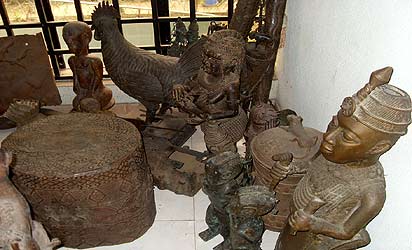
*Some of the rare collections of late Aguene Okorie in the custody of Solomon Ogbonna.
By JAPHET ALAKAM
One of the lines in the Nigeria national anthem reads, “ the labours of our Heroes past shall never be in vain.” It was in realisation of this prayerful wish that Ogbonna Solomon Nwainyinya, one of the sons of popular art collector and culture exponent, late Chief Aguene Nwainyinya Okorie (1901–2004), in honour of the indelible achievements left by his father is set to preserve the rich collections of his works.
Okorie who was until death, the Agu Udo 1 of Onicha Igboeze, Ebonyi State was a man of positive vision, transparency, humility and hospitality. His commitment to art and culture was unequaled that experts of African art described him as the highest art collector in Africa with a total of 7600 works of diverse media including bronze, wood and painting in his gallery.
Apart from the fact that Okorie was a traditional ruler, his love for art took him to many countries such as Congo, Kenya and Cameroun for exchange of artworks through giving and receiving. His love for art, tourism and tradition in the Diaspora deepened at a very young age. He was popularly known for his slogan then, ‘Art work is my treasure.’ As an ardent traditional believer, the late Okorie believed that old ways are safer and surer for people’s existence particularly in Africa.

*Some of the rare collections of late Aguene Okorie in the custody of Solomon Ogbonna.
But despite, the high level of accomplishment by this great man of art, many do not know much about him nor the works. And now that he is dead what happens to the works becomes the challenge of his children and art enthusiasts. Poised in keeping his legacy alive, one of his children, Ogbonna Solomon Nwainyinya who had followed his footsteps took up the task of preserving the works.
Who is now involved in advocacy aimed at protecting and preserving the art, culture and tradition of his people especially those being eroded as a result of western influence has mapped out plans to put the monumental works in order.
In a chat with him, Ogbonna disclosed that the works are now being preserved in Lagos and Ebonyi.
A view at some of the works at Ogbonna’s residence in Ajah, Lagos, showed that there was quite a high level of creativity among the undocumented artists of the early 1920s through 60s when his father collected some of the works. The number of works there reveals the words of art experts that he was indeed the highest collector of arts in his time, even some of the present collectors have not equaled him. Though some of the works has provenance which is subject to verification by art scholars, but one problem noticed was that they were not well preserved as some of them especially the wood works are aging.
Taking art writers around the stores where the works are kept, Ogbonna unfolded his twofold plans toward the realisation of his dream of salvaging the images, this he said is the cataloging of the works in a hardcover with scholarly inputs and the building of a museum/gallery where the works will be kept. According to Ogbonna , the book titled The Interest of the White Man in African Art: Unknown facts is scheduled for launch in November 2012 while the construction of the museum/ gallery to be known as Aguene Art Foundation will take off any time from now at Lekki, Lagos.
For Ogbonna, the book is not just a catalogue but also on the history of a collector who tried to modify the line between art and African traditional religion. He disclosed, “My father started collecting when he was 20 years-old. And he was misunderstood for a native doctor. He had 6,700 art pieces in his collection before he died”.
Before his death, he shared the works among his children, I inherited about 400 pieces and acquired some from my brother. “And after his death, I chose to acquire most of his art works. In my possession now, I have nothing less than four thousand pieces; some are here, others are in the east,” he explained.
On how his father acquired such huge works, Ogbonna disclosed that his father changed his collections by bringing objects from other cultures and hiding such works, “because the culture of his people does not permit bringing images of other cultures into the community”. The foreign works, he said, “were hidden in Abakaliki, and not until the 1980s that he started bringing them out”.
On why it took him so long to start the project, Ogbonna who his father believes that art is a form of culture and an extension of the minds and reasoning of the spirits disclosed that he waited for the right time as preserving the rare works was a huge task coupled with problem of funds needed for it.
Looking at the value of works which ran into millions, one will be tempted to ask why he has not sold some of them, but he replied that the works are not for sale. “My father warned him not to sell the works because they provide life messages. “ He added.
Disclaimer
Comments expressed here do not reflect the opinions of Vanguard newspapers or any employee thereof.