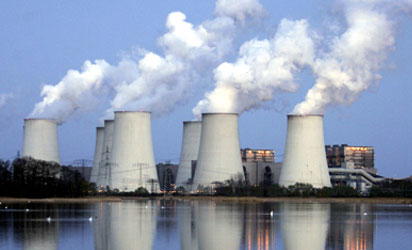
Nuclear power Plant
By Kunle KALEJAYE
Despite assurances by the Federal Government to secure Nigeria’s first nuclear power plant, a university don has expressed scepticism about government’s preparedness to execute the project.
Professor Hilary Inyang of University of North Carolina Charlotte USA, in an interview with Sweetcrude, noted that it was one thing to have the concept and the desire to achieve it, but quite another thing to have the capacity to execute it.
Recall that while explaining the rationale for Nigeria’s incursion to nuclear energy, the Minister of Science and Technology, Prof Ita Oko-Bassey Ewa, that Nigeria is in dire need of diversifying its energy generation base as part of the overall goal of providing sufficient energy for the people.
This, he said, is the reason for the inauguration of the Nigeria Atomic Energy Commission, NAEC, in September 2011, by President Goodluck Jonathan, as the pivotal promotional agency to achieve this objective.
The Fukushima nuclear disaster opened the eyes of the world to the dangers of nuclear power, a development that caused Japan to begin to reconsider its views on nuclear power, with Germany promising to end generating power from nuclear power plants by 2022.
While these two technologically developed countries are phasing out nuclear energy, Nigeria, strangely, is hoping to build one.
Analysts insist that Nigeria should learn from the Japanese experience as well s from the worst nuclear accident in humankind history, the Ukrainian Chernobyl disaster of 1986, that was ranked seventh on INES,
The Ukrainian disaster was blamed on human error, when engineers testing the turbines of a reactor to see if it could produce more energy whenever there is power loss caused a lethal explosion. The faulty design of the Chernobyl power plant exacerbated it.
But speaking at the opening of the Nuclear Security Summit in Seoul, the South Korean capital in March 2012, President Jonathan assured the global community that Nigeria would do everything possible to ensure that adequate safety measures were deployed when the country introduced nuclear power into its energy mix.
According to the President, “Nigeria remained fully committed to complying with all international legal and regulatory requirements for safety and security in the use of nuclear energy.”
However, Iyang, who served as a Technical Judge in the USA Nuclear Regulatory Commission in 2008 under the President George W. Bush administration, argued that “Nuclear power plants require a level of care that is very big because we have many hazards associated with that because it is not something that somebody gets involves in it and goes to work very late. It is not something that you can have inadequate protection from even weather elements.”
Disclaimer
Comments expressed here do not reflect the opinions of Vanguard newspapers or any employee thereof.