By Bisi Lawrence
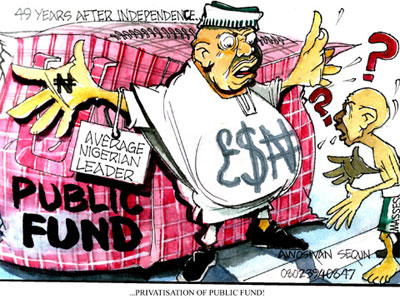
All these events swirling around us embodying power outage, poor health delivery, bad roads, dysfunctional so-called amenities, brutal insecurity, stifling corruption and ineffective leadership strike one as a mirror of our society. They express a sad comment about what we are, and who we are.
Even if you are not a participant in any of the events, you still feel ashamed because you cannot totally separate yourself from what Nigerians are, since you are a Nigerian.
Though you may not be directly involved in the events, you still cannot avoid being part of what is going on. Electricity is the blood stream of life in a modern society. So are we not a modern society? We do claim, at the least, a modicum of civilized existence.
The whole country yearns today for electricity supply to grant us a satisfactory life, we need it for the kitchen, for the bathroom, for ironing our clothes, and all other household chores—to say little of our industrial life, about which we should say much really.
And in fact, we have probably said everything. But we have done so little. Our individual lives are sustained largely by courtesy of generating plants of all dimensions and capacity, imported from all over the world. We appreciate the fact that Ghana, our fellow West African State and former British colonial territory has put this problem behind her; that the problem has badly affected our industries—several of which have even been relocated to Ghana, though Nigeria. had been the first choice of “investment destination” from many foreign economies.
We are losing out, going and coming, to nations that can only be described as puny beside us, not only in size but in current wealth and patent potentials, but we seem incapable of doing something tangible about it. We wail about it; we make promises about it; then we throw money, good money at it—down the drain. Is it not enough to make one feel really ashamed? Does it not make you want to ask what kind of people we are? We cannot even look after our own health. We cannot heal ailments in which we have specialists, people who have qualified as experts in treating the diseases and proved their worth overseas. They return home, as they properly should, whilst many of their contemporaries who are also from Nigeria willfully remain abroad. But while those in the Diaspora continue to maintain their high professional practice, those who have returned home somehow inspire no confidence in the populace who continue to send their sick kinsfolk abroad.
A friend was recently fairly elated as he narrated how highly respected his surgeon son was in the United States. With such professional skills, I suggested, he should have tried to come back home where he would be needed more than in the US. “Well, he did”, replied my friend, not too happily. “He did for about two years, but then he knew he simply had to go back. But that is another story.” Yes, and in some ways, a typical Nigerian story.
We do so well elsewhere. We are a loud noise in countries where we have established oil refineries, having somehow turned our back on our own native turf in which the “black gold” flows more abundantly than in most parts of the world. The refineries in our country are mostly owned by the government—and like most government controlled ventures, they do not work. So we mine our oil and export it in the raw to other countries, where it is refined and sent back to us at a price we can hardly afford, so that the government helps out by offsetting part of the cost. Yes, that is the “subsidy” that is now tearing us apart .. Did you ever hear such a roundelay even from children’s moonlight tales?
But it is happening here, and from this weird scenario has developed ramifications of such a bizarre hue that people are asking, “What next, for goodness’ sake?” The truth is that in such a stifling atmosphere of corruption, anything can happen. Perhaps that is why the President of the nation recently told off his own country. The issue of the declaration of the personal assets of a high government official upon entering office, we thought, had been settled for all time by the late President Umar Yar’ Adua, when he publicly declared both his own and those of his wife. As the Vice-President at that time, the procedure was followed by Goodluck Jonathan. His volte-face, and the language of its expression—that language in particular— when it was time to follow suit, fairly threw sand in our face. He went on to dare the nation. We will not soil this page with a reprise of his ill-chosen words which amounted to nothing less than contempt for those whose votes put him where he is. He would be well advised to re-classify what he meant by that statement. Politicians all over the world do so when it is found necessary. And we are saying it is here and now necessary.
Anyway, a sober appraisal of what is now mockingly referred to as “Faroukgate” reveals that this type of prank must have been going on for quite a while. In addition to the fiasco at the Stock Exchange hearings, one could sense the emergence of a sordid pattern that may begin to explain some particular events in our legislative procedures—like the proliferation of enquiries initiated by national assembly committees, for instance. Does it not occur to you that they are simply too many? It is a wonder the honourable members have any space to accommodate the real reason for their existence which is, simply put, to make laws.
Of course, they have sweeping laws to effect their authority, especially when it concerns the summoning of citizens to help with investigations, but it is not likely that they can effectively demand that a witness must speak in camera. It would have been more our expectations that the insistence should be on a public hearing, rather than, the other way around. All in all, “Faroukgate” has dented the shining armour of our knight of the “transparent order”, and it would appear that we can now see more than we were meant to.
We may here touch on the consideration of when to end a “sting” operation. I believe that it is when the arrest is made. A “sting”, of course, takes place only with the knowledge and participation of the police. But a crime has to be committed first before an arrest is made. In the case of a bribe episode, it is not always enough to establish that the gratification has been fulfilled; the favour for which it is paid may also have to have been accomplished. So while the question has been asked about why an arrest was not immediately executed at the point of the alleged payment of those mouth-watering sums of dollars in the “Faroukgate” saga, one cannot speak for the police but it seems they know what they are doing. But do we, as a nation, know where we are heading?
Lines for Ayo Francis
A lovely orchid suddenly drooped and fell
The bees that cheered her with their happy buzz
Now silently share a calm of grief
Because they miss her
Elegant butterflies that danced for her
Hang their wings too in mournful pain
Cause they also miss her
Showers that fell in play upon her petals
Turn into rains of scalding tears
For they too miss her
And Pancos, how we all miss you too
Time out
Disclaimer
Comments expressed here do not reflect the opinions of Vanguard newspapers or any employee thereof.